

BHU Exhibition Revisits Six Pioneering Women Through Indian Folk A

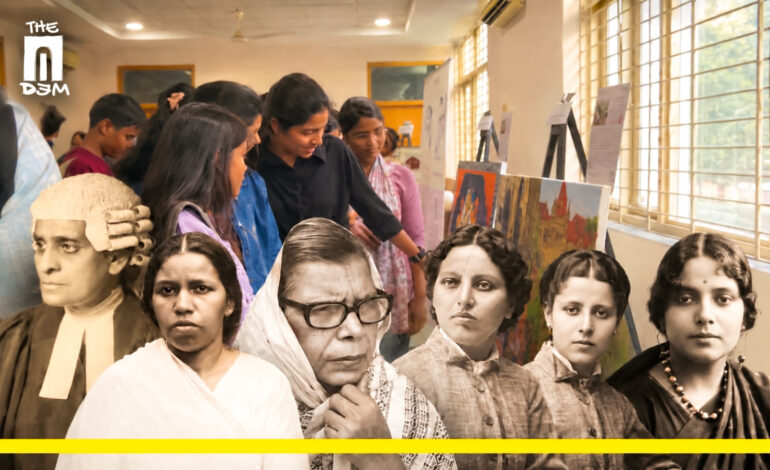
Six women who helped shape modern India—and whose lives deserve far more than the occasional textbook reference or commemorative portrait—are at the centre of a new art exhibition at Banaras Hindu University in Varanasi.
Annie Besant, Kamaladevi Chattopadhyay, Pandita Ramabai, Mahadevi Verma, Dakshayani Velayudhan and Cornelia Sorabji belonged to different generations and came from very different social and political backgrounds. Yet each challenged the limits imposed on women by caste, patriarchy, colonial rule and social convention.
Their contributions extended across education, social reform, literature, politics, law, public life and the freedom movement. While their areas of work differed, their lives reflected different dimensions of women’s participation in India’s social and public history.
Trailblazing Women of India, opening at the Malaviya Moolya Anusheelan Kendra at BHU, brings their stories into the hands of a younger generation of artists. Instead of reproducing familiar portraits, the artists have been asked to delve into the lives, struggles and ideas of these six women and interpret them through Indian folk-art traditions.
The result is an attempt to move these pioneers out of the frame of history and back into public imagination.
From AV Series to an Art Exhibition
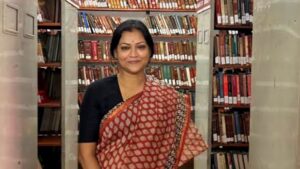 Dr. Priyanka Jha, Social Scientist, Banaras Hindu University
The exhibition is organised by Shuru(A)rt, with New Historia as Knowledge Partner and The AIDEM as official media partner. It grew out of The AIDEM’s six-part video series Trailblazing Women of India, presented by Dr Priyanka Jha.
These stories were first showcased as an AV series on The AIDEM. The move from an audio-visual series to an art exhibition has allowed the stories to be revisited through another form of storytelling. The artists have taken the research and narratives surrounding the six women and developed their own visual interpretations, making the exhibition an extension of the conversations initiated through the video series.
What makes the project distinctive is the research that has gone into the paintings. Around 40 young artists initially responded to the call for participation. Those selected spent months studying the women, reading about their work and developing visual interpretations before arriving at the final canvases.
In the process, some discovered that the woman behind the familiaThe exhibition is organised by Shuru(A)rt, with New Historia as Knowledge Partner and The AIDEM as official media partner. It grew out of The AIDEM’s six-part video series Trailblazing Women of India, presented by Dr Priyanka Jhar name was far more complex—and far more radical—than the image they had initially carried in their minds.
The exhibition features artworks inspired by the six women, whose lives and contributions span different areas of India’s social, cultural, educational and public history. Annie Besant’s work in education and political life, Kamaladevi Chattopadhyay’s contribution to social reform and cultural revival, Pandita Ramabai’s work for women’s education, Mahadevi Verma’s literary and educational contributions, Dakshayani Velayudhan’s engagement with questions of caste and political representation, and Cornelia Sorabji’s pioneering role in law together present different dimensions of women’s participation in India’s public life.
The project brings together artists from different institutions and encourages them to approach these historical figures through research as well as artistic interpretation.
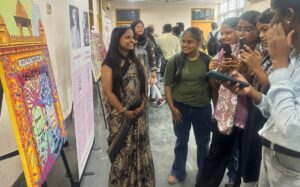 Artworks inspired by six pioneering women on display at BHU.
The research process began in June, following the call for artists. Over the following three months, the selected participants studied Dr Jha’s video series and undertook independent reading and research on the six women.
The research was followed by an artistic process in which the participants developed their own layouts and approaches to representing the historical figures. Their work received feedback from senior artist Mridula Sinha, former Head of the Department, Faculty of Visual Arts, BHU.
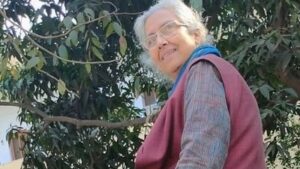 Mridula Sinha, former HOD of the Visual Arts Department, BHU.
The emphasis on research was intended to take the artists beyond readily available photographs or familiar biographical descriptions. By studying the women’s work and the historical circumstances in which they lived, the participants were able to develop interpretations that reflected more than their public images.
The process also allowed the artists to discover different aspects of the six women’s lives. The resulting artworks therefore reflect not only who these women were, but how their lives and contributions were understood by a younger generation engaging with their histories.
Artists associated with BHU, the University of Allahabad and Patna University participated in the project. Most of the artworks have been created in acrylic on canvas, while some incorporate Indian folk-art traditions including Gond, Madhubani, Phad and Warli.
The artists were encouraged to move beyond conventional biographical portraits and explore different ways of representing the lives, contributions and historical contexts of the women.
This approach gives the exhibition a visual diversity that mirrors the diversity of the six women themselves. Rather than asking every artist to follow a single format, the project allows different artistic approaches to coexist, with folk-art traditions providing one of the important ways through which historical stories are translated into visual form.
The paintings consequently become more than illustrations of historical figures. They represent an attempt to interpret their lives through contemporary artistic practice while retaining connections to Indian visual traditions.
An Exhibition Rooted in History and Public Memory
At its core, Trailblazing Women of India seeks to bring historical figures into a contemporary visual space and encourage audiences to engage with their stories beyond conventional representations.
The six women featured in the exhibition came from different backgrounds and contributed to different spheres of Indian public life. By bringing them together, the exhibition creates a broader conversation around women’s contributions to India’s social, cultural, educational and historical development.
Their individual stories also demonstrate that there was no single path through which women participated in India’s social and public transformation. Their work ranged from education and literature to law, politics, social reform and the freedom movement.
By placing these different histories alongside one another, the exhibition creates an opportunity to look at women’s contributions to modern India in a wider and more interconnected way.
The organisers have sought to move beyond the idea of a straightforward biographical portrait. Instead, the artists were encouraged to interpret the women through their work, ideas and historical circumstances, allowing the artworks to function as visual narratives.
This makes the exhibition an exercise not only in artistic interpretation but also in public memory. The paintings offer viewers an opportunity to encounter historical figures through a medium that can make their stories more accessible to audiences who may not otherwise encounter their lives beyond textbooks or conventional historical accounts.
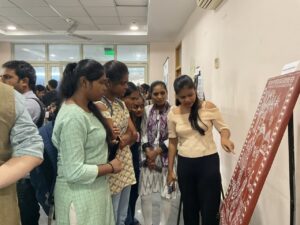 Visitors learning about the artworks at the exhibition.
Sana Sabah, CEO of Shuru(A)rt, emphasised the importance of research in developing an artwork. According to her, research enables an artist to develop a stronger story, while painting can become a medium through which that story is communicated.
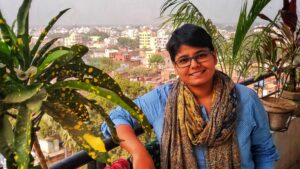 Sana Sabah, CEO of Shuru(A)rt.
She also pointed to the gap between the documentation of women’s contributions and their visibility outside academic or specialist circles. The project, she said, seeks to use art as a way of bringing these stories to a wider public.
The exhibition thus places historical research alongside artistic interpretation, inviting viewers to look beyond a name or portrait and engage with the larger stories associated with each woman.
In doing so, the project also creates a dialogue between different forms of storytelling. The original AV series introduced the six histories through moving images and narration, while the paintings reinterpret those histories through composition, symbolism, colour and folk-art influences.
Inauguration at BHU
The exhibition was inaugurated on September 28 at the Malaviya Moolya Anusheelan Kendra, with Dr Sutapa Das, coordinator at MMAK, hosting the event.
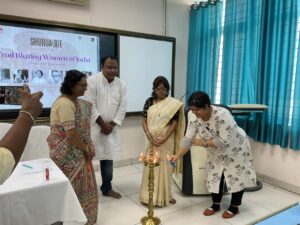 The Trailblazing Women of India exhibition inauguration ceremony at the Malaviya Moolya Anusheelan Kendra at BHU on September 28.
Professor Mangala Kapoor attended as the chief guest. She was awarded the Padma Shri this year and is known for teaching music to children free of cost.
The inauguration also placed the exhibition’s six women within a wider historical context. Dr Prashant Kumar spoke about women inspired by Mahatma Gandhi and their participation in the freedom movement, connecting their individual stories to broader currents in India’s history.
The event brought together the artists, organisers and members of the university community around the exhibition’s central theme of remembering women’s contributions through art.
Participating artists Kavita, Annapurna Shivhare and Priti Raj were felicitated during the event. Avni delivered the vote of thanks.
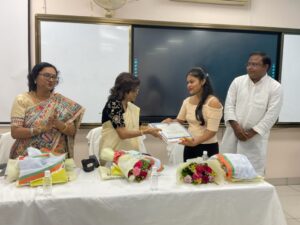 Participating artists getting felicitated during the inauguration of the exhibition.
Taking the Exhibition Beyond Varanasi
The organisers intend for Trailblazing Women of India to travel beyond the BHU campus and reach audiences in other parts of the country.
The travelling exhibition is an extension of the project’s effort to take these stories beyond a single university setting. By moving the artworks to different cities, the organisers aim to give audiences elsewhere an opportunity to encounter the six women’s histories through the interpretations created by the participating artists.
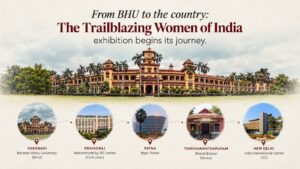 From BHU to the country: The Trailblazing Women of India exhibition begins its journey.
Following the Varanasi exhibition, it is scheduled to travel to Welcomhotel by ITC Hotels in Civil Lines, Prayagraj. The exhibition will then move to Bapu Tower in Patna, followed by Bharat Bhavan in Thiruvananthapuram, Kerala, before concluding at the India International Centre (IIC) in New Delhi.
The travelling format is intended to take the artworks and the stories behind them beyond the university setting, allowing audiences in different cities to encounter the six women’s histories through the artists’ interpretations.
The movement of the exhibition also mirrors the larger journey of the project itself—from the original six-part AV series to the research undertaken by young artists, from the resulting paintings at BHU to their planned presentation in different parts of the country.
The exhibition will remain open at the Malaviya Moolya Anusheelan Kendra, BHU, until October 9, from 11 am to 4 pm.
Through its combination of historical research, artistic interpretation and Indian folk-art traditions, Trailblazing Women of India seeks to make the stories of six pioneering women accessible through a medium that extends beyond conventional academic narratives.
The exhibition brings together different ways of remembering and telling history, allowing the lives of six women to be revisited through the perspectives of young artists. In doing so, it connects the work of historical figures with contemporary forms of storytelling and creates a space for their contributions to be encountered beyond the pages of history.






.