
No Deadline for RTI Second Appeals: A Gap That Undermines the Right to Know


The Right to Information Act sets deadlines for providing information and deciding first appeals, but prescribes none for disposing of second appeals before information commissions. This statutory gap leaves citizens waiting for years, delays scrutiny of defaulting officials and can make information worthless by the time it arrives. For people seeking records to claim wages, secure pensions or defend land rights, such delays can defeat the purpose of the law.
A Patna High Court judgment concerning an information request unresolved for seventeen years highlights the consequences. Several High Courts have endorsed a forty-five-day deadline, but differing judicial approaches strengthen the case for an explicit statutory time limit. Legislative reform must be accompanied by timely appointments, public reporting of delays, priority for urgent cases and continued access to offline filing.
A Right with a Clock at Every Door But the Last
The Right to Information Act, 2005, is among the most empowering laws of our republic. It does something few statutes attempt: it hands the ordinary citizen a lever to lift the lid on the decision-making of the State, and it asks for no reason in return. Section 6(2) forbids the Public Information Officer from asking why the applicant wants the information. The citizen need not be a party, a litigant or a person aggrieved. It is enough to be a citizen.
What gives this right its force is time. Parliament was meticulous about it. Section 7(1) obliges the Public Information Officer to decide within thirty days, and within forty-eight hours where life or liberty is at stake. Silence beyond that period amounts to a deemed refusal under Section 7(2). Section 19(1) allows thirty days for filing a first appeal, and Section 19(6) obliges the First Appellate Authority to decide it within thirty days, extendable, for reasons recorded in writing, to a total of forty-five days. Section 20 even puts a price on delay: a penalty of two hundred and fifty rupees for each day of default, up to twenty-five thousand rupees.
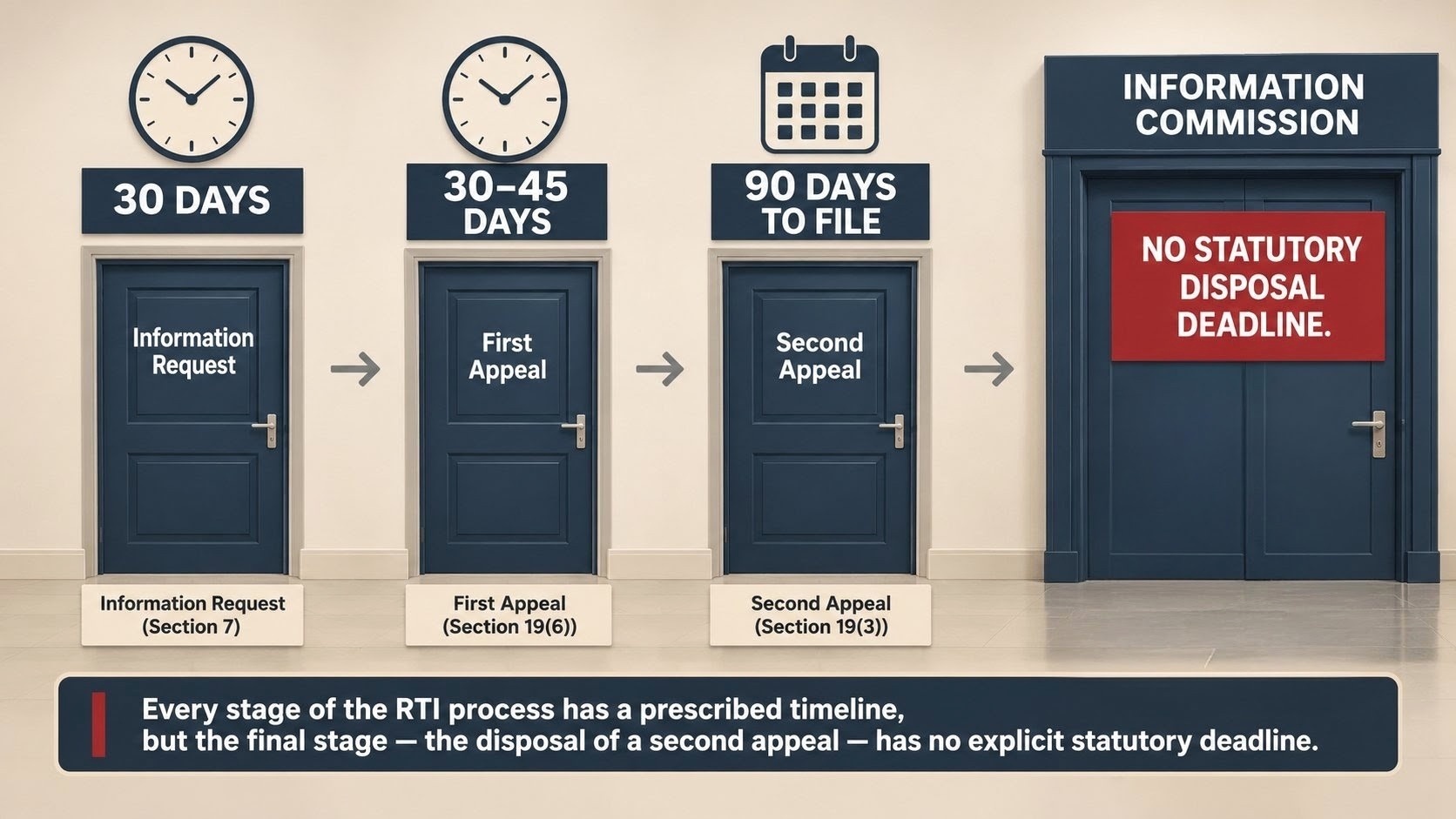 Statutory timelines for different stages of the RTI process under the RTI Act, 2005.
And then, at the final and most important door, the clock stops. Section 19(3) allows ninety days for filing a second appeal before the Central or State Information Commission. It says nothing at all about when the Commission must decide it. The forum that sits at the apex of the statutory scheme—the body empowered to compel disclosure and impose penalties—is the only one the Act leaves without a deadline.
In The Lamp and The Lock, I described the RTI Act as a lamp placed in the citizen’s hand. A lamp that reaches the citizen ten years late lights nothing. This article argues that the silence in Section 19 is the single most consequential gap in the Act, examines how the High Courts have begun to fill it—most recently the Patna High Court in Md. Rizwan v. State of Bihar (decided on 11 August 2026)—and asks what must now follow.
 The cover of The Lamp and the Lock by S. M. Haider Rizvi.
Seventeen Years for a Land Record: Md. Rizwan v. State of Bihar
The facts are modest; that is what makes them damning. In 2009, Md. Rizwan of Siwan applied under the RTI Act for certified copies of the barwarda and Register-II relating to his halka and tauzi. He needed them as evidence in Title Suit No. 106 of 1992, then pending before a civil court. The Circle Officer, acting as the Public Information Officer, refused. His second appeal was filed before the Bihar State Information Commission on 18 May 2010 and decided only on 30 July 2011, more than fourteen months later.
Even that decision did not end the matter. The Circle Officer’s letter of 28 June 2011 offered two explanations that cannot both be true: the original was unavailable, and what was available was too torn to be read. The Commission initiated penalty proceedings under Section 20(1), accepted this explanation and dropped the proceedings by its order of 6 January 2012. The petitioner’s written objection of 30 July 2011, which named other persons who had been given copies of the very same barwarda from the same Circle Office, finds no mention in that order. The writ petition challenging the order was filed in 2016 and decided by Justice Raj Kumar of the Patna High Court in CWJC No. 7073 of 2016 on 11 August 2026.
The Court quashed both the Commission’s order and the Circle Officer’s letter. Its reasoning rests on four propositions.
- The record is public. The barwarda, which records the rent paid each year by co-sharers, was held to be a public document under Section 74 of the Indian Evidence Act, usable in partition suits and admissible as secondary evidence.
- A missing file is no answer. Relying on a Central Information Commission decision, the Court held that a public authority cannot defeat the right by pleading that a file is lost; if it cannot be traced, the authority must reconstruct it.
- Destruction has a procedure. Under Rules 80 and 230 of the Bihar Records Manual, 1960, the Collector is answerable for missing files, and an illegible record may be destroyed only after personal inspection by the Collector or SDO and the preparation of a signed memorandum. No such memorandum was produced. The Court found a complete violation of Rule 230.
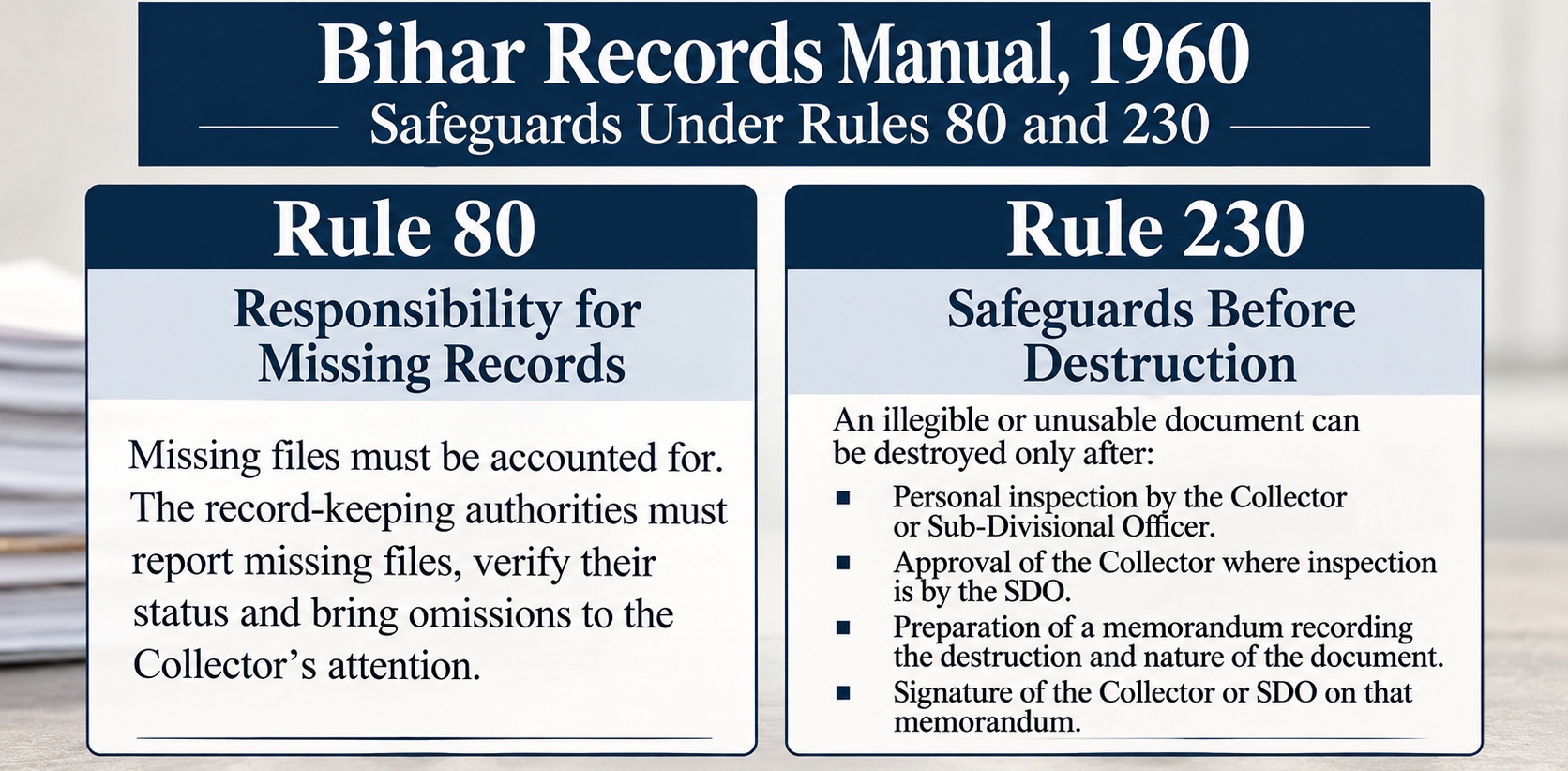 Key safeguards under Rules 80 and 230 of the Bihar Records Manual, 1960, as discussed in the Patna High Court judgment in Md. Rizwan v. State of Bihar (CWJC No. 7073 of 2016).
4. The State cannot profit from its own neglect. In the Court’s words, “The State cannot take advantage of its own failure to preserve records.”
The directions are practical. The District Magistrate and Circle Officer must physically search the Circle Office, the DCLR’s office and the district record room. If the barwarda is found to be torn or illegible, it must be digitised, enlarged or typed by an expert and certified by the Circle Officer. If it is not found, it must be reconstructed from the revenue records. Should the parties reach an impasse, the authorities must pass a reasoned order demonstrating that their best efforts have failed. The entire exercise must be completed within eight weeks.
For the purposes of this article, however, the most significant passage is paragraph 18. Having noted that Section 19 prescribes no time frame for deciding a second appeal, the Court expressly endorsed the view that a second appeal must be decided within thirty days, or within an extended period not exceeding forty-five days, so that the person seeking information is not left without a remedy. Paragraph 19 explains why the point mattered: an application made in 2009 remained unresolved in 2026. The Court called it a small issue. Yet it took seventeen years to resolve, while a title suit filed in 1992 waited on it.
The Forty-Five-Day Reading: Calcutta (2010) and Karnataka (2015)
The Patna High Court did not write on a blank slate. It drew on two earlier rulings that had already read a timeline into the Commission’s work.
The first is the Calcutta High Court’s decision in Akhil Kumar Roy v. West Bengal Information Commission (W.P. No. 11933 of 2010, decided on 7 July 2010). Faced with a second appeal that had simply not been heard, the Court drew its reasoning from the scheme of the Act. If the first appeal must be decided within forty-five days at the latest, that period is the statute’s own measure of what is reasonable for an appeal, and the second appeal should be held to the same standard. The Court directed the Commission to decide the petitioner’s appeal within forty-five days.
The second, and more widely cited, ruling is the Karnataka High Court’s decision in Jayaprakash Reddy v. Central Information Commission (W.P. Nos. 28310–28311 and 45540–45542 of 2015, decided on 29 October 2015 by Justice Anand Byrareddy). The petitioner, from Chintamani in Chikkaballapur district, had sought information about election expenditure. His second appeal had remained before the Central Information Commission for over a year without a hearing, according to contemporary reporting. The Court held that a second appeal, too, must be deemed subject to a deadline of forty-five days from the date of filing, if not earlier.
The logic of both judgments is the logic of the statute itself.
- Coherence. Every other stage of the RTI process is subject to a deadline. An apex stage without a deadline makes the earlier deadlines meaningless, because a defaulting officer knows that the final reckoning may never come.
- Purpose. The Preamble speaks of securing access to information to promote transparency and accountability. Information that arrives after the decision to which it relates has been taken, or after a limitation period has expired, serves neither purpose.
- Symmetry. The Commission penalises officers for each day of delay under Section 20. A body that enforces deadlines so strictly against others cannot claim to be wholly free of them.
The Karnataka ruling had practical effects. The Karnataka Information Commission, which then had about 28,375 pending cases, publicly acknowledged that it was working out how to comply. Activists in Maharashtra later served notice on that State’s Chief Information Commissioner, citing both rulings. With Md. Rizwan, the Patna High Court becomes the third High Court to adopt this reading.
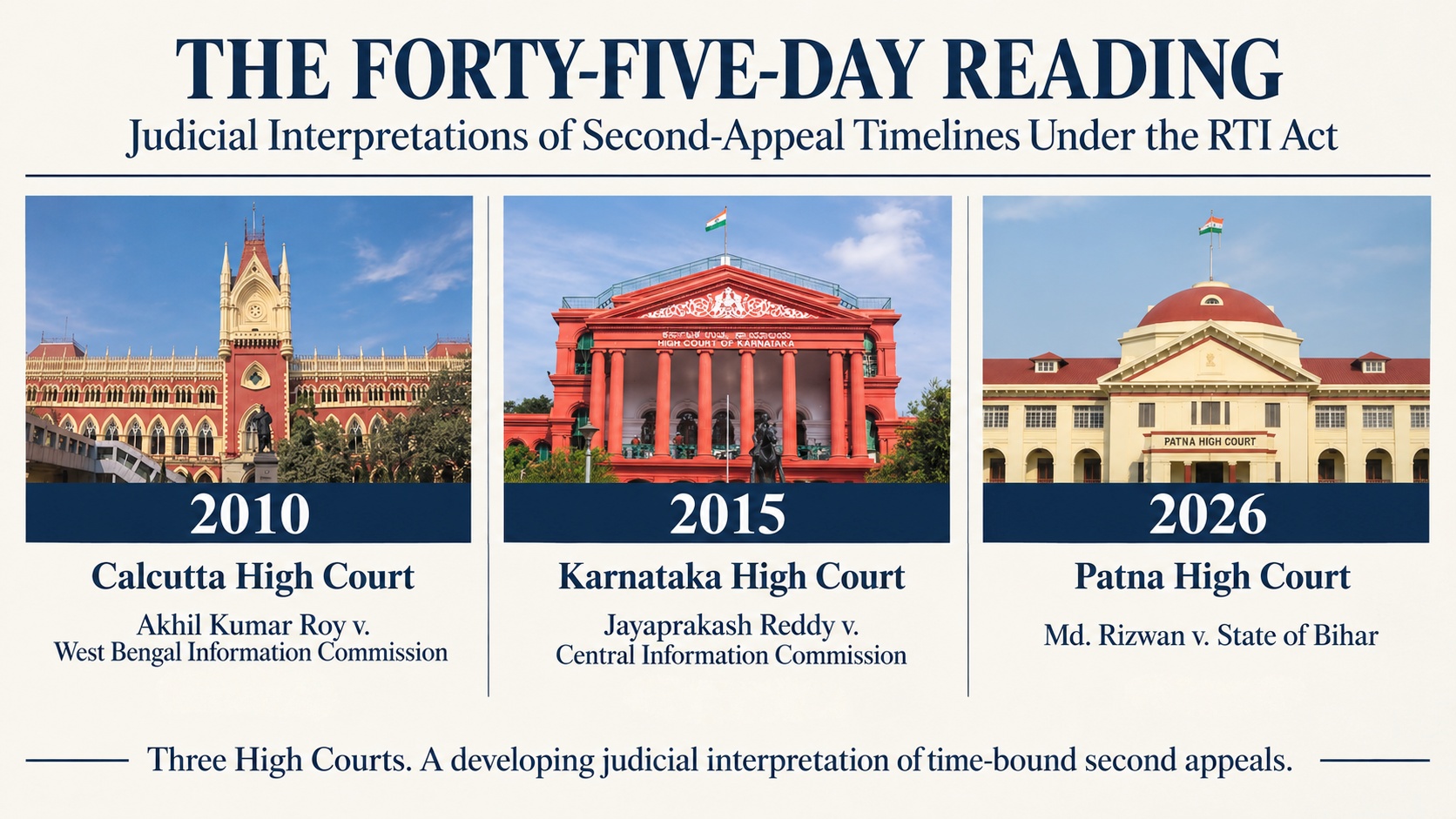 Judicial interpretations of the timeline for deciding second appeals under the RTI Act, from the Calcutta High Court (2010) and Karnataka High Court (2015) to the Patna High Court (2026).
The Honest Difficulty: What Section 19(6) Actually Says
An advocate for reform must meet the strongest objection, not the weakest. Section 19(6) reads, in material part:
An appeal under sub-section (1) or sub-section (2) shall be disposed of within thirty days of the receipt of the appeal or within such extended period not exceeding a total of forty-five days from the date of filing thereof, as the case may be, for reasons to be recorded in writing.
Sub-sections (1) and (2) concern the first appeal. The second appeal is provided for in sub-section (3), which the provision prescribing the timeline does not mention. Parliament drafted the provision with care and stopped short of extending it to the Commission. Read literally, the omission appears deliberate.
That is the view taken in July 2026 by a Division Bench of the High Court of Jammu & Kashmir and Ladakh, comprising Acting Chief Justice Sanjeev Kumar and Justice Mohd Yousuf Wani, in a petition filed by Junaid Javid of Uri. The Bench declined to issue a mandamus prescribing a forty-five-day deadline, holding that it could not impose a deadline the Act does not contain. The Central Information Commission had cited limited infrastructure and the sheer volume of filings. Yet the same Bench made clear that the Commission cannot sit on appeals for years and directed it to establish a mechanism to tackle the backlog.
The divergence is narrower than it appears. No High Court has held that the Commission may take as long as it likes. The difference lies in the remedy.
| Court | Year | Holding on the second appeal |
|---|---|---|
| Patna HC, Md. Rizwan | 2026 | Must be decided within 30 days, extendable to 45 |
| J&K and Ladakh HC, Junaid Javid | 2026 | No statutory timeline; no mandamus for 45 days, but years-long delay impermissible |
| Karnataka HC, Jayaprakash Reddy | 2015 | Deemed to be decided within 45 days of filing |
| Calcutta HC, Akhil Kumar Roy | 2010 | 45 days is the reasonable period by the Act’s scheme |
Two things follow. First, the forty-five-day reading is best understood as a standard of reasonableness drawn from the Act’s own scheme, rather than a literal application of Section 19(6). Where a statute prescribes no time limit, the law implies a reasonable period, and the Act tells us what Parliament considered reasonable for an appeal. Second, the divergence itself is the strongest argument for legislative action. A citizen’s right to a timely hearing should not depend on the High Court jurisdiction in which they happen to live.
Who Pays for the Silence
The gap is not academic. It is measured in years, and its cost is borne by the people for whom the Act was written.
The numbers. Satark Nagrik Sangathan’s report card for 2024–25 found that more than four lakh appeals and complaints were pending before India’s twenty-nine information commissions, and that the estimated wait for disposal exceeded a year at eighteen of them. The same group’s earlier report recorded 24,035 cases pending before the Uttar Pradesh commission on 30 June 2024 and noted that UP was among the commissions that had been entirely without commissioners for part of 2023–24. By my own assessment, more than 25,000 second appeals are pending in Uttar Pradesh today. Each represents a citizen who has already waited through the thirty-day period under Section 7 and the forty-five-day period under Section 19(6).
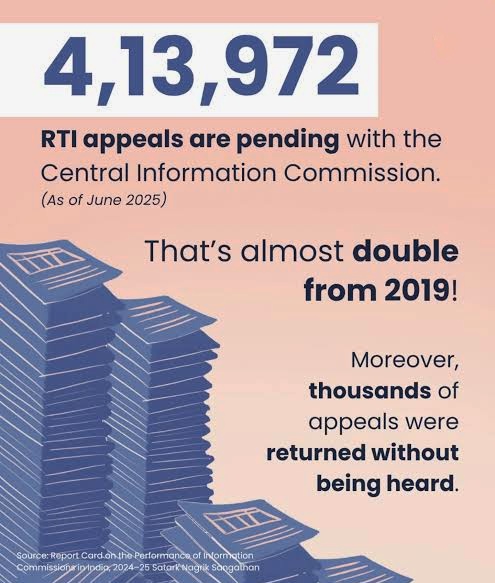 Pending appeals and complaints across India’s Information Commissions, highlighting the scale of the RTI backlog in 2024–25. Source: Satark Nagrik Sangathan, Report Card on the Performance of Information Commissions in India, 2024–25.
The law of limitation does not wait. Under a law that is straightforward in purpose yet technical in procedure, delay is not neutral. Much of what citizens seek under the RTI Act is evidence for another proceeding: a land record for a title suit, a service file for a pension claim or an inspection report for a compensation case. Those proceedings are governed by limitation periods that continue to run regardless of what the Information Commission does. A labourer who needs muster-roll entries to claim unpaid wages, or a widow who needs a file noting to contest the refusal of a pension, may win the second appeal only to find the underlying remedy time-barred. Md. Rizwan’s title suit, filed in 1992, was still awaiting a document requested in 2009. Delay of this kind does not merely postpone a right; it extinguishes the cause that the right was meant to serve.
Delay rewards the defaulter. The penalty under Section 20 is the Act’s sharpest tooth, and it bites only when the Commission decides. An officer who refuses information in 2026 and faces a hearing in 2030 may by then have been transferred, promoted or retired. The record in Md. Rizwan shows the pattern: a refusal resting on two contradictory explanations survived penalty proceedings because no one tested it in time.
The digital door. The Uttar Pradesh Information Commission has moved its second appeals and complaints to an online system, the Complaint and Appeal Tracking System (CATS-UPSIC), which requires citizens to register through OTP verification. Online filing is a welcome option. Made mandatory, it becomes a barrier. The Act was envisaged above all for the poorest citizen: the landless agricultural worker, the ration-card holder struck off a list or the rural woman without a smartphone or a mobile number in her own name. For such citizens, an OTP, the uploading of scanned enclosures and a portal in a language they may not read are not conveniences. They are a locked gate. Section 6(1) itself permits an application in writing or through electronic means, and the Act nowhere makes electronic filing a condition of access to the Commission. A procedural choice cannot be allowed to narrow a statutory right, and the State must keep the paper door open alongside the digital one, with assistance at the district level for those who need it.
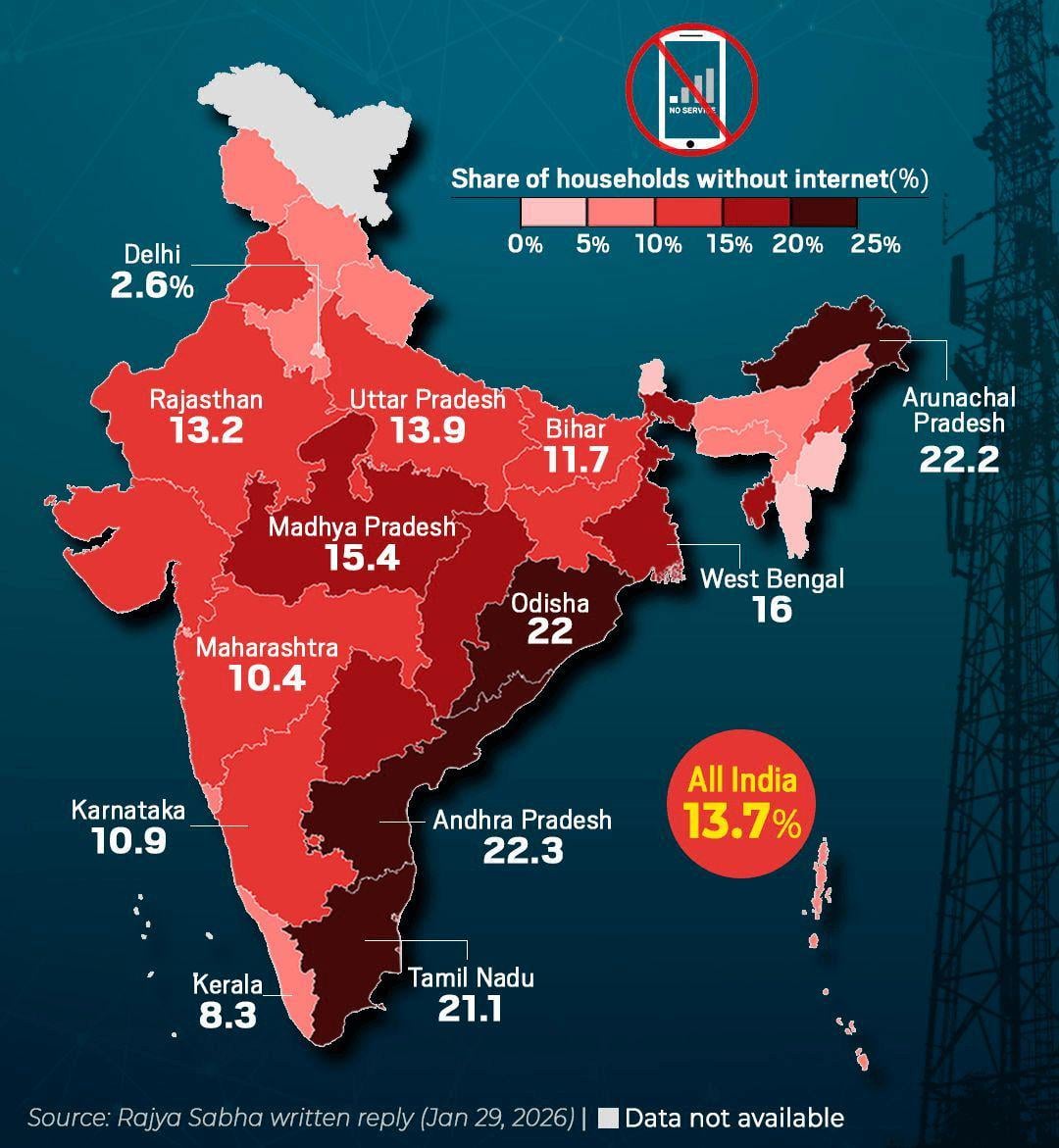 Map showing the share of households across Indian states without internet access, according to official data tabled in the Rajya Sabha on January 29, 2026, with Uttar Pradesh closely mirroring the national baseline at 13.9% of households remaining offline
The two problems compound each other. A citizen who cannot reach the Commission is invisible in the pendency figures. A citizen who does reach it then joins a queue measured in years. Together, these barriers exclude the poor twice over.
What Must Follow
The High Courts have done what courts can do. They have declared a standard. The rest is for Parliament, the State Governments and the Commissions themselves.
- Amend Section 19. A new sub-section, say Section 19(6A), should require the Commission to decide a second appeal or complaint within forty-five days of filing, extendable, for reasons recorded in writing, to ninety days. This would resolve the divergence between the courts at a stroke.
- Use the rule-making power now. Pending an amendment, State Governments can frame procedural rules under Section 27, and Commissions can adopt internal regulations, to set a disposal target and require reasons to be recorded whenever it is exceeded.
- Publish the age of pending cases. Every Commission should publish monthly figures showing not only filings and disposals but also how long each pending case has been awaiting a decision. What is measured gets managed.
- Fill vacancies on time. No timeline can be met with an empty bench. Appointments must be made before posts fall vacant, as the Supreme Court has repeatedly urged in the Anjali Bhardwaj litigation.
- Prioritise by urgency. Appeals involving life and liberty, the poor, and information needed for pending litigation or claims subject to limitation periods should be listed first.
- Keep the paper door open. Online filing should remain an option, never a condition. Offline appeals submitted by post or at a district facilitation desk must be accepted and digitised by the Commission itself.
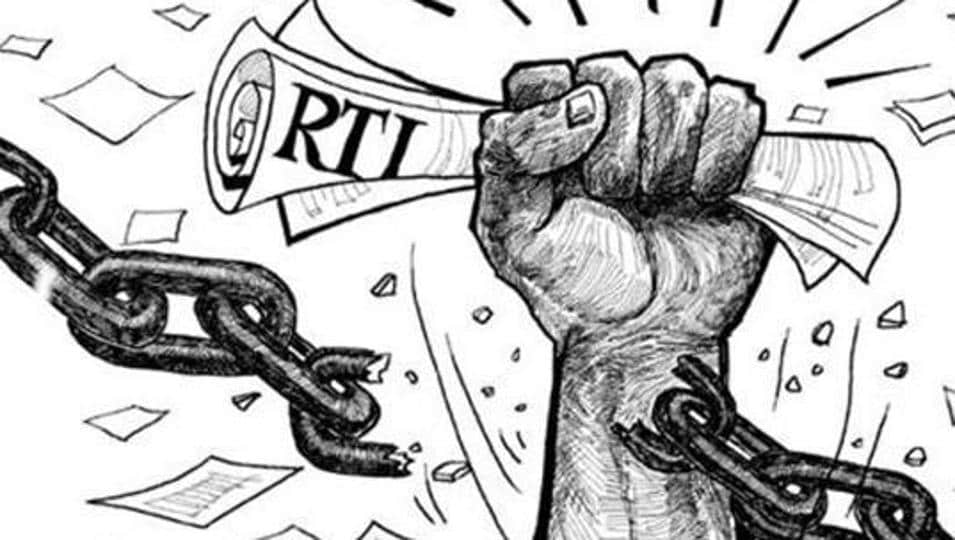 Breaking the barriers to transparency requires more than the Right to Information on paper—it demands time-bound decisions, accessible appeals and accountable Information Commissions.
The Md. Rizwan judgment ends with a direction that the entire exercise be completed within eight weeks. There is a quiet irony in that. A High Court, seventeen years after the request was made, had to set a deadline for for the authorities because the statutory forum had none of its own. The right to information was designed so that a citizen would never need to approach a constitutional court to obtain a land record. Until the clock that governs every other stage of the Act is extended to its final stage, he will keep having to.
The lamp is in the citizen’s hand. It is time the law stopped letting it burn out in the waiting room.
References:
- Md. Rizwan v. State of Bihar & Ors., CWJC No. 7073 of 2016, Patna High Court, judgment dated 11 August 2026 (Raj Kumar, J.)
- Jayaprakash Reddy v. Central Information Commission, W.P. Nos. 28310–28311 and 45540–45542 of 2015, Karnataka High Court, 29 October 2015
- Akhil Kumar Roy v. West Bengal Information Commission, W.P. No. 11933 of 2010, Calcutta High Court, 7 July 2010
- J&K and Ladakh High Court declines 45-day mandamus, Supreme Today, 7 July 2026
- Report Card on Information Commissions, 2024–25, as reported by The Wire
- Pendency as of 30 June 2024, Satark Nagrik Sangathan data, as reported by The Wire
- CATS-UPSIC portal description, Government of Uttar Pradesh
- Karnataka Information Commission pendency, 2015, Deccan Herald