
Messianic Dreams: The Religious Roots of End Times Fascism

A Reading of End Times Fascism and the Fight for the Living World by Naomi Klein and Astra Taylor – Part 2
“Heaven and earth will pass away. But of that day and hour no one knows, not even the angels of heaven.”
— Matthew 24:35–36 ( New Testament )
This passage from the New Testament took on an unusual role in 2024 when it became the opening of a Hoover Institution conversation about modern technology. Peter Robinson read the verse to begin his interview with Peter Thiel, a co-founder of PayPal and Palantir. (Uncommon Knowledge with Peter Robinson, “Apocalypse Now? Peter Thiel on Ancient Prophecies and Modern Tech”, 2024, YouTube.)
“Well, man, this is a very broad topic. It’s in this larger question about the extraordinary history of our time.” Thiel then turned to the pace and power of technological change. He suggested that modern technology had acquired an apocalyptic quality. “Perhaps, since the Renaissance, the modern world has been defined by scientific and technological development. The dimensions of technology—which have become particularly potent over the last century or two—certainly possess an ‘apocalyptic’ quality.” He ended this part of his response by returning to the biblical tradition. “It might perhaps be considered strange that no attempt has been made to link this to the Biblical tradition.”
Thiel shares these convictions, to varying degrees, with a small group of influential technology figures, including Elon Musk, Sam Altman, Marc Andreessen, Alex Karp and David Sacks. The group includes some of the world’s wealthiest people and wields considerable influence over the development and use of digital technology. Political figures ranging from Donald Trump to J.D. Vance likewise hold similar convictions.

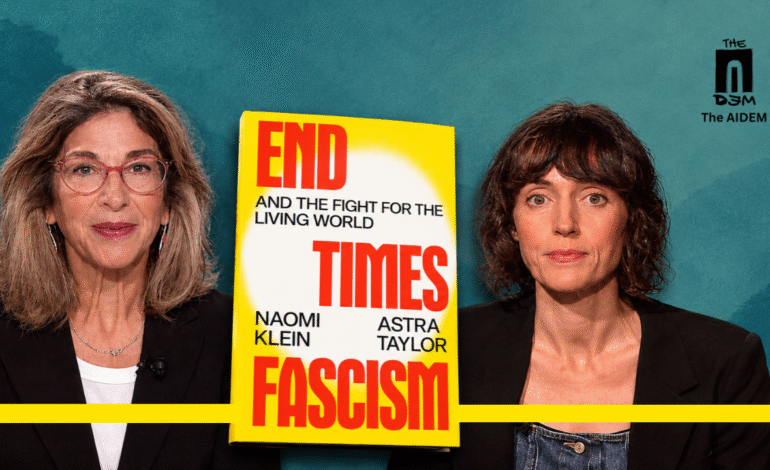
In “Messianic Dreams”, the first part of End Times Fascism and the Fight for the Living World, Klein and Taylor argue that a loose coalition of religious fundamentalists, “tech-accelerationists” and ethno-nationalists shares an “apocalyptic vision” of the world. They examine the religious underpinnings of what they call “End Times Fascism”.
This part focuses on religious fundamentalists who believe in an imminent Last Judgement and wield significant influence in the United States, Israel and parts of Latin America. “The Unfolding of History: From Colonial Genocide to Anti-Fascist Resistance”, the first of the three chapters in Part I, rejects the view of twentieth-century fascism as a historical anomaly. It traces continuities between twentieth-century fascism and earlier forms of colonial violence, racial hierarchy and the politics of “purification”, and draws parallels with contemporary Christian Zionist and Messianic Jewish political movements.
The authors present evidence of how a worldview once confined to the margins gained a foothold in centres of power. They point to the influence of these beliefs on the US decision to recognise Jerusalem as Israel’s capital and to the presence of people who hold such beliefs in senior positions in the US military and government.
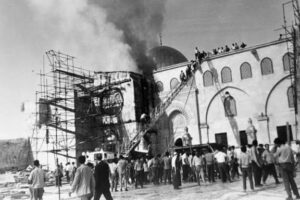
To illustrate the dangers of this worldview, the authors recount a 1969 incident in which a young man set fire to one of Islam’s holiest sites. He was said to be mentally unwell and believed he was the “chosen one” destined to bring about the end of the world and its subsequent rebirth. His actions could have triggered a global war. At the time, however, the authors argue that such “end-timers” held no key decision-making posts in governments around the world. Today, the authors see a different balance of power. People who can influence decisions about the use of highly destructive weapons now occupy senior positions in government. The authors present evidence of the danger this poses. Some of these individuals believe that catastrophes heralding the end of the world are imminent and that they should welcome or even hasten them.
These individuals see pandemics, climate collapse and wars as confirmation of apocalyptic prophecies. Klein and Taylor argue that religious apocalypticism helps shape both the ambitions of tech accelerationists and the politics of ethno-nationalists.
Members of all three groups often see the crisis as inevitable, and some take actions that hasten it. Climate summits repeatedly call for cuts in fossil fuel use to address the climate crisis, yet developed countries continue to adopt policies that increase fossil fuel consumption.
In “Messianic Dreams”, the authors explain “end-times fascism” by tracing the links between religious beliefs about the end of the world and fascist ideologies. By examining how this ideology draws on both biblical prophecy and the survival strategies of elites, they show how religious extremism helps hold the coalition together.
For readers unfamiliar with the alliance between Christian Zionists and Messianic Jews, or with apocalyptic theology, this part of the book may prove challenging. The connections become clearer in the later parts, as the authors explain how these religious beliefs intersect with the political ambitions of the other groups in the coalition.
(To be continued)