


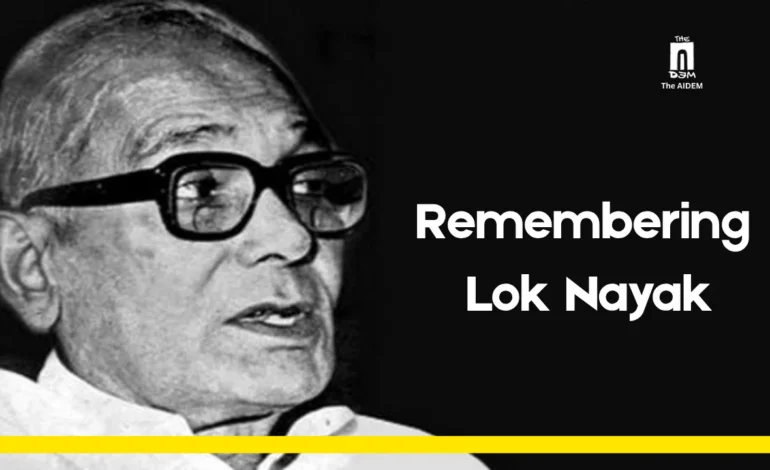
On the 124th birth anniversary of Jayaprakash Narayan, Arvindar Singh revisits the life and political legacy of the leader who galvanised a nationwide movement against corruption and authoritarianism in the 1970s. From the call for Total Revolution to the defeat of Indira Gandhi’s government following the Emergency, JP’s political journey remains an important chapter in India’s democratic history. His insistence on probity in public life, his commitment to dissent and his later disillusionment with the Janata government also raise questions that retain their relevance in contemporary India.
Jayaprakash Narayan, popularly known as JP, was born on 11 October 1902 in Sitab Diara, a village in the Saran district of Bihar, bordering Uttar Pradesh. He was destined to play a vital role in Indian politics, although he never held governmental office, despite receiving several offers during his lifetime. His influence came not from the exercise of official power but from his ability to mobilise public opinion and inspire political action.
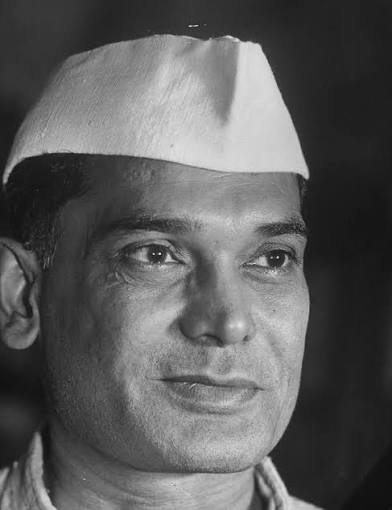
This article, written on his 124th birth anniversary, revisits the life of a remarkable public figure with whom many younger Indians may be unfamiliar. It focuses particularly on his struggle against corruption and authoritarianism, which gathered momentum in early 1974 and culminated in the formation of India’s first non-Congress government at the Centre in 1977. The emphasis is on the movement he led and the final phase of his life, for these years offer important insights into the role of dissent in democratic politics. JP’s movement ultimately brought together disparate opposition forces under the Janata Party banner and secured a dramatic electoral victory.
From Marxism to Gandhian Socialism
JP pursued higher education in the United States, including at Ohio State University. He returned to India a committed Marxist but joined the Indian National Congress and, in 1930, headed the party’s Labour Cell. He subsequently became the founding general secretary of the Congress Socialist Party in 1934. Although the socialists constituted a distinct political grouping, they continued to function within the Congress through a system of dual membership.
During the freedom struggle, JP was arrested on several occasions. He made a daring escape from Hazaribagh Jail in 1942, was subsequently imprisoned and tortured, and eventually emerged from incarceration before Independence. In the post-Independence years, he remained committed to socialism, became associated with the Bhoodan movement and was regarded by many as a possible successor to Jawaharlal Nehru.
His Gandhian convictions were also reflected in his efforts to persuade armed outlaws to abandon violence. In 1971–72, he played an important role in securing the surrender of more than 400 dacoits from the Chambal region, including the notorious Mohar Singh and his associates. Their decision to lay down arms represented a significant achievement for the Gandhian approach of persuasion and reconciliation.
Writing about a meeting with JP in the seventies, the well-known writer Khushwant Singh observed:
“He was a strikingly handsome man—tall, sinewy. He wore coarse handspun clothes; his voice was as gentle as his speech. His accent, both in English and in Hindustani, was that of a westernised oriental professor. There were several politicians present. The last to come was Maharani Gayatri Devi of Jaipur, a Member of Parliament for the Swatantra Party and a renowned beauty. She gestured to the others not to disturb the proceedings and sat down on the carpet near JP’s chair. He interrupted his discourse to remark, ‘A beautiful princess sitting at the feet of a commoner. This is indeed a revolution.’”
Although remembered for various milestones, such as his daring escape from Hazaribagh Jail in 1942, JP will chiefly be remembered in India for the movement he launched against the Indira Gandhi government in 1974. In late 1973, he published ‘An Appeal to the Youth’, which drew an enthusiastic response. Meanwhile, students in Gujarat had launched the Navnirman agitation against corruption, inflation, and rising student hostel fees. JP joined their protest, and soon enough, students in his home state of Bihar launched an agitation on similar grounds. JP agreed to lead it on the strict condition that it remain non-violent. This movement later blossomed into the Bihar Movement, which spread throughout Northern India in the months that followed. On 5 June 1974, addressing a massive crowd of an estimated one million, JP called for a “Total Revolution” and declared that the struggle was no longer limited to the dismissal of the Abdul Ghafoor ministry (the Congress government in Bihar at the time), but was the outcome of a dysfunctional education system, bleak prospects for students, spiralling inflation, massive corruption, and widespread unemployment.
Following this clarion call, JP immersed himself in public meetings across various parts of the country and called upon students to boycott classes for one year. Some politicians, such as Morarji Desai and Atal Bihari Vajpayee, expressed reservations, believing it did not behove a leader of his stature to advocate a course that might lead to indiscipline among students. Be that as it may, there is no doubt that the JP Movement captured the imagination of the public, particularly in Northern India.
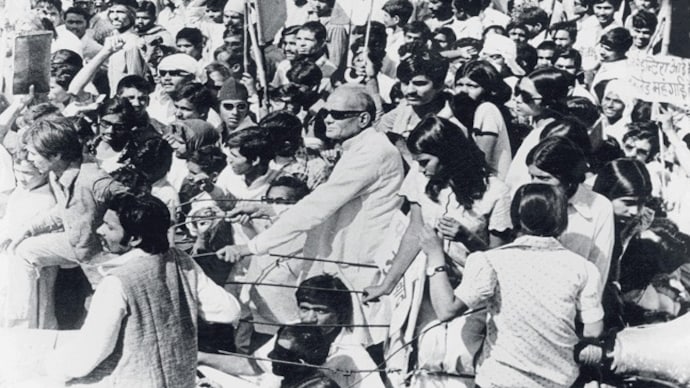
On 4 November 1974, the heavy-handed Bihar administration, while lathi-charging protesters at a massive march in Patna led by JP, did not spare him, striking him on the collarbone, elbow, and leg. This was a disgraceful act.
On 6 March 1975, JP led the People’s March to Parliament, where the crowd swelled to nearly half a million. The marchers demanded fresh elections in Gujarat and Bihar, measures to secure the socio-economic rights of the populace, the provision of essential commodities to underprivileged sections at affordable prices, full employment, the withdrawal of the draconian Maintenance of Internal Security Act (MISA), electoral reforms, national austerity, genuine democracy, and moral values within a Gandhian framework. These demands were formally presented to the Speaker of the Lok Sabha and the Chairman of the Rajya Sabha.
Events moved swiftly. After the Allahabad High Court unseated Prime Minister Indira Gandhi in June 1975 for electoral malpractices, the opposition parties called for her resignation with one voice. JP and Morarji Desai led the charge. Addressing a massive rally in Delhi on 25 June 1975, JP declared: “We have challenged the government; they have no moral right to govern.” Little did JP and his colleagues in the opposition know that Indira Gandhi had other plans. A midnight knock at their doors ensured that all major opposition leaders were arrested under the draconian MISA, marking the beginning of 19 months of the Emergency. JP’s period in detention is too well known to require detailed repetition; suffice it to say that by the end of 1975, his kidneys had failed, leaving him dependent on dialysis for the remainder of his life.
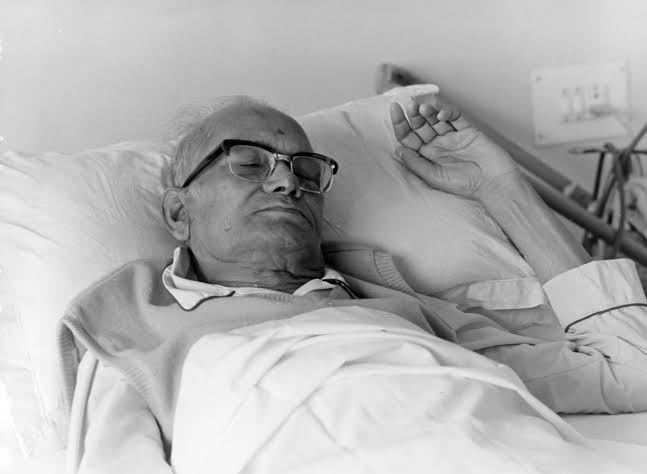
Upon the relaxation of the Emergency and the announcement of general elections in 1977, JP campaigned relentlessly for the newly formed Janata Party of the united opposition. In a final appeal to the electorate through the print media, he wrote: “I appeal to each one of you. Free India, defeat the dictators. This is the last chance. If you falter, 19 months of tyranny will become 19 years of terror.”
The public response was electric: the Janata Party and its allies secured a landslide victory, winning 344 of the 542 seats in the Lok Sabha.
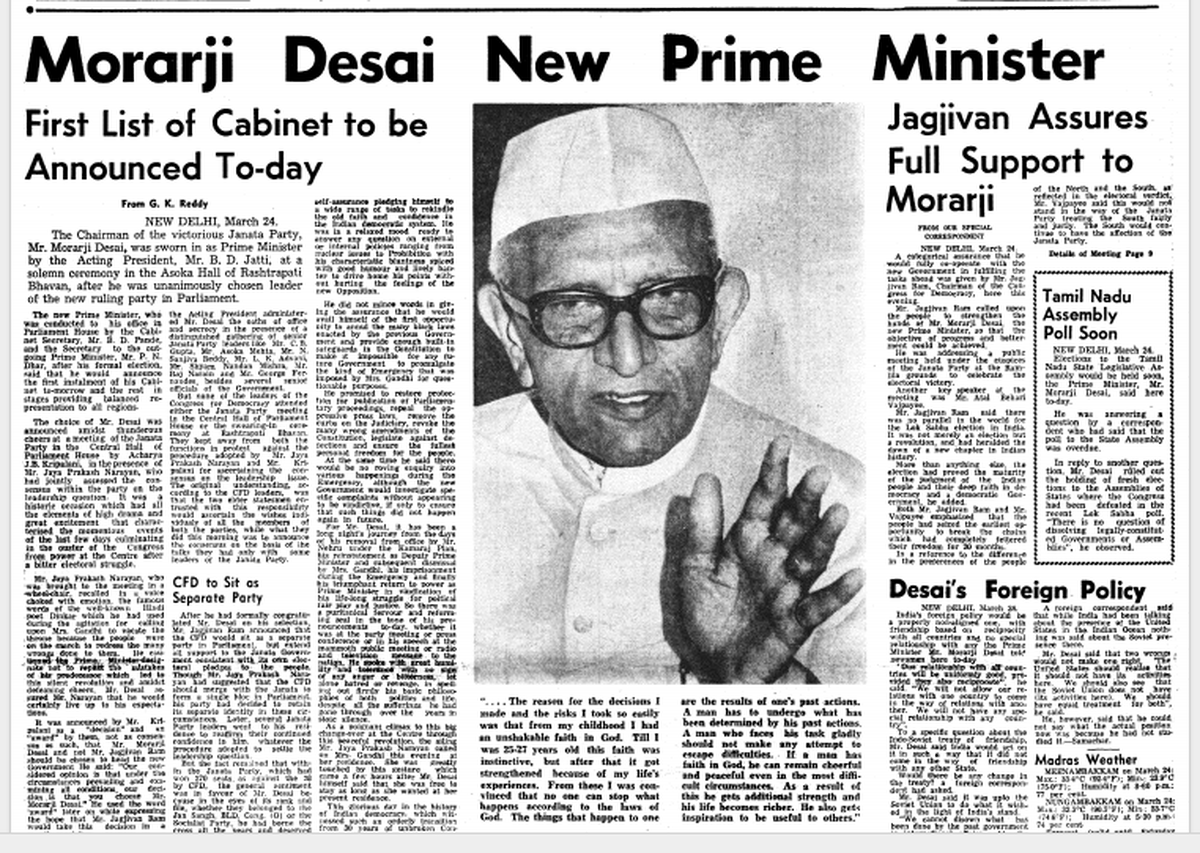
JP and Acharya J.B. Kripalani—another veteran of the freedom struggle—were tasked with nominating the Janata Party’s Prime Minister. Their choice fell on the 81-year-old Morarji Desai, an able administrator who had previously held various ministerial portfolios, including that of Deputy Prime Minister. The other major contender, Jagjivan Ram, had remained a minister throughout the Emergency and quit the Cabinet only after elections were announced—a factor that ultimately worked against him.
Winston Churchill’s dictum of “magnanimity in victory” was upheld by Jayaprakash Narayan and Prime Minister Desai, who called on the defeated Prime Minister to assure her of her security and that of her family—particularly her son Sanjay, who was widely regarded as the arch-villain of the Emergency.
On 13 April 1977, JP addressed the nation in a broadcast, stating that he was speaking to the country as a common citizen. He emphasised that elected representatives could be recalled through public pressure or constitutional means, and called for the establishment of a Lokpal on the lines of the Swedish Ombudsman. He also dwelt upon his ideal of “Total Revolution”. Writing about JP at the time, the eminent jurist Nani A. Palkhivala remarked:
“Not since the time of Gandhiji has moral force, personified by a frail invalid, triumphed so spectacularly over the forces of evil. He changed decisively the course of history. One life transformed the destiny of six hundred and twenty million.”
Although appreciative of the Janata government’s steps towards economic stability, probity in public life, and the reversal of Emergency-era constitutional amendments, JP remained critical regarding issues of communal violence. He pleaded with the government to distance itself from those involved, explicitly referencing the RSS in this context. He also later appealed to Prime Minister Morarji Desai to use his influence over the RSS to open its doors to Muslims, Christians, and other communities so that it might shed its purely Hindu image.
Due to false information and a blunder by an Intelligence Bureau officer in Mumbai, JP—who was critically ill at Mumbai’s Jaslok Hospital—became the subject of a major faux pas by the Janata government when Prime Minister Morarji Desai announced his passing in Parliament on 23 March 1979, only to apologise for the lapse a few hours later.
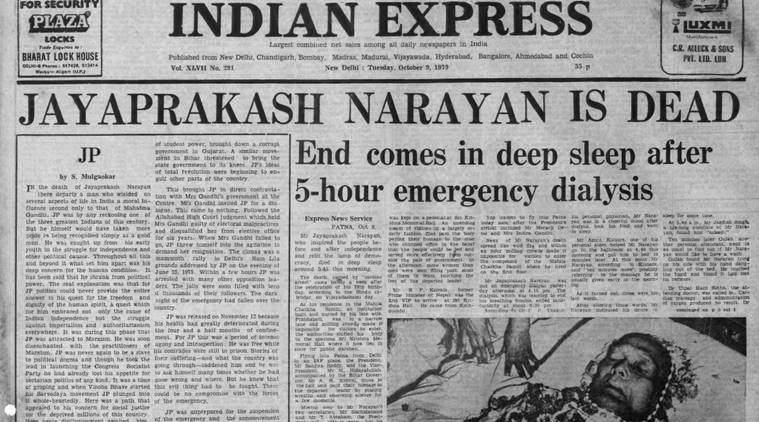
In July 1979, defections from the parent party brought down the Janata government, and JP passed away a few months later. On 8 October 1979, he died peacefully in his sleep. Writing in The Hindu on 9 October 1979, G.K. Reddy paid tribute to him:
“A grateful nation pays its homage to a departed leader who embodied in himself all that was best in Indian public life and tradition. As the last surviving link between the pre-independence and post-independence generations, he did whatever he could during the last two or three years of his life to halt the rapid slide down by rekindling some of the old spirit.”
Arvindar Singh is the author of the book Jayaprakash Narayan: The People’s Leader.

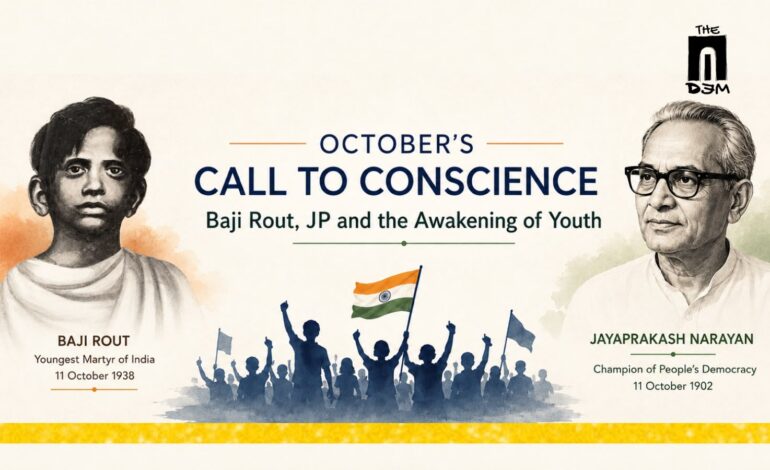




Jayaprakash Narayan’s legacy reminds us that democracy is not merely about winning elections; it is about defending people’s rights, questioning those in power, and standing fearlessly against injustice. Today, when dissent is increasingly treated as a threat and democratic institutions face serious challenges, JP’s call for Sampoorna Kranti remains more relevant than ever. A government that fears questions has forgotten the meaning of democracy. The true tribute to Lok Nayak is not to glorify his memory, but to uphold freedom of expression, constitutional values, and the people’s right to dissent.