


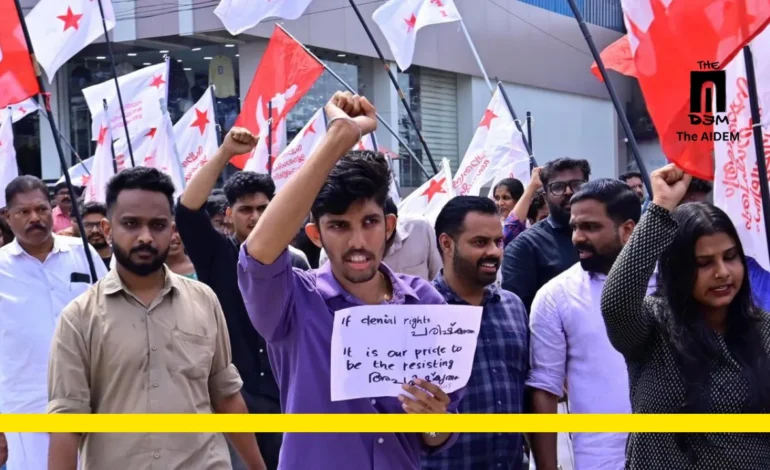
The prolonged agitation and legal battle waged by sixteen students of the Sree Sankaracharya University of Sanskrit, Kalady, have culminated in a decisive victory with the verdict of the Kerala High Court. The court, which quashed the suspension orders issued by the university against the students on charges of misconduct, also invalidated the report submitted by the university’s disciplinary committee. It directed the university to conduct a special examination to ensure that the students’ academic future was not jeopardised. At the same time, the verdict clarified that the university was at liberty to conduct a fresh inquiry, if necessary, in accordance with legally prescribed procedures. Following the favourable High Court verdict, the students called off their twenty-two-day hunger strike.
The verdict represents more than mere legal relief for sixteen students. It is a development that lends renewed relevance to a wider discussion on the limits of disciplinary action in universities, students’ right to education, the principles of natural justice, and the democratic freedom to protest and dissent. Against this backdrop, the approach of the university administration, which insisted on a written apology as a condition for revoking the students’ suspension and appealed against the High Court’s interim order permitting them to sit their examinations, warrants more serious scrutiny. The court verdict has brought into sharper relief the contradiction inherent in an institution entrusted with safeguarding the academic future of its students adopting a position that denies them educational opportunities.
The Kalady episode must be viewed as a critical turning point in the history of higher education in Kerala. In the years to come, the developments at Kalady may well be read as a manifestation of one of the gravest crises confronting our conception of the university. A right-wing educational philosophy that calls into question the foundational values of the university as a democratic institution, its academic autonomy and the possibilities of critical thinking has made its presence strongly felt at Kalady. What comes under scrutiny here is an administrative culture that views student protests merely as acts of indiscipline and seeks to extinguish dissent by demanding submission to institutional authority.

Student agitations and the disciplinary action that follows them are hardly unprecedented in Kerala’s history. Many of those occupying different levels of political leadership today have themselves emerged from such struggles. At Kalady, however, two particularly significant tendencies manifested themselves simultaneously. The first was the university’s decision to approach the Division Bench of the High Court against an order of the Single Bench directing that students be allowed to sit their examinations. An institution entrusted with protecting the academic future of its own students was approaching the court to prevent them from availing themselves of judicial relief. Beyond this extraordinary contradiction, the university’s position also suggested that disciplinary action was acquiring a vindictive character.
The second was the Syndicate’s position that students who had participated in the agitation could be reinstated if they apologised. With a criminal case pending, a written apology need not remain merely an expression of regret in the context of disciplinary proceedings. It could also be interpreted as a documented admission of guilt by the students themselves. Beyond this legal complexity, the demand for an ‘apology’ becomes an insistence that students relinquish their political convictions and their right to protest and submit to institutional authority. Both positions adopted by the university authorities are symptomatic of an educational philosophy that regards students not as citizens endowed with rights, but as subjects of discipline expected to remain subservient to institutional authority.
While delivering justice to the students, the latest High Court verdict also brings fundamental questions about the exercise of power by the university administration back into focus. The problems at Kalady do not end merely because the suspension orders and the disciplinary committee’s report have been invalidated. Rather, the verdict creates an occasion for a more rigorous examination of the democratic character of the university, academic freedom and the limits of institutional authority. The agitation and the litigation that followed it thus open up a larger political and philosophical question concerning higher education. The questions raised by the students’ struggle for justice extend beyond their immediate victory to encompass the future of higher education in Kerala.
The ‘saffronisation of universities’ is not confined to appointing individuals sympathetic to Hindutva politics to official positions or surreptitiously introducing Hindutva-oriented interpretations of history into curricula. It is also a process that transforms the internal culture of the university as a democratic institution, its power relations and its approach to criticism and dissent. This process can be understood at three levels. The first involves appointments to official positions of authority and the elevation of individuals in accordance with Hindutva interests. This intervention is administrative and overtly political in character.
The second involves dismantling the secular-democratic vision that has informed our curricula, research practices and academic policies. Although less conspicuous than the first, it is readily identifiable by a vigilant academic community. The third, however, is considerably more subtle and potentially more dangerous in the long run. It involves a right-wing educational philosophy beginning to govern the democratic consciousness of the university and its institutional culture. It entails the emergence of an administrative culture that regards dissent as hostility, protest as indiscipline and criticism as an affront to the institution. It is also an attempt to transform the university from a space for criticism, debate and democratic dissent into an institution of authority where obedience and submission must be enforced. It is this that can be characterised as an ‘extreme right-wing educational philosophy’.
Since July 2026, students under the banner of the Students’ Federation of India (SFI) had been agitating over issues such as inadequate infrastructure, drinking water shortages, hostel restrictions and vacancies in teaching positions. The protest during the Syndicate meeting on August 13 and the ‘spontaneous drama’ performed by students of the Department of Theatre as part of it subsequently developed into a major controversy. The university alleged that the students had staged a symbolic funeral of the Vice-Chancellor, physically manhandled her and attempted to damage her vehicle. The students, however, maintained that the theme of the performance was the symbolic funeral of non-functional stage lights.
These allegations and counter-allegations would undoubtedly have been subjected to legal scrutiny in court. Beyond that, the crucial question here is how the university dealt with the student protest. On September 1, the university suspended sixteen students in connection with the events of August 13. As part of the subsequent disciplinary proceedings, an inquiry committee heard the students on September 29 and 30. Reports indicated that although the committee had submitted its findings, the report was not placed before the Syndicate for consideration on account of certain procedural lapses. Meanwhile, the suspension continued, jeopardising the students’ studies and their opportunity to sit examinations. It was against this situation that the students approached the High Court.
On October 30, the Single Bench of Justice P.V. Kunhikrishnan provisionally permitted the students to appear for the examinations scheduled to commence on November 4. The university, however, approached the Division Bench against this order. On November 3, a Division Bench comprising Justices Anil K. Narendran and Muralee Krishna set aside the interim order of the Single Bench. The decision was based on the observation that the petition did not contain the necessary pleadings and documents concerning the students’ eligibility to sit the examinations and that the interim order amounted to granting final relief. With this, the students lost their first judicially secured opportunity to appear for the examinations.

The students subsequently approached the Supreme Court. While the Supreme Court, which considered the petition in the first week of November, declined to interfere with the Division Bench’s order, it directed the High Court to expedite the hearing of the students’ main petition, and the university indicated that a special examination could be conducted if the suspension was quashed. When the case was taken up on November 11, the High Court reportedly asked why an apology was still being demanded from students who had already undergone more than sixty days of suspension. Having concluded the hearing on November 18, the court reserved its verdict for November 23. The verdict was scheduled to be pronounced by the Kerala High Court at around 10.15 a.m. on November 23, as the first case on its list.
I
The demand for an ‘apology’ from the university authorities emerged at the Syndicate meeting held on November 3. On that day, the Syndicate decided to revoke the suspension of twelve students subject to certain conditions. These included the students appearing in person with their parents, submitting written apologies and furnishing an assurance that they would not participate in violent protests in the future. The Syndicate also decided to extend the suspension of the remaining four students by another two months. The students rejected these conditions.
If the authorities believe that student protests and agitations are disrupting the functioning of the university, there are established legal and academic procedures to address such situations. Clearly establishing the offence, determining the involvement of each student, adhering to the principles of natural justice and prescribing proportionate punishment are the normal procedures for dealing with an agitation within a democratic framework. However, when an ‘apology’ is stipulated as a condition for revoking suspension, the nature of the exercise changes. The question then arises whether the institution of learning is asking its students to rectify a wrongdoing or to submit to institutional authority. Embedded in this demand for a compulsory apology is an extreme right-wing position that transforms the university’s authority into an instrument for subjugating students’ self-respect and political self-determination. The casual suggestion emanating from the highest levels of the administration that the matter was trivial enough to be settled by writing a few words on a blank sheet of paper ought to disturb modern Kerala, a society that attaches considerable value to human dignity.
The power relations involved when a student is asked to apologise and when a student demands an apology from the university are fundamentally different. An ‘apology’ must emerge from an independent realisation of wrongdoing. An apology extracted through the pressure of authority is merely a demonstration of obedience. Modern institutions function not merely through punishment, but also through processes that induce individuals to regulate themselves and internalise the norms of authority. In this sense, demanding an apology from students is not simply a disciplinary measure; it is also a demand that students reconstitute themselves in a manner that acknowledges institutional authority.
The democratic greatness of a university lies not in its ability to secure obedience from students, but in its capacity to address their disagreements and conflicts on the basis of justice and dialogue. A demand that students apologise should never emanate from university authorities in this manner. A training ground that produces docile flocks of sheep can hardly be described as a university.
Another crucial issue is that when a university argues in court that its students should not be permitted to sit their examinations, the character of disciplinary action shifts from correction to retribution. Disciplinary action should be intended to safeguard the functioning of the institution and its collective learning environment; when it begins to pursue the objective of inflicting greater suffering on an individual or a group, the purpose of discipline itself changes. When the university argues in court that students should be denied the opportunity to sit examinations, it exceeds the limits of disciplinary action and makes the academic future of the protesters itself part of their punishment.
The opportunity to sit an examination is integral to a student’s educational rights. Denying that opportunity is not merely an administrative restriction. It is a measure that affects the continuity of education, academic progress and future employment prospects. Consequently, when such a demand is made, the question of what the university seeks to achieve becomes unavoidable. Is the objective to restore institutional discipline? Or is it to subject students who have challenged institutional authority to more serious consequences? Once the purpose of punishment shifts from regulating conduct to obstructing the future of those being punished, the element of retribution has already entered the picture. As pointed out earlier, it is an extraordinary contradiction that the demand to deprive students of the opportunity to continue their education should emanate from their own institution of learning.
The concept of restorative justice is particularly relevant to a university. Its emphasis is on addressing the consequences of a conflict or a transgression, restoring relationships and making collective life possible again. Its focus is not on excluding the person who has committed an offence, but on facilitating their reintegration with a sense of responsibility. When conflicts arise among students or between students and the administration, avenues for resolving them must be opened up. Even when disciplinary action becomes necessary, it must not extinguish a student’s right to education. Excluding an individual from education itself in the name of punishment is incompatible with the educational responsibilities of a university.
Is the institution’s position that students must acknowledge their protest as wrongful, apologise for it and only thereafter be permitted to return to its normal academic life? If so, the apology ceases to be part of an ethical reconciliation. It becomes a ritual of submission to authority. Instead of forgiveness and apology being possibilities for restoring mutual trust, they are presented as instruments for enforcing obedience. What has been fashioned at Kalady is undoubtedly a methodology that must never be allowed to recur. Its consequences could be far greater than we imagine.
II
What is a university? Is it merely an institution that disseminates knowledge, conducts examinations and awards degrees? Or is it a dynamic system that shapes the intellectual and cultural life of society, produces new knowledge and continually subjects existing knowledge and beliefs to critical scrutiny? The greatness of a university does not reside merely in its repository of knowledge or in the academic degrees it awards. Rather, its true distinction lies in the possibilities it opens up for questioning knowledge, criticising authority, challenging prevailing social assumptions and developing new ideas.
Free thought, debate, criticism and dissent are, therefore, not activities extraneous to the functioning of a university; they are indispensable to its very existence. Within this ‘dynamic system’, comprising teachers, students, researchers, non-teaching staff and administrators, each constituent has distinct responsibilities and powers. In the realisation of the university’s fundamental objectives, students are not merely recipients of services. They are participants in the pursuit, production and critical examination of knowledge. An approach that regards students merely as individuals subject to the administrative control of the university is, therefore, incompatible with the foundational character of the university as a concept.
A ‘student-centred university’ does not mean an institution that must concede everything its students demand. It is a university that recognises students’ freedom of thought, dignity, privacy and freedom of association, and provides institutional space for their opinions and criticism. A university must possess the capacity to understand student dissent not as hostility towards the institution, but as a natural democratic activity within the academic community.
Certain common rules are indispensable for the smooth conduct of teaching, learning and research and for safeguarding the academic environment. Discipline, however, is not synonymous with obedience. Discipline established by extinguishing criticism and dissent is contrary to the fundamental principles of academic freedom. The challenge before a university is to maintain a democratic balance between the freedom of students and the responsibilities of the institution. A ‘competent university leadership’ is one that possesses the ability to negotiate this challenge with ease.
The 1967 Joint Statement on Rights and Freedoms of Students is regarded as one of the documents articulating a modern approach to how universities ought to regard their students. It was against the backdrop of the intensification of student agitations, civil rights movements and anti-war politics in American universities during the 1960s that a wider discussion on students’ rights emerged and this document was formulated. The statement is not a law directly applicable to Indian universities. Nevertheless, recognising its ethical significance, universities across the world have sought to adopt it as a benchmark. The statement also enjoys international acceptance in matters concerning the democratic character of universities, students’ freedoms, the exercise of institutional authority and fairness in disciplinary proceedings. This joint statement was also an academic intervention against an approach that regarded students merely as individuals subject to institutional control.
The preamble to the Joint Statement itself articulates a fundamental understanding of the objectives of a university. It identifies the transmission of knowledge, the pursuit of truth, the personal development of students and contributions to the common good of society as the principal objectives of institutions of higher education. For these objectives to be realised, teachers and students must have an environment in which they can think freely, express their opinions and engage in dialogue. The document’s observation that the freedom to teach and the freedom to learn are inseparable aspects of academic freedom is particularly significant in this context.
From this perspective, students are not merely passive recipients of the knowledge imparted by teachers. They have the right to disagree with positions advanced in their subjects of study, raise reasoned questions and formulate independent opinions. Freedom of expression in the classroom, freedom to form student organisations, the right to participate in discussions on public issues and engage in political activity, participation in university policymaking, and non-discriminatory academic evaluation are all addressed in this document. Similarly, the statement stipulates that when disciplinary action is initiated, students must be informed of the charges against them, given an opportunity to present their case and allowed to demand fair procedures.
What deserves particular attention in this document is its conception of discipline. Rather than treating punishment as the first means of regulating student conduct, it accords priority to counselling, guidance and warnings. Even when disciplinary action becomes necessary in serious circumstances, such proceedings must be fair and transparent. In other words, while recognising the authority of the university, the document reminds us that this authority is circumscribed by limits and responsibilities.
In the Indian context, the influence of the aforementioned Joint Statement can be discerned in the University Grants Commission’s (UGC) 2013 Guidelines for Students’ Entitlement, which are frequently invoked as a basis for such discussions. The UGC published these guidelines on April 23, 2013. The stated objective of the document is to familiarise students, teachers, administrators and educational institutions with the fundamental entitlements of students. The document stipulates that these guidelines are applicable to all universities, colleges and institutions of higher education in the country and that they must be published in full in institutional prospectuses and made available on the homepages of their websites.
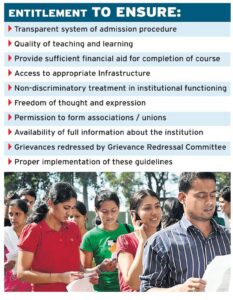
The significance of this document lies not merely in its enumeration of rights, but also in the conception of the student that it advances. The UGC regards students not as individuals dependent on the benevolence of the university, but as individuals entitled to demand certain things from the institution. Ensuring students’ rights is the responsibility of educational institutions, administrators, teachers and policymakers. If this responsibility is not fulfilled, students may approach the grievance redressal authority or the ombudsman. Persistent violations of the guidelines may be brought to the attention of the UGC, and appropriate action may be sought on that basis. The document makes it clear that rights are not acts of institutional benevolence and that they entail institutional obligations. It also reminds students that their rights are accompanied by certain responsibilities.
This document cannot be reduced to a mere list of services to which students are entitled. Its sixth and seventh sections deserve particular attention. The sixth section concerns students’ freedom of thought and expression. The document makes it clear that, as citizens of a democracy, students have the right to think and express their opinions both within and outside the institution. Universities must provide space for the free exchange of ideas and public discussions. The objective is to foster critical thinking and a culture of questioning. This section also stipulates that discriminatory or unilateral restrictions should not be imposed on the organisation of seminars, lectures and debates that do not violate established legal provisions.
The seventh section concerns students’ freedom of association and participation in governance. Students have the right to form organisations and unions, directly elect their representatives and be represented on various decision-making bodies of the university. The document also requires universities to establish mechanisms for consultation with student representatives before taking important decisions that affect students. In other words, the document does not envisage the authority to make decisions concerning students as being vested exclusively in the administrative machinery. Students must also have a role in that decision-making process. The essence of this provision is to ensure a democratic space for students within the governance structure of the university.
What deserves particular attention here is that the UGC document regards students not merely as learners, but also as citizens of a democracy. Students’ freedom of thought and expression, and their political and organisational participation, are not matters extraneous to the academic functioning of the university. Rather, they are integral to the role that a university must fulfil in a democratic society. Reading these documents together brings into focus a democratic conception of the university.
The historical objectives of universities, international understandings of academic freedom and the guidelines advanced by the UGC concerning students’ rights in the Indian context all lead us towards the same fundamental idea. A student is not merely an individual subject to the administrative authority of the university, but a rights-bearing member of the academic community. Consequently, student dissent and criticism cannot be regarded merely as acts inimical to institutional dignity and discipline. They must also be understood as integral to democratic academic life.
It is against this backdrop that the student agitation at the Sree Sankaracharya University of Sanskrit, Kalady, must be evaluated. When students protest against the university, is the institution capable of listening to their criticism and engaging with it? Or is the very act of questioning authority interpreted as a breach of discipline? Instead of responding to a student’s criticism, should the university demonstrate its authority by compelling the student to apologise? One thing can be stated with certainty: the greatness of a university is determined not by the extent to which it renders its authority unquestionable, but by the extent to which it can democratically accommodate criticism and dissent. It is this latter position that has come to be recognised across the world as ‘civilised’.
III
During the previous United Democratic Front (UDF) government’s tenure, this writer was an active member of a Left-wing student organisation at the very same university in Kalady. Dr M.C. Dileep Kumar, who was sympathetic to the political positions of the Congress, was the Vice-Chancellor at the time. As activists of a student organisation occupying an oppositional political space, we experienced a period of constant friction with the university administration. Let me conclude this article by recounting an experience from those years of conflict that remains undimmed in my memory.

It must have been in early 2014 that the SFI and the All Kerala Research Scholars Association (AKRSA) erected a makeshift hut in front of the university’s academic block and launched an agitation demanding an increase in research fellowships. When none of our creative forms of protest, including begging for alms and planting banana saplings, appeared to attract the Vice-Chancellor’s attention, we decided to intensify the agitation. The Vice-Chancellor’s office was on the first floor of the academic block. Ordinarily, the grille on the ground floor would be locked to prevent protesters from gaining access.
That day, around ten of us entered the academic block without any prior announcement, pretending to have come there on various errands. At around half past nine in the morning, when the Vice-Chancellor stepped out of the lift, we surrounded him with our flags and slogans. It was a tense, face-to-face confrontation, with barely any physical distance between us. He, however, stood there unperturbed, looking at us silently with a faint smile. It took considerable effort on the part of the security personnel to bring the three- or four-minute blockade to an end.
Yet Dr M.C. Dileep Kumar subsequently conducted himself as though the incident had never occurred. He did not demand an explanation from us, nor did he initiate action against anyone. That experience taught us that individuals occupying positions of authority could rise above political differences in dealing with student protests, and that every act of opposition need not be converted into disciplinary proceedings or personal animosity. It remains one of the most important lessons from my student life that I carry with me to this day.
He is unlikely even to remember me now as one of the students who participated in that blockade. Yet, despite my fundamental disagreement with his political positions, the exemplary forbearance he displayed that day is what will always make me address him affectionately and respectfully as ‘Mashe’ — teacher. As Kumaran Asan wrote:
“Indeed, man has no other kinsman so devoted to doing good … nor a true teacher who imparts wisdom, quite like forbearance.”







The student victory at Kalady University is a powerful reminder that student unity and collective resistance can challenge the misuse of institutional power. Universities must remain spaces of academic freedom, democratic participation and dissent—not instruments of authority or intimidation. This victory belongs to every student fighting for dignity, justice and the rig