


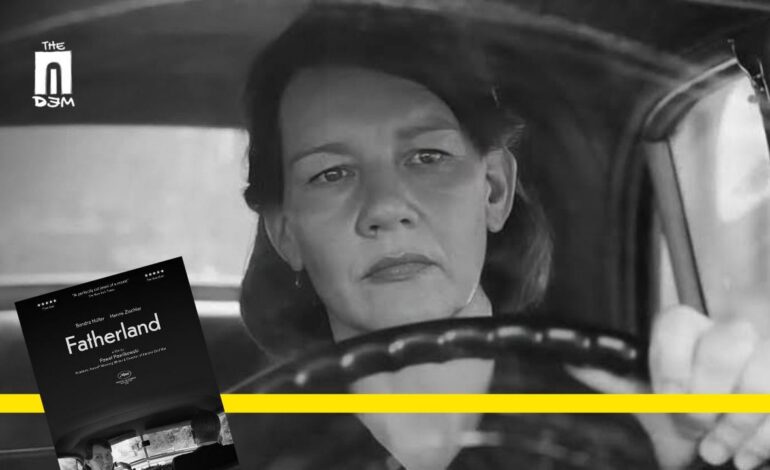
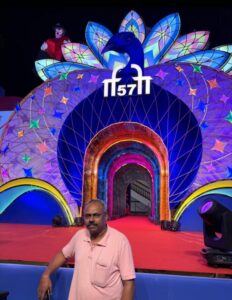
Fatherland, by the Polish director Paweł Pawlikowski, opened the 57th International Film Festival of India (IFFI) in Goa. Pawlikowski had already won the Best Director award for the film at the 2026 Cannes Film Festival. It has also been selected as Poland’s official entry for the Oscars.
In a broader sense, this 82-minute black-and-white film seeks to understand a people divided by the redrawing of the map of post-war Europe. The biographical drama follows the Nobel Prize-winning German writer Thomas Mann and his daughter Erika.
Following their journey through Germany in 1949, the road movie sifts through the ashes of history to examine the tensions between literature, politics and our obligations to one another. With Sandra Hüller as Erika and Hanns Zischler as Thomas Mann, the film reached Indian audiences in Goa after its Cannes success.
The realisation that a civilisation of such cultural stature could become an instrument of terror on its own soil wounds Thomas Mann more deeply than exile itself. The film takes the measure of that wound.
The Exiled Man’s Homeland
When Thomas Mann arrives in Frankfurt to receive the Goethe Prize, a journalist asks him a simple question, ‘Where is your home?’ The question becomes politically charged for the 74-year-old writer, an American citizen with a home in California. He returns to Germany sixteen years after fleeing the Nazi regime.
The German language and its traditions are part of who he is, and he is still haunted by the shame of seeing them appropriated by a regime that perpetrated genocide. Here, the film reveals the depth of the German word Heimat, meaning ‘home’ or ‘homeland’. Heimat also describes an inner map of memories and cultural practices, one that extends beyond geographical borders. The film conveys this with quiet force. Even in the safety of America, Germany’s ruined cities and political divisions stir Mann’s guilt.
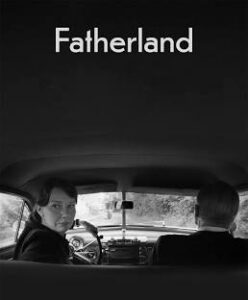
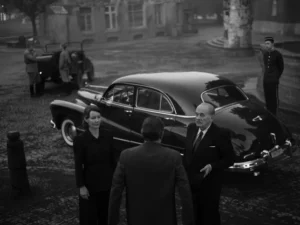
From Frankfurt, in the American occupation zone, to Weimar, in the Soviet zone, the characters cross a divide between two political systems. That image of a divided world also speaks to the present. At a time when borders are hardening and hostilities are deepening, the film fits IFFI’s theme, ‘Stories Without Borders’. Pawlikowski’s images also suggest that a writer can speak as both a citizen of a country and a witness to the human condition. In one scene in Weimar, the people posing for a photograph are asked to change places. By positioning Mann to the left of Goethe’s statue, the Soviet officials seem intent on presenting him as the direct heir to that cultural tradition.
Father and Son
The tension between the artist’s moral responsibilities and the dangers of artistic ambition runs through Thomas Mann’s literary career. In his 1947 novel Doctor Faustus, he tells the story of Adrian Leverkühn, a German composer who pledges his soul in pursuit of artistic greatness.
In Fatherland, Mann himself must answer for the choices he once explored in fiction. Can artistic ambition and humanity coexist in the same person? Or must humanity be sacrificed in the name of art? The life of his son Klaus follows him through the film like a shadow. In his novel Mephisto, Klaus Mann exposed how collaboration with the Nazi regime transformed an artist, while his own life descended into despair and loneliness.
The film opens with a single shot of Klaus, naked and in despair just before dawn, through which Pawlikowski suggests the private anguish of a generation. When news of his son’s tragedy reaches him, Thomas Mann presses on with his lecture tour and public engagements, caught between his sense of duty as a writer and his helplessness as a father.
This may be the point at which a thought begins to haunt Mann. An artist’s greatest test in a time of terror may lie in the choice between silence and speaking out. The fascination with illness and decay, and the sense of a world coming apart that runs through Mann’s work from Death in Venice to The Magic Mountain, find new expression in Pawlikowski’s visual language. Frail with age and burdened by history, Mann appears as a man who has lived through the collapse of his world.
Thomas Mann’s Journey to Weimar
Johann Wolfgang von Goethe enters the film as an embodiment of the German cultural tradition Mann still claims as his own. After receiving the Goethe Prize in Frankfurt, Mann travels to Weimar, where Goethe’s memory is still alive, on what feels like a pilgrimage.
Given the Nazis’ appropriation of Goethe and other figures of the classical tradition for propaganda, Mann’s journey to Weimar can also be read as a political act of defiance against Nazism. The connections between Mephistopheles in Goethe’s Faust and Mann’s Doctor Faustus become more intricate here.
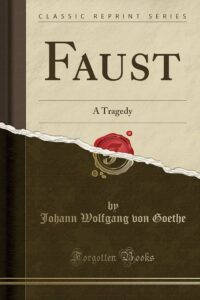
If Germany was a centre of world literature and humanism in Goethe’s time, Mann’s journey explores how that humanist tradition came under strain by the late nineteenth century and how far it had collapsed by the middle of the twentieth. The distance between Goethe’s age and Hitler’s confronts the audience at every turn. Goethe’s words take on particular force here. ‘Divide and rule, the politicians say; unite and lead, the wise men say.’
As Mann and Erika cross the political divide, Goethe’s appeal to wisdom and unity echoes through their journey. Pawlikowski leaves little room for nostalgia. In both Weimar and Frankfurt, he shows how readily officials enlist Goethe’s name in their political manoeuvres.
The White of Memory and the Black of Forgetting
Fatherland completes Pawlikowski’s historical trilogy, following Ida and Cold War. One observation has stayed with me. Perhaps only a director born in Warsaw, who lost his grandmother at Auschwitz and knew the pain of exile, could have understood Mann’s predicament so intimately.
Pawlikowski brings emotional sensitivity and precision of composition to the film. The black-and-white cinematography carries the moral weight of the past. Set against the clamour of the present, the film draws strength from its quiet storytelling and the understated sharpness of its dialogue. Sandra Hüller’s Erika Mann emerges as a political and intellectual presence in her own right.
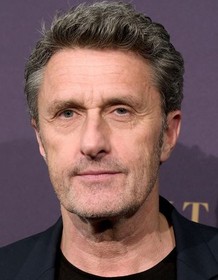
Erika has firm political convictions and a sharp wit. Her expressions and remarks convey a critical eye for the history unfolding around her. Goethe’s words, ‘All theory, dear friend, is grey, but the golden tree of life is green’, suggest that the vitality of lived experience exceeds the reach of theory and ideology, an idea that resonates with Pawlikowski’s climactic scene.
On the return journey, Bach’s music sounds from a broken organ in a ruined church, moving Thomas Mann to tears as Erika takes his hand. Does the scene suggest that what has vanished can still be felt in the air around us? Watching Fatherland, we see what war and division can do to a family and a culture. As even a writer of Mann’s stature finds himself powerless against the forces of history, we are left to ask how much literature can change the world.
The film lays bare a bitter truth. Great art and intellectual learning are, by themselves, insufficient to prevent human cruelty. Fatherland holds the audience for 82 minutes through the restraint of its storytelling. With its unhurried pace and avoidance of melodrama, I found it a fitting choice to open IFFI. In the world Pawlikowski creates, Mann and Goethe meet in a continuing struggle between memory and forgetting.
Echoing the poetic thought, attributed here to Theodor Rothe, that the eyes begin to see in dark times, Fatherland asks what humanity and art can recover from the wreckage of war and division. The journey through Germany’s past leaves us with a question about our own times. Where do we stand, and where are we headed?


A broken society is reflected not only in its politics and institutions but also in its cultural landscape. Culture should challenge injustice, preserve diversity and give voice to the marginalised, not become a tool for division and exclusion. Understanding this cultural crisis is essential to understanding the deeper failures of society. We need a culture that promotes critical thinking, freedom and human dignity rather than hatred and narrow identities.