

The Oedipal Trap and the Ontological Wound of Caste

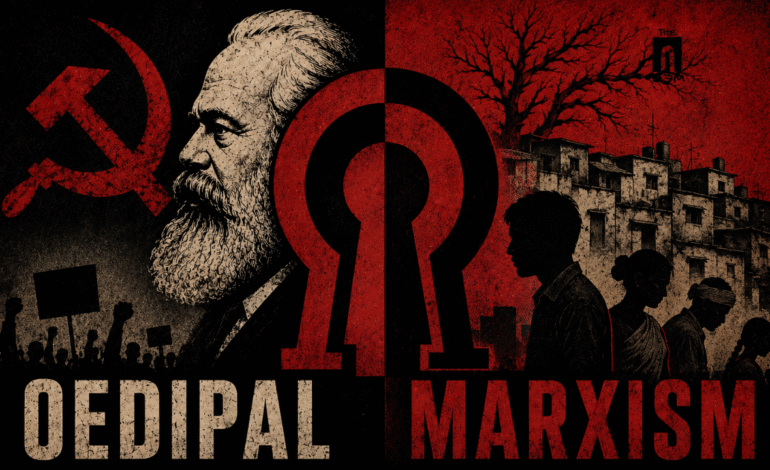
Part 3: The Oedipal Marxism
This is Part Three of The Oedipal Marxism, Solomon Mubash’s series on the crisis of Indian Marxism. Having traced the Left’s loss of the inner domain and its blindness to caste as biopower, Mubash now names the trap at the heart of vanguard politics: the party that claims to kill the Father ends up becoming one. Through Kerala’s Laksham Veedu colonies, he shows how land reform without dignity produced not liberation, but a better-decorated cage.
The Oedipal Trap: How the Vanguard Became the Father
The traditional Leninist vanguard party begins with a revolutionary claim: the party is the “advanced detachment” of the working class, the conscious minority that leads the spontaneous majority. This is a myth that only a minority of conscious beings can understand the truth. But over time, especially when the party gains state power or becomes a permanent opposition bureaucracy, this structure inverts. The party ceases to be an instrument of the class and becomes an instrument of its own reproduction.
Here is the trap, step by step. The Party claims to know the truth, scientific socialism and dialectical materialism. Only Party members are trained in this truth. The masses are ignorant, in a state of false consciousness. Therefore, the Party must lead, and the masses must follow. Dissent within the Party is deviation. Discipline means obedience. The Party bureaucracy becomes the guardian of truth. The Secretariat, the Central Committee, and the leader decide what Marxism means. The Party no longer learns from the masses. It commands them. At this point, the vanguard has become the State’s philosophy: a hierarchical, dogmatic, disciplinary apparatus that uses Marxist language to enforce its authority. It has not killed the bourgeois, Father. It has become the father.
In the Greek myth, Oedipus kills his father and marries his mother, only to discover that he has fulfilled a prophecy and remains trapped. In politics, the revolutionary party claims to kill the bourgeois state (the father). But to do so, it becomes like the father: hierarchical, authoritarian, secretive, bureaucratic. It ends up ruling as a new Father rather than a liberator. The vanguard that becomes State philosophy is the revolution that devours its own children. It produces cadres who memorise the catechism of the political priest but cannot hear the cry of the Dalit identity. It produces leaders who speak of class struggle but live in gated compounds. It produces a party that wins elections but has no idea why it loses the people.
The vanguard claims a second, higher birth through Marxist theory. Just as the Brahmin claims spiritual superiority through the sacred thread, the Party leadership claims political superiority through “scientific socialism.” Both are hierarchies of initiation. Both say: “We have seen the truth. You have not. Follow us.” This is the first pillar of the Oedipal complex: an obsessive focus on the European “Father-conflict” (Class), while ignoring the “Native-structure” (Caste). The wound of the Indian subaltern masses is ontological, but the prescription that Indian Marxism offers is economic. The Brahmin says, “I am pure. You are impure. I lead. You follow.” The Party leadership says, “I have class consciousness. You have false consciousness. I lead. You follow.” The structure is the same. Only the language has changed.
Because the vanguard was twice-born, it was blind to the primary struggles of the Dalit and the Adivasi. The struggle for dignity was dismissed as “cultural” or “religious,” deemed secondary to the “real” economic struggle. The struggle for land was understood solely as an economic transfer of assets, not as an ontological recovery of what caste stole. To be landless is not merely to be poor. It is to be confined to the colony, a spatial ghetto in which the Dalit body is contained, surveilled, and stigmatised. The colony is not a neutral settlement. It is an architecture of caste.
The Kerala Paradox: The Colony as Containment
The case of Kerala offers an unambiguous illustration of this epistemological failure. While the 1963 Land Reforms are hailed as a success, they were “arborescent” in logic, focusing on the tenant-landlord relationship. Because the “Father-Theory” defined the subject as the tenant farmer, landless agricultural labourers, often caste Dalits, were excluded.
Instead of being settled on productive land, Dalits were settled in “Laksham Veedu” colonies. This created spatial ghettos in which the Dalit body was preserved as a labour reserve for newly landed middle-caste farmers. This “Colony Model” is the ultimate expression of bureaucratic paternalism: it provides survival through welfare while denying sovereignty through land.

In Kerala’s “Laksham Veedu” colonies, Dalits were settled on plots of 3 to 5 cents, barely enough for a single hut. These colonies were deliberately sited on the outskirts of villages, often across a stream, behind a hill, or at the end of a broken road. They were physically separated from the main village, as was the traditional “cheri” (Dalit hamlet), which lay downwind of the upper-caste “tharavadu”. The spatial logic of caste was not abolished by land reforms. It was simply concretised in new forms. Living in the colony entails social stigmatisation: the address itself marks you as Dalit. Employers, landlords, and state officials know where the colony is and what it signifies. Your location becomes a pre-judgement, a verdict before any interaction.
The persistence of Brahminical Patriarchy in Kerala’s “progressive” society is a corollary of this. As middle castes “modernised”, they adopted the Namboothiri Brahmins’ patriarchal norms: purity, endogamy, and the domestic containment of women to signal status. The library and literacy movements, while successful in the public sphere, often stopped at the doorstep of the “Inner Domain”, leaving the caste-patriarchal logic of the home intact.
Marxists understood the struggle for land only as the transfer of an economic asset, a quantifiable plot to be registered and taxed. What remained invisible was that, for the Dalit, land is the ontological recovery of what caste stole. To be landless is to be consigned to the colony: a spatial ghetto of social stigmatisation, infrastructural neglect, and daily humiliation. The colony reproduces caste not through legal prohibition but through spatial containment, an address that marks one as untouchable, a boundary that keeps you outside, a shame that becomes your inheritance. A Marxism that sees land only as capital cannot see the Dalit demand for dignity, belonging, and recognition. It sees a transfer of assets. It does not see the healing of an ontological wound.
The Ontological Wound: What Marxism Cannot See
The ontological wound is the injury to being itself: the fact that you are born into a category that society has imagined and decided is polluting, impure, untouchable, and less than fully human. A wound to the body is physical; a wound to the wallet is economic; a wound to the reputation is social. But the ontological wound is the wound to being itself. It is not a single event. It is the daily repetition of small and large violence that together constitutes a life of degradation. It is through the body, through space, through language, through shame, and through generational inheritance. The wound is in the bones. It is in the name. It is in the address. It is in the way the world looks at you and sees something less. That is the wound. And no title deed, no welfare scheme, no election victory has ever touched it.
Why did the Indian Marxists fail to see the ontological wound? Because derivative Marxism has no category for it. Marxism recognises class (relation to the means of production), exploitation (extraction of surplus value), and alienation (separation from the product of labour). It does not recognise pollution (ontological impurity by birth), stigma (social death, not economic poverty), or caste as constitutive of being rather than as an ideology. So, when the Dalit says, “I am treated as less than human,” the Marxist translates, “You are underpaid and landless.” The translation is not wrong. It is simply radically incomplete. It treats the wound as economic when it is existential. It prescribes a cure for the wallet while the person is dying in the soul.
The ontological wound is the injury to existence itself inflicted by caste: the daily, generational, spatial, bodily experience of being treated as less than human by birth, an injury no economic reform can heal because it is not economic at its root. It is the wound of being born into a category that society has decided does not fully belong to the human race. When a Dalit family demands land, they are not asking for an economic asset. They are asking to escape the colony’s stigmatised address, to live among their fellow citizens rather than apart from them, to have a piece of earth that is theirs, not a reservation, not charity, not a ghetto, and to reclaim the dignity of belonging.
The Kerala government that gives Dalit families a title to their colony plot is the same government that put them in the colony in 1963. The same government that kept them there for sixty years. The same government that now calls that plot “your property.” This is not liberation. It is containment. The state says, “We will not give you land in the village. We will not break the colony. But we will give you a paper that says you own your cage.”
Read the Opening article here
Part 4: Chengara, Language, and the Routinisation of Charisma, follows








Caste is not merely a social hierarchy—it is a deep wound that shapes identity, dignity and the very possibilities of freedom. The “Oedipal trap” exposes how power reproduces itself not only through institutions, but also through the psychological structures we inherit. A powerful and unsettling reflection on why dismantling caste requires confronting both the system and the consciousness it creates.