


The recent controversy triggered by Uttar Pradesh-based vlogger Amrit Singh Darren over the serving of beef at Kashi Art Cafe in Fort Kochi has once again brought into sharp focus the politics of food and religious identity in contemporary India.

Darren took exception not merely to beef being served at an establishment he mistakenly associated with the Hindu holy city of Kashi, but also to an artwork juxtaposing Mahatma Gandhi and Muhammad Ali Jinnah. His video went further, making communally charged claims about the Muslim population of Fort Kochi and portraying Keralam’s cultural diversity as a threat. The controversy, which has led to a police case against the vlogger, is another reminder of how ordinary food habits and cultural expressions can be transformed into instruments of communal polarisation.
The episode acquires a particularly disturbing resonance when viewed against the history of violence unleashed in India over food, especially beef.
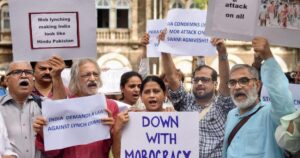
From the policing of dietary choices to mob attacks and lynchings, the politics of what people eat has repeatedly become a means of asserting religious supremacy and manufacturing hatred.
The process is seldom spontaneous.
Prejudices are cultivated, suspicions are sharpened, lies are repeated and violence is gradually made to appear legitimate.
What begins as an objection to a particular food can become part of a much larger assault on the pluralistic foundations of society.
It is in this context that we revisit Anand Haridas’ This is how you cook Beef, a striking poem previously featured in Guftagu. Beginning with the familiar domestic ritual of cooking meat in a pressure cooker, the poem develops into a chilling allegory of how communal hatred is prepared, seasoned and brought to a point where violence becomes acceptable. Each whistle marks another stage in this transformation, as memory, prejudice, propaganda, complicity and moral surrender converge. The imagery of trains carrying dead bodies, borders, domes, flags and marching mobs draws upon the violent history of the subcontinent, while exposing the mechanisms through which that history continues to haunt the present.

The poem’s most unsettling achievement is its transformation of a recipe into a metaphor for the systematic normalisation of brutality. The meat that finally emerges from the cooker bears no visible trace of the wounds from which it came. The spices have done their work, and the violence has been rendered palatable. Against the backdrop of the Fort Kochi controversy, This is how you cook Beef offers a powerful reflection on the manufacture of communal hatred and the silences that allow it to reach its final, deadly form.

This is How You Cook Beef
Five whistles. Six, at the most.
One more whistle,
And it will lose consistency.
You stand there, by the stove.
Waiting for the first whistle.
Wondering what could be
Happening inside the pressure cooker.
To start with,
You need to be sure that
The meat is cut from the softest region.
Rub salt to the cut pieces.
Nothing cleanses like pain.
Spices are added with precision.
There seems to be some unwritten measure
For every scoop added.

Chopped onion. Sautéed to the right shade of brown.
A slice of green chilli. Crushed ginger.
Unwritten rules of taste.
It takes a long, very long time for the first whistle.
One has to wait patiently.
Once the first whistle happens, rest follows.
But the wait for the first one is long,
And special too.
That’s when you get a whiff of things to come.
First Whistle
A train of thoughts
Filled with dead bodies,
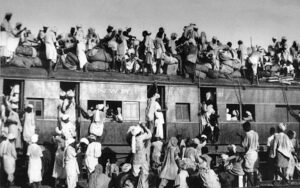
Some cut, some charred,
Always precedes the first whistle.
There is an unsettling silence before that.
In that silence, you try to forget
The fact that the train exists.
But it invariably comes.
From a long dark past
Stretching endlessly behind you,
It will come anyway.
Like that proverbial light in the tunnel
The whistle announces the train.
It comes from across the border of logic.
Driven by the desire for good taste.
Then, it starts.
Second Whistle
Once you have crossed the border
With the first whistle,
The distance to the second whistle is short.
You can measure it, brick by brick,
Spoon by spoon.
The dish is still half-cooked, yet
The smell is so tempting.
It will drive you up domes of fantasy
And put your flags up there.

You start getting visuals, smell and
Feel the touch of soft, cooked meat.
You refer back to cookbooks at this point.
Just to make sure, spices were added
In right measures.
From those pages, letters come out in hordes,
Marching along with chants,
With malice and hatred,
Determined to cook the raw cuts.
That’s when you realise
That the secret of a good recipe
Is in the unwritten measures of ingredients.
Third Whistle
There will be a reluctance in letting go
The third whistle.
A slight hesitance.
As if giving a second thought on
Whether you really wanted to cook this meat.
Is this the dish that you look forward to?
You cannot take it out now,
You cannot have it as it is now.
You are neither there, nor anywhere.
The third whistle will then sound like
‘Where were you, when the first one went off?’
‘What did you do when the second whistle was on?’
‘Why are you now thinking about this?’
‘Who are you?’
The third whistle is when the meat
Starts to get the heat.
From all sides.
Fourth Whistle
By now, the aroma of the meat
Is swirling around you.
You are drooling.
You lie to yourself
That this meal is good for you.
You list out the good qualities
Of this freshly cut meat
Cooked in the perfect manner.

You keep repeating the same lies
Again, and again.
You are desperate to taste it now.
You recall all the best moments
You have had before this.
And assure yourself that
This one is going to be special.
Better than anything that happened
Till now.
The pressure of repeated lies adds that
Extra flavour to the meat being cooked.
Fifth Whistle
You close your eyes.
You have almost lost count.
All you see now is the meat
Well-settled to its edible best
Bubbling within the cooker.
You can see those brown bulbs
Popping up on the top of gravy,
Almost musically,
And then vanishing.
The symphony of a spicy meal.
Half A Whistle More
Just when you are about to
Turn the stove off,
You hear half a whistle.
You stop.
It is not the sixth one.
Neither is it the fifth.

Something happened after that.
Or was it before that?
You wonder, did you really hear it?
But then,
It does not matter now.
The cut pieces have been cooked.
To the best of culinary standards.
They are no longer wounds that bled once.
Spices added in specific measures
Have done their magic.
Those pieces are meant to be eaten.
They await garnishing now.
You switch off the stove.







Food is a matter of personal choice, culture and dignity—not a weapon to impose majoritarian values or police people’s lives. In a democracy, diversity must be respected, not targeted. No one has the right to dictate another person’s food choices in the name of religion or politics. Freedom means respecting differences, not forcing conformity.
Anand Haridas poem is so poignant and in many ways utterly devastating in the way it capturers contemporary Indian reality through the metaphor of cooking – In solidarity with you , Sir
Striking and intense!
And the first whistle is the dog whistle, exposing the unassuming target to the hounds waiting round the corner…