

Elizabeth Mallet: The Woman Who Paved the Way for the Modern Daily Newspaper

Who were the women who dared to report, publish and speak when journalism itself was overwhelmingly a man’s world?
From the printing presses of eighteenth-century London to newsrooms and conflict zones across the modern world, women journalists have repeatedly entered spaces where they were not expected to belong. They reported wars, confronted power, challenged censorship, questioned social conventions and, often, had to fight simply to be recognised as journalists.
Their stories are not merely stories of journalism. They are stories of courage, persistence and the determination to make women’s voices heard.
Fearless Women Journalists is a new weekly series in The AIDEM, authored by K. A. Beena, the series brings these remarkable women back into focus—one story and one chapter in the history of journalism at a time.
The series begins with Elizabeth Mallet, the woman behind The Daily Courant, Britain’s first daily newspaper, who more than three centuries ago helped shape an idea that remains central to journalism: give readers the facts, and trust them to think for themselves.
Publishing simultaneously in English and Malayalam.
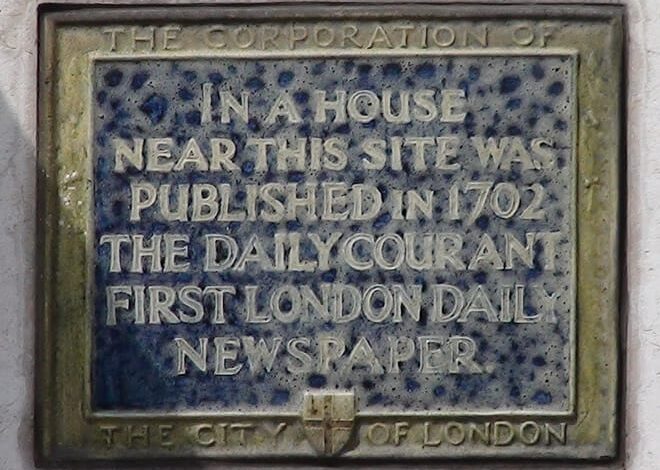
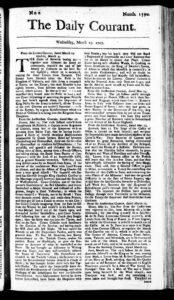
“On March 11, 1702, The Daily Courant, Britain’s first daily newspaper, was published in London by a woman named Elizabeth Mallet.”
At a time when journalism was entirely a man’s world, it is only natural to wonder how this was possible. The Daily Courant appeared with the fundamental characteristics of modern journalism: providing news every day, separating news from opinion, keeping the publisher’s own views and conjectures aside, and presenting only facts to readers.
“Shouldn’t people receive the news every morning?”
Historians have written that it was this thought that inspired Mallet to start the daily newspaper.
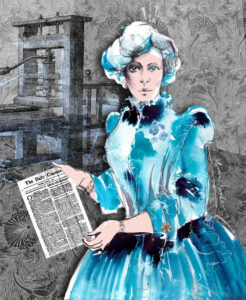
Elizabeth Mallet is a name that deserves to be written in golden letters in the history of journalism. At a time when women could scarcely dream of a life beyond the home or hope to establish themselves in public life, Mallet broke through those barriers and launched The Daily Courant, Britain’s first daily newspaper, opening the way for the development of modern journalism. She remains a source of inspiration and pride for women entering the profession.
The exact date of Mallet’s birth has not been clearly recorded. Elizabeth entered the world of publishing after marrying David Mallet, a printer and bookseller associated with St Martin Ludgate, in 1672. Together, they printed and published the “Last Dying Speeches” of people condemned to public execution at Tyburn in England. These speeches, which aroused both fear and curiosity, were immensely popular in London at the time.
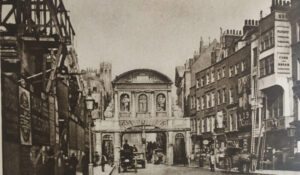
Elizabeth and David operated their printing press in Black Horse Alley, near Fleet Bridge. In later years, this area would become synonymous with the British newspaper world itself.
David Mallet died in 1683. Although the sudden death of her husband left her emotionally devastated, Elizabeth Mallet remained in publishing. She took over her husband’s printing press. She tried to train their son David to assist her, but the attempt did not succeed. By 1685, Elizabeth Mallet was running two presses and had established a place for herself in London’s publishing world. In 1701, by bringing out news publications such as The New State of Europe, Elizabeth became one of London’s notable publishers.
The Daily Courant began publication on March 11, 1702. The newspaper was issued from Mallet’s establishment next to the King’s Arms Tavern at Fleet Bridge. It consisted of a single sheet. News appeared on one side and advertisements on the other. Foreign news was given prominence. Mindful of government restrictions and censorship, Mallet did not include domestic English news in the newspaper.
But what distinguished The Daily Courant in the history of journalism was not merely the fact that it was published every day. In the very first issue, Mallet set out the editorial policy of her newspaper. She declared that she would not mix her own opinions and conjectures with the news, that she would present only facts, and that she trusted readers to have the intelligence to draw their own conclusions from them.
Looking back today, Elizabeth Mallet’s position assumes great significance. More than three hundred years ago, she made it the policy of her newspaper to uphold what would become a fundamental principle of modern journalism: that there should be a clear boundary between news and opinion.
Presenting facts without adding editorial comments or mixing them with opinion was a significant step for its time. The Daily Courant can be seen as one of the early models of fact-based journalism that drew a clear line between news and opinion.
In the social order of the time, it was not easy for women to establish a place of their own in printing and publishing. She published the newspaper under the name E. Mallet. It is believed that she did not publish the paper under her full name in order to conceal the fact that its publisher was a woman.
The approach Elizabeth Mallet adopted in The Daily Courant setting aside her own opinions and providing only facts later became one of the major principles of quality journalism. Giving importance to the credibility and truthfulness of news grew into a fundamental value of journalism.
Mallet also took care to gather news from foreign publications in different languages and publish it in her newspaper. Newspapers arriving from different parts of Europe were her principal sources of news.
Elizabeth Mallet’s efforts to publish daily news and practise factual reporting helped bring about changes in the journalistic practices of the period. The idea that news should reach readers every day also changed the relationship between news and time. It was a step towards a new news culture in which events that had happened the previous day could reach the reader the following morning.
As historians Charles Sommerville, Mark Turner and Joel Wiener have pointed out, the arrival of daily newspapers changed the way people perceived the world itself. The world appeared before readers as a place of events in constant motion. The relationship between news and the perception of time became stronger.
After a short period, Elizabeth Mallet transferred responsibility for her newspaper to Samuel Buckley. The Daily Courant, which Mallet had started, continued publication for more than three decades. Its final issue appeared on June 28, 1735.
Although Elizabeth Mallet had demonstrated her talent in publishing in the early years of the eighteenth century, her contributions did not receive the recognition they deserved during her lifetime. Even the exact date of her death has not been clearly recorded.
It was only much later that attempts were made to rediscover this remarkable figure from history.
On October 30, 1883, the Australian newspaper The Herald raised the question of how many people knew that a woman named Elizabeth Mallet had been behind Britain’s first daily newspaper.

On June 13, 1914, an article titled “Women and Journalism,” published in the Fitzroy City Press, described Mallet in these words:
“So it was the imagination of a woman who first conceived the idea that man would have news every morning with his breakfast.”
“In other words, the idea that men should have news every morning along with their breakfast was first born in the imagination of a woman.”
Though expressed humorously, these words underline Elizabeth Mallet’s importance in the history of journalism.
Einkommende Zeitungen, published from Leipzig, Germany, in 1650, is generally regarded as the world’s first daily newspaper. Half a century later, however, Elizabeth Mallet’s The Daily Courant went beyond being Britain’s first daily newspaper and laid the foundations for fundamental concepts of modern journalism: separating news from opinion, providing facts alone, respecting the reader’s ability to think, and delivering news every day.
Elizabeth Mallet’s significance, therefore, is not confined to being the woman who launched Britain’s first daily newspaper. More than three hundred years ago, she was also a journalist who took a clear position on what news should be and how it should be presented to the reader.
Elizabeth Mallet’s life stands as evidence that the intelligence and courage of women can change the world, and that the courage to publish the truth lies at the heart of journalism.










Elizabeth Mallet’s story is a powerful reminder that journalism has always needed courage, independence and respect for the reader’s intelligence. More than three centuries ago, she helped shape the idea that news should be separated from opinion and that readers deserve facts, not manipulation. Her forgotten contribution is not just a chapter in newspaper history—it is a lasting lesson for journalism today. A remarkable tribute to a fearless woman who helped change the way the world receives news.