

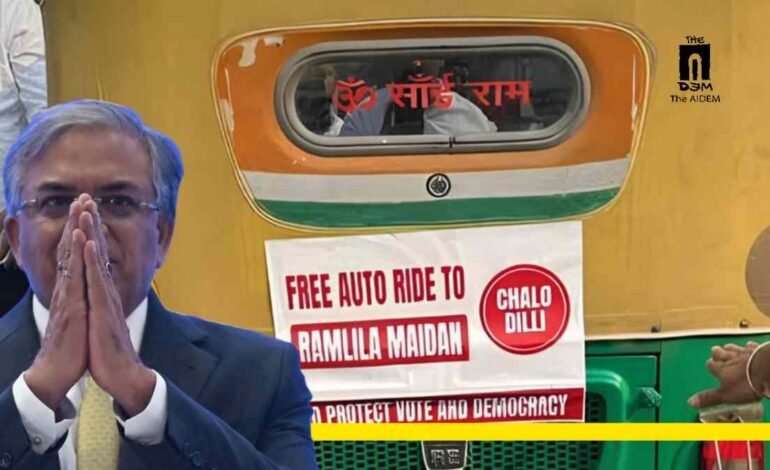
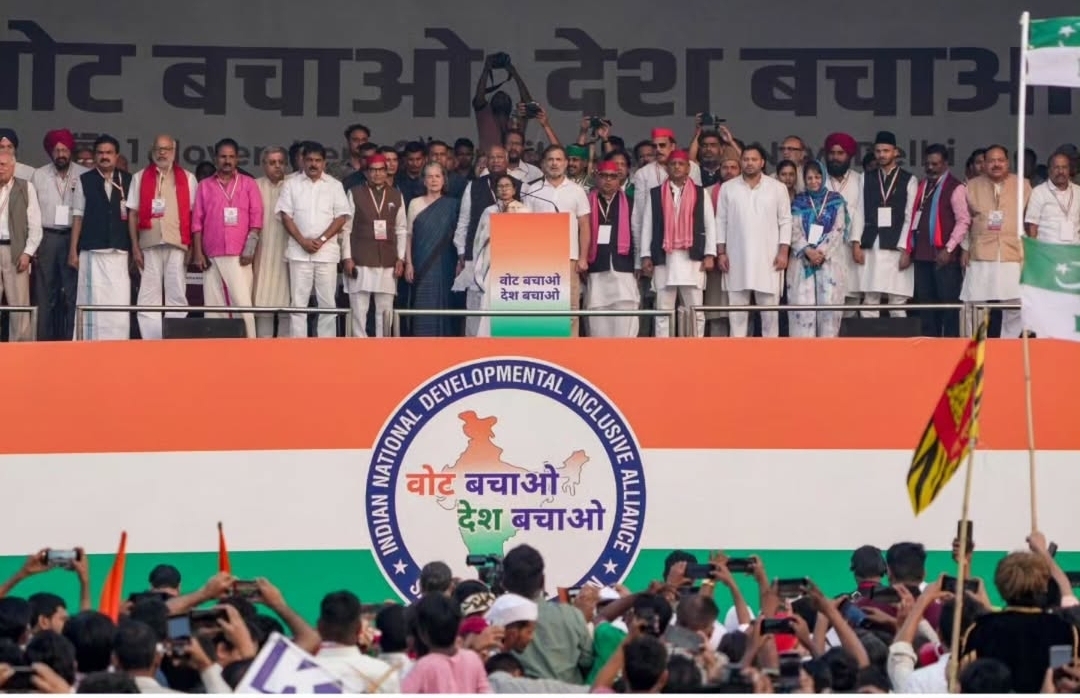
Different interpretations and assessments have emerged on public platforms regarding the scale of participation in the INDIA bloc’s November 1 rally at Delhi’s Ramlila Maidan and its larger implications for the country’s political situation. However, for me, as a political journalist who has covered national politics from Delhi since 1985, the most significant takeaway from the mobilisation was a relatively small development that I witnessed personally and that was also reported by a handful of smaller media outlets, including the news portal Maktoob. It involved a group of autorickshaw drivers who offered free rides to people travelling to Ramlila Maidan to participate in the protest against the Special Intensive Revision (SIR) of electoral rolls I and Chief Election Commissioner Gyanesh Kumar. The gesture, seemingly modest in itself, had unmistakable political and social dimensions.
Some of the autorickshaws displayed posters announcing free rides to Ramlila Maidan, carrying the message, “To Protect Vote and Democracy”. The number of drivers who participated in the initiative was not large, with informal estimates putting it at around 10 to 20. Even so, the gesture has a political significance that extends beyond the immediate event. I see it as a “straw in the political wind,” reminding me of a similar expression of democratic consciousness that I had written about in Frontline in 2015. That account was based on a real-life incident recounted by the late political analyst Hariraj Singh Tyagi, who had passed away in 2010.
A Recollection from 1977
Tyagi, a long-time associate of the socialist leader Ram Manohar Lohia, used to recount this personal experience from January 1977 as an illustration of what he described as the democratic principle inherent in the Indian population. The incident took place on January 18, 1977, the day Prime Minister Indira Gandhi announced general elections after relaxing certain restrictions imposed during the Emergency.
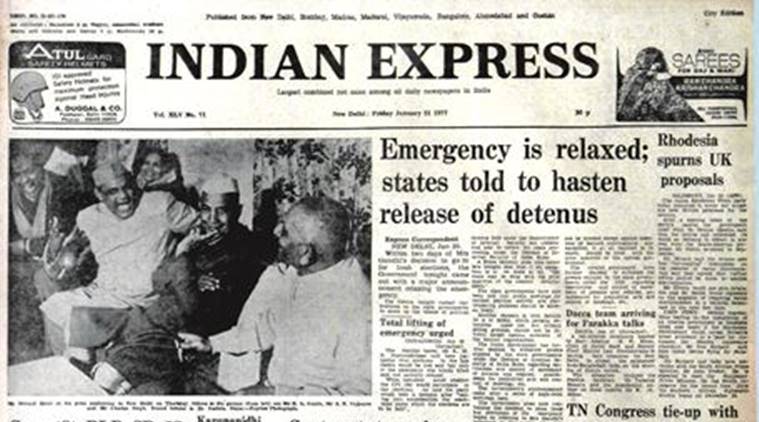
Tyagi was in Meerut when the Socialist Party leadership summoned him for consultations. He hired a cycle rickshaw to reach the railway station and, during the journey, casually asked the rickshaw puller whether he had heard the day’s news. The response was immediate: “Chunav ghoshna ke baare mein radio mein suna. Ab maa-bete ko kuch ganatantra sikhayenge.” (I heard about the announcement of elections on the radio. Now we will teach the mother and son a lesson in democracy.)
The mother and son referred to were Indira Gandhi and Sanjay Gandhi, who was widely held responsible for several of the excesses committed during the Emergency. Tyagi maintained that the response of the rickshaw puller, who probably had little formal education, was an indication of the popular mood that would eventually produce the historic verdict against Indira Gandhi and the Congress in the March 1977 general election.
More importantly, Tyagi saw in the remark an expression of the democratic consciousness of ordinary Indians. His argument was that this consciousness was not necessarily dependent on formal political education or organisational affiliation. It could manifest itself in the responses of people who were otherwise not visibly involved in political activity.
I had referred to this account in a 2015 Frontline article precisely because of the larger political principle Tyagi sought to underline. The 1977 election result was, of course, shaped by several factors, including the suspension of civil liberties, the arrest of Opposition leaders, press censorship and the coercive measures associated with the Emergency. But the rickshaw puller’s response suggested that the implications of these developments had been understood well beyond the circles of organised political activity.
The November 1 Gesture
It is in this context that the autorickshaw drivers’ initiative during the November 1 rally assumes significance. There are obvious differences between the political situation in 1977 and the circumstances prevailing today. The Emergency involved the formal suspension of several constitutional freedoms. At present, although no Emergency has been formally declared, people are witnessing a steady erosion of the functioning of democratic institutions, including the Election Commission. This is reflected, among other things, in the implications of the Special Intensive Revision (SIR) exercise and the large-scale denial of voting rights to crores of citizens. But, at its core there is a common thread in the two incidents: the response of ordinary working people to what they perceive as a threat to democratic rights.
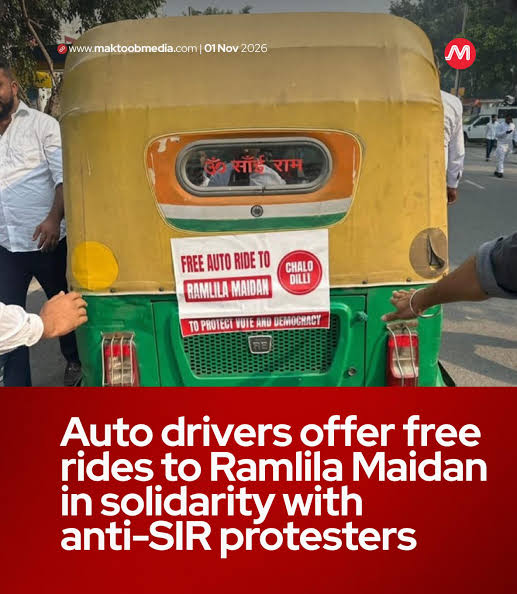
The Meerut rickshaw puller viewed the announcement of elections as an opportunity to hold the government accountable. The autorickshaw drivers in Delhi expressed their support for a mobilisation organised around the protection of voting rights. The gesture of offering free rides also involved a material consideration. Autorickshaw drivers depend on their daily earnings, and providing free transport entails a loss of income, however limited. Their willingness to make such a contribution indicates a degree of identification with the issue around which the rally was organised.
The Larger Political Context
The November 1 rally was part of the Opposition’s effort to mobilise public opinion around concerns over the SIR, the deletion of crores of voters from the electoral rolls, and the inexplicable and indefensible functioning of the Election Commission of India (ECI) in general and the CEC Gyanesh Kumar in particular. But participation in the rally was not confined to organised political groups of the Opposition. Common people from various walks of life were also seen joining the rally enthusiastically.
However, the rally was not without its organisational deficiencies and political limitations. The absence of the Aam Aadmi Party (AAP), which has a substantial political presence in Delhi and has been an important constituent of the broader Opposition mobilisation against the BJP, was particularly conspicuous. Equally significant was the absence of Cockroach Janata Party. CJP), which has been actively involved in campaigns concerning electoral rights and democratic accountability.
These absences raised questions about the extent of coordination among political parties, civil society organisations and people’s movements on an issue that demands the broadest possible democratic mobilisation. They also reflected the continuing difficulties faced by the Opposition in translating agreement on major political questions into sustained organisational unity and collective action.
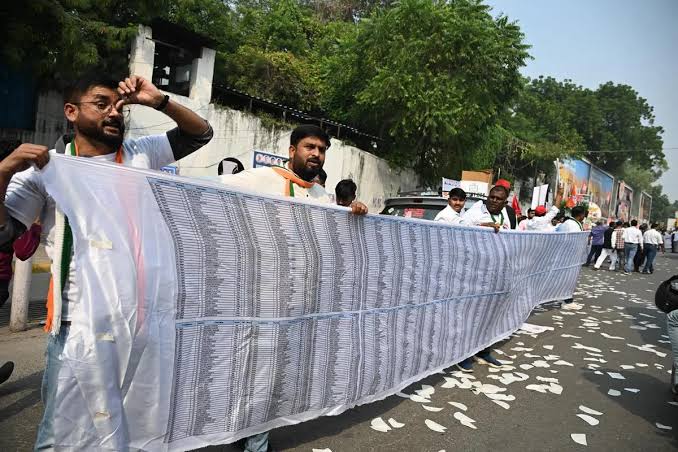
Yet, the spontaneous response from ordinary people, including the autorickshaw drivers who volunteered to ferry participants to the rally without charging fares, suggests that these organisational deficiencies are not necessarily determining how the larger public views the mobilisation. The participation of people who were not visibly associated with political parties or organised activist groups indicates that concerns over electoral rights have begun to acquire a resonance beyond the organisational structures of the Opposition.
The autorickshaw drivers’ initiative needs to be viewed against this background. It underscores the fact that the issue of electoral rights is finding resonance among sections of the population whose participation in political activity is not always reflected in conventional assessments of party strength or organisational mobilisation.
This is where Tyagi’s interpretation of the 1977 incident becomes relevant. His emphasis was not merely on the rickshaw puller’s opposition to Indira Gandhi. It was on the political understanding reflected in the man’s response. The announcement of elections had been interpreted as an opportunity for the people to exercise their democratic authority over those in power.
The concern expressed by the autorickshaw drivers in Delhi is related to an earlier stage of the same democratic process: the protection of the right to participate in elections itself. The slogan displayed on the autorickshaw, linking the protection of the vote with the protection of democracy, makes this connection explicit.
Reading the Political Signals
What impact do such expressions of public sentiment have on possible electoral consequences? In 1977, the rickshaw puller’s observation was subsequently borne out by the election results. But that does not mean every comparable expression of political concern will necessarily lead to a similar outcome.
The political conditions of 2026 are different in several respects. The organisational strength of the ruling BJP, the composition and effectiveness of the Opposition, regional variations in political attitudes and the functioning of electoral institutions will all influence the course of developments. A single incident, however suggestive, cannot provide a comprehensive assessment of the national political situation.
Nevertheless, political analysis cannot be restricted to electoral arithmetic, party organisation and the pronouncements of political leaders. It must also take into account developments that indicate how political questions are being understood and interpreted by ordinary citizens.
In this respect, the November 1 initiative signals a significant churning among the people. The response of the autorickshaw drivers is a clear indication that concerns over electoral democracy are not confined to political parties and activist organisations.
The Democratic Principle
Tyagi’s formulation about the democratic principle inherent in Indian consciousness was based on his understanding of the country’s political history and his experiences within the socialist movement. What Tyagi sought to emphasise was the capacity of ordinary people to recognise the importance of democratic rights and assert them when political circumstances demanded such a response. The rickshaw puller’s remark in January 1977 was, for him, a particularly striking illustration of this capacity. Nearly five decades separate the two incidents. The political circumstances, the issues involved and the forms of participation are different. Yet, the underlying democratic concern is comparable. The democratic spirit that Tyagi spoke about in 1977 is showing signs of reasserting itself, and the November 1 gesture offers one concrete instance of that development.

The real strength of democracy lies not merely in political parties or powerful leaders, but in the political consciousness of ordinary people. From the rickshaw puller of 1977 to the autorickshaw drivers of 2026, the message remains clear: democracy belongs to the people, and no authority can take away their right to protect it. When ordinary working people are willing to sacrifice their daily earnings to defend voting rights, it signals something far deeper than a political protest. It reflects a democratic awakening that those in power cannot afford to ignore. The people’s voice may be ignored, but it can never be silenced.
What a perceptive analysis- only someone with the kind of experience VRK has can write – kudos sir