

Protecting RTI from Those Who Turn Transparency into Harassment

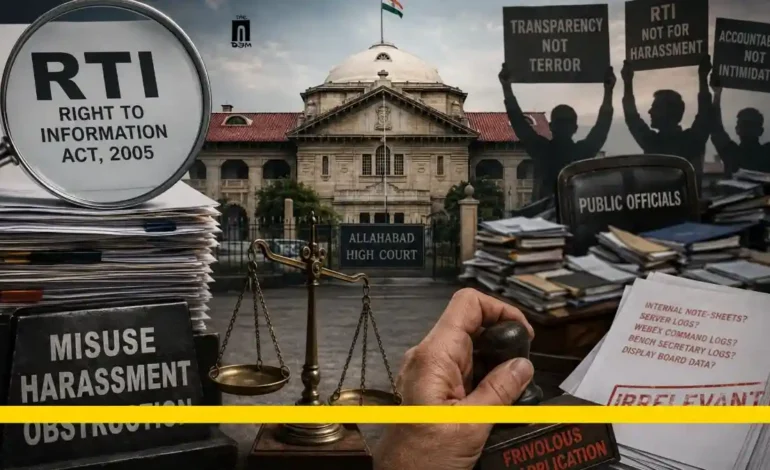
The Allahabad High Court’s judgement of 5 August 2026 in Vemula Venkata Vinay Babu Alias Vinay Vemula v. State of U.P. and 3 Others (Writ-C No. 547 of 2024) is both timely and significant. Delivered by Justice Saurabh Shyam Shamshery, the order imposed cumulative costs of Rs. 6,70,000 on a party-in-person who, during the course of a single writ petition, used the Right to Information Act, 2005 in ways the Court found obstructive to the functioning of the Registry and the Court itself.
The judgement should not be read as an indictment of the RTI Act. On the contrary, it reinforces the purpose of one of India’s most important transparency laws. An Act designed to empower ordinary citizens cannot be allowed to become an instrument for harassing institutions, delaying adjudication or overwhelming public officials with demands unrelated to transparency and accountability.
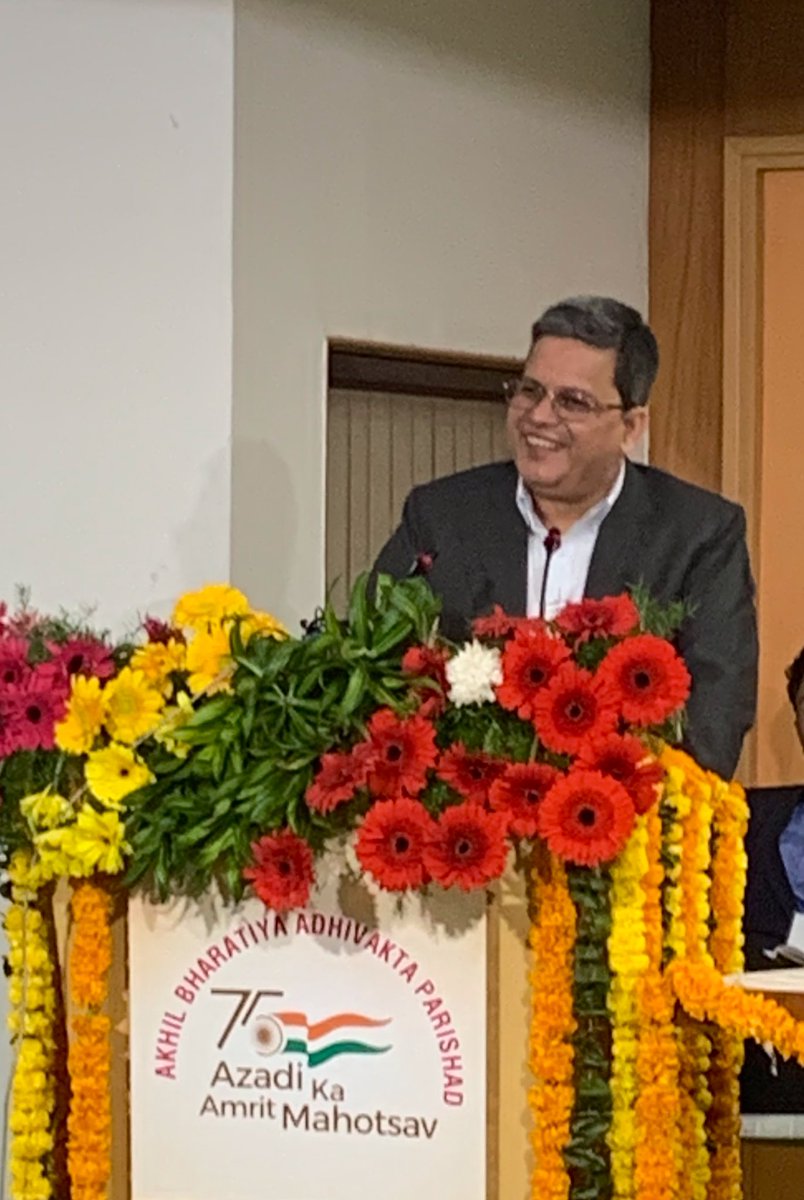
The facts of the case are revealing. The petitioner, appearing in person from Hyderabad, had initially engaged a lawyer, later sought to discharge him and subsequently insisted on an “absolute right” to appear only through Video Conferencing (VC).
By an order dated 24 July 2026, the Court directed him to appear in person at the next hearing. It specifically recorded that his RTI applications concerning the Court’s own internal proceedings “would cause hindrance in the administration of justice” and directed that no further such applications be filed until the writ petition was decided.
The petitioner nevertheless appeared through VC on 5 August 2026. The Court described this as “a case of violation of this Court’s order”.
More striking was the pattern revealed by the Registry’s report. Between 4 June and 17 July 2026 alone, the petitioner had filed 24 RTI applications seeking, among other things, internal office note-sheets of the Chief Justice’s Secretariat, server backend logs of the electronic display board, Bench Secretary log entries, Cisco Webex session command logs and reasons why particular matters had been marked “Passed Over”.
None of these requests, the Court found, had any connection with the petitioner’s own case.
Convenience Is Not A Fundamental Right
One of the judgement’s most important propositions concerns virtual hearings. The Court rejected the suggestion that appearing through Video Conferencing constitutes a fundamental right.
VC, it held, “is only to facilitate a litigant or an Advocate to expedite the adjudication” and “cannot be claimed a matter of right”. It is a facility that remains within “the Court’s discretion”.
The Court also considered the petitioner’s “Formal Written Declaration of Protest”, in which he asserted VC as a fundamental right. The document was found to be unverified, while its heading was described as “vague” and “contemptuous”. The Court reiterated that virtual appearance was “not a fundamental right but… a convenience based on Court’s discretion.”
The distinction matters.
The normalisation of virtual hearings during the pandemic appears to have produced a degree of confusion within the legal system. A facility that became indispensable during 2020-21 has sometimes been treated as though it subsequently acquired the status of a constitutional entitlement. It has not.
The writ petition filed before the Supreme Court by All India Association of Jurists v. High Court of Uttarakhand & Others, seeking a declaration that access to virtual courts is a facet of fundamental rights under Article 32, remains a pending matter. The question has not been settled in favour of such a fundamental right.
The Allahabad High Court’s order therefore reiterates the basic position: when a Court directs physical appearance, the direction has to be complied with “without any unreasonable excuse”. The Court also noted that the petitioner had travelled to Prayagraj “on about 4-5 times” earlier, making the sudden assertion of logistical impossibility difficult to sustain.
When Transparency Becomes Harassment
The more significant part of the judgment, however, concerns the RTI applications.
The Court observed that the petitioner-in-person was “habitual of making unnecessary allegations” and held that such information requests should not be entertained where they “not only waste the time of employees of Court but have also caused hindrance in administration of justice”.
For the 24 applications filed within barely six weeks, the Court imposed costs of Rs. 5,000 each, amounting to Rs. 1,20,000. It also directed that the applications be “consigned to record”, effectively preventing their further prosecution during the pendency of the writ petition.
Two additional costs followed.
A sum of Rs. 50,000 was imposed in connection with a separate contempt application, Misc. Application No. 7/25, which the Court found to be “misconceived” and “based on incorrect statement and contrary to record”. A counter affidavit on behalf of the principal contesting respondent had, in fact, already been filed and served before the application was moved.
After dismissing the writ petition, the Court imposed a further Rs. 5,00,000, expressly “to discourage the persons such as petitioner-in-person, not to disturb the Court’s proceedings and administration of justice”.
The cumulative cost of Rs. 6,70,000, payable to the High Court Legal Services Committee within four weeks, sends an unmistakable message. Transparency cannot become a cover for institutional harassment. The RTI Act cannot be turned into a cost-free mechanism for disrupting the functioning of courts and public institutions.
A Wider Judicial Concern
The Allahabad order does not stand alone. It forms part of a broader body of judicial thinking that recognises both the immense value of the RTI Act and its vulnerability to misuse.
In CBSE v. Aditya Bandopadhyay (2011) 8 SCC 497, the Supreme Court, while affirming a student’s right to inspect evaluated answer scripts, cautioned against indiscriminate and impractical RTI demands unrelated to transparency and accountability in public functioning.
In ICAI v. Shaunak H. Satya (2011) 8 SCC 781, the Supreme Court similarly drew a line between legitimate demands for transparency and requests that could seriously compromise institutional processes.
The question of costs as a deterrent is also well established. In Dnyandeo Sabaji Naik v. Pradnya Prakash Khadekar (2017) 5 SCC 496, the Supreme Court described frivolous and groundless litigation as a serious threat to the administration of justice and called for an institutional approach to penalising such conduct. Liberal access to justice, the Court made clear, does not mean access to chaos and indiscipline.
The Bombay High Court relied on this precedent as recently as October 2025 in Auto Credit Corporation v. Mahesh Mithalal Trivedi, imposing costs of Rs. 25 lakh and reiterating that exemplary costs are an important instrument for deterring frivolous litigation.
The concern is not limited to ordinary litigation. It also extends to allegations of the RTI mechanism being used for illegitimate gain.

In late 2019, a Supreme Court Bench headed by then Chief Justice S.A. Bobde remarked during proceedings concerning the non-appointment of Information Commissioners that there had been instances of blackmail and extortion in the working of the RTI Act. The observation was made during oral exchanges rather than in a reasoned judgement and was rightly criticised by transparency advocates for being too sweeping. Yet subsequent cases have demonstrated that misuse of the RTI mechanism is a concern that cannot simply be dismissed.
There have also been several reported cases in which RTI applications allegedly became a means of extortion. In Pune in 2022, police booked a self-proclaimed RTI activist after a former BJP corporator’s husband alleged that he was being asked for Rs. 25 lakh to withdraw RTI applications concerning alleged illegal construction. The case was registered under provisions relating to extortion. In another Pune case, the Bombay High Court in 2020 rejected anticipatory bail for an RTI activist accused, along with an alleged accomplice, of attempting to extort money from a builder. The Court was told that the activist had helped draft a false rape complaint as part of the alleged pressure campaign.
A particularly stark case was reported from Mumbai in December 2022, when the Crime Branch arrested a self-proclaimed RTI activist accused of attempting to extort Rs. 1 crore from a developer. Police alleged that false complaints had been filed to obstruct the developer’s construction work and that the demand for money was made to stop further harassment. (India Today) In Thane in 2023, an RTI activist and two journalists were arrested after a sub-registrar alleged that they had threatened him with complaints of corruption and demanded money to desist from pursuing the allegations. Police said the three were caught accepting Rs. 50,000 and Rs. 1 lakh respectively. (Hindustan Times) These are allegations and arrests, not convictions, and that distinction is essential. Yet the recurring pattern reported in such cases cannot be ignored: information obtained through a transparency law can, in the hands of a few, become leverage for private bargaining rather than a means of public accountability.
In Indian Institute of Foreign Trade v. Kamal Jit Chibber (Delhi High Court, 26 April 2024), the Court dealt with an applicant who had filed more than 20 RTI applications containing between 27 and 50 questions each. In Radha Raman Tiwari v. Anandi Ramlingam (30 July 2024), the adjudicating authority likewise found indications of misuse of the RTI Act, drawing upon the reasoning in ICAI v. Shaunak H. Satya.
Taken together, these decisions point towards a consistent judicial approach. The courts remain protective of the citizen’s right to information while recognising that a small section of applicants may use the Act for personal vendetta, litigative delay or even illegitimate gain.
The answer, however, is not to weaken the RTI Act.
It is to ensure that the cost of abusing it is proportionate to the damage caused — to the public exchequer, to overburdened information officers and, in this case, to the functioning of the Court itself.
The 48-Hour Question
There is another dimension that makes the issue particularly important.
The present judgement does not concern the proviso to Section 7(1) of the RTI Act. Yet that provision provides an important lens through which to understand why responsible use of the Act matters.
The proviso creates a narrow and urgent category for information concerning the life or liberty of a person and requires a response within 48 hours rather than the ordinary 30 days.
This is the RTI Act at its most humane: a mechanism intended for situations in which a person’s safety, or the safety of a family member, may genuinely depend on obtaining information from the State without delay.
Its credibility depends on institutions having the capacity to respond to such urgent requests.
Every frivolous demand for server logs, attendance registers, Webex histories or courtroom display-board records consumes institutional time and attention. When such demands are multiplied, the same administrative bandwidth that should be available to respond to a genuine life-and-liberty request within 48 hours is diverted elsewhere.
The petitioner in the Allahabad case did not invoke the Section 7(1) proviso. The larger structural point nevertheless remains: an Act that provides a 48-hour lifeline in matters involving life and liberty is diminished, rather than honoured, when the same public authority is overwhelmed by a barrage of unrelated information requests.
Protecting The Act By Preventing Its Misuse
The Allahabad High Court’s order is ultimately less about closing doors than about keeping them meaningful.
It does not suggest that RTI applicants should be viewed with suspicion. Nor does it dilute the citizen’s right to demand accountability from public institutions. What it does is draw a line between the legitimate exercise of a democratic right and the use of that right as an instrument of harassment, delay or obstruction.
Read alongside Aditya Bandopadhyay, Shaunak H. Satya and Dnyandeo Sabaji Naik, the judgement reinforces an important judicial principle: the genuine RTI applicant deserves strong protection, but the machinery of transparency cannot be allowed to become a weapon against the institutions it is meant to make accountable.
The RTI Act derives its strength from the trust placed in citizens to use information as a means of advancing transparency and democratic accountability. Protecting that trust requires not only defending the right to information, but also resisting attempts to turn the right into a tool of intimidation.
RTI is a tool for truth. Its credibility depends on ensuring that it is never allowed to become a tool for terror.









RTI is not a privilege handed down by the government—it is a citizen’s democratic right to question power. The real threat to transparency begins when those in power start treating questions as harassment and accountability as an inconvenience. As Advocate Syed Mohammad Haider Rizvi rightly highlights, misuse of RTI must be addressed without weakening the law itself. Democracy does not become stronger by silencing questions; it becomes stronger when power is forced to answer them. Transparency should expose the misuse of power—not become another casualty of it.