

Remigration and Europe’s Resurgent Far-Right Zeitgeist

Once confined to Europe’s far-right fringes, “remigration” is moving steadily into mainstream political discourse. As old political firewalls weaken and exclusionary ideas acquire new legitimacy, Kevin Jacob traces the rise of a term that could reshape Europe’s debates over migration, citizenship and belonging.
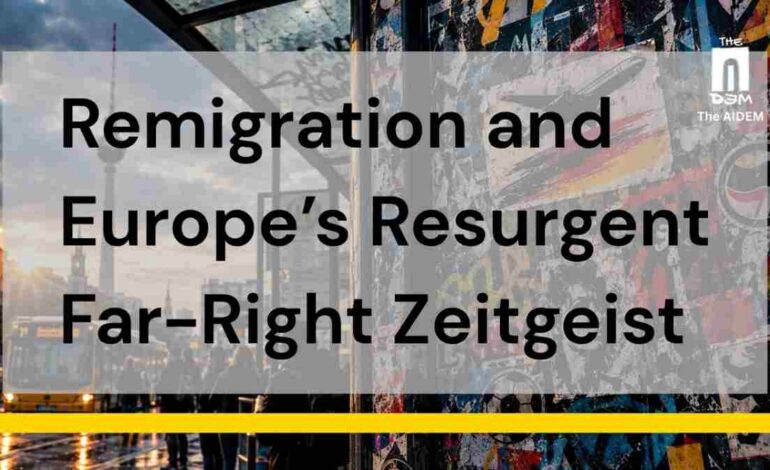
Berlin bus stops are inevitably chaotic collages of graffiti, football stickers, and political slogans. One sticker in particular, perched high above the rest, caught my eye: a graphic of a passenger plane labelled Remigration Jetzt!(Remigration Now!).
To anyone following German politics, seeing key slogans from the far-right Alternative für Deutschland (AfD) is no longer surprising. Following their record second-place finish in the 2025 federal elections, the firewall—a tacit agreement by mainstream parties to isolate the AfD—is showing deep cracks. At the centre of this surge is a single, euphemistic concept: Remigration.

The concept rests on The Great Replacement, a conspiracy theory coined by French author Renaud Camus. Camus posited that “replacist elites” are intentionally replacing white European populations with non-white Muslim migrants through mass migration, demographic growth, and a drop in European birth rates. He termed it a “genocide by substitution.”
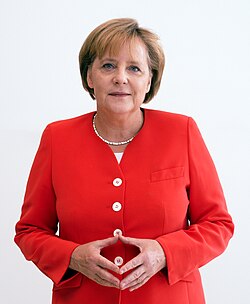
Far-right parties across Europe were quick to pick up this theory in the context of the migrant crisis of the 2010s. Nowhere has this appropriation been more visible than in Germany. The AfD was founded in 2013 mainly to oppose the euro currency and bailouts in the wider eurozone. In 2015, as Germany received large numbers of refugees, particularly from Syria and Afghanistan, Chancellor Angela Merkel’s famous declaration, Wir schaffen das (‘We can do this’), became a defining catalyst for the AfD’s transformation.
While Camus provided the overarching cultural diagnosis, Austrian far-right activist Martin Sellner supplied the operational proposal. In his 2024 manifesto Remigration: A Proposal, Sellner mapped out a strategy targeting three distinct segments of society for deportation. The first category focuses on asylum seekers and refugees, including those currently protected under international legal frameworks such as the Geneva Convention. His plan then expands to encompass legal foreign residents living on work visas or temporary stay permits. Most controversially, however, Sellner advocates for targeting “non-assimilated” naturalised citizens. These are German passport holders of foreign origin deemed culturally unintegrated, a category that legal experts note fundamentally undermines basic constitutional guarantees.
Officially, AfD party leadership, including co-chair Alice Weidel, distances itself from mass deportations of citizens to avoid legal bans under Germany’s constitutional protection laws. The party’s public platform, outlined in documents like their “7 Points on Remigration,” focuses on deporting rejected asylum seekers and individuals convicted of crimes. Yet the distinction becomes considerably less clear when one examines the positions articulated by figures associated with the party. Large protests took place on the streets following investigative reports revealing secret meetings between AfD figures and extremists like Sellner.
Germany’s mainstream parties have long maintained the Brandmauer, ruling out governing coalitions with the AfD. But that firewall faces an unprecedented test following the September 2026 state elections in Saxony-Anhalt, where the AfD secured a historic victory with nearly 44 percent of the vote. How this rural, sparsely populated, ageing population voted has confirmed shifting political winds across East Germany.
Studies of the former East German states point to lower incomes and relative deprivation, distrust of state institutions, susceptibility to political conspiracy narratives, reliance on alternative political media, and stronger populist and nativist attitudes as important correlates of AfD support.
The numbers tell a compelling story. This shift is most pronounced among young voters aged 18 to 24, where support for the party tripled from just 7 percent in 2021 to 21 percent in 2025. A broader gender gap spans the party’s overall electorate as well. In 2021, the party held a modest four-point gap between male (12 percent) and female (8 percent) voters. By 2025, that divide widened to seven percentage points as support among men jumped to 24 percent compared to 17 percent among women, a gender disparity significantly larger than that of any other major German party. A similar upward trend occurred across working-class demographics; support among blue-collar workers surged by 17 percentage points to reach 38 percent, while backing among unemployed citizens experienced an identical 17-point jump, rising to 34 percent. By contrast, growth among white-collar workers, civil servants, and pensioners remained comparatively modest, inching up by only 5 to 10 percentage points.

The phenomenon is not unique to Germany. The rhetoric of remigration can now be heard in Austria, France, Sweden and Italy, as well as across the Atlantic. Donald Trump first used the word Remigration in the run-up to the 2024 US Presidential election. Since then, he has endorsed the idea and it has gained traction eventually culminating in the controversial Department of Homeland Security tweet Remigration Now on its official X account.
Europe has survived many political tremors throughout its history. But as the idea of remigration transitions from street-art slogans into parliamentary debates and international strategy sessions, a familiar question re-emerges: Is this merely another passing political tremor, or is remigration the new spectre haunting Europe?










When “remigration” moves from the far-right fringe into mainstream political discourse, it is no longer just a slogan—it becomes a serious warning about how exclusion can be normalised through politics and language. Europe’s history shows where dehumanising ideas can lead when citizenship, belonging and identity are turned into tools of division. This is a crucial conversation about protecting democratic values, pluralism and the dignity of every citizen, regardless of their origin.