


A household income still classified as “middle class” is buckling under rent, school fees and groceries in India’s NCR suburbs. Two salaried families earning close to ₹5 lakh a year describe a life with no savings, no job security, and no room for anything to go wrong.
Radhey Shyam Tiwari totals his monthly expenses on the back of an old diary. He knows the number before he writes it. Nothing is left to save. He does it anyway, a small, stubborn ritual, as if the sum might one day change.
It never does.

Tiwari, a polytechnic graduate, works as a supervisor in a manufacturing unit in the industrial belt straddling Noida and Ghaziabad. His annual income is close to ₹5 lakh, a figure that still counts as respectable middle-class income in most government and market surveys. In these two cities, it is barely enough to stand still.
“People think if you cross ₹5 lakh a year, you have arrived,” Tiwari says. “Nobody tells you that arriving and surviving are two different things.”
The Arithmetic Nobody Escapes
Sit with Tiwari’s monthly ledger, or with that of Anita Singh, a homemaker whose husband, a senior accountant with an M.Com degree, earns a similar amount at a manufacturing firm in the same industrial belt. The crisis stops being an abstraction. It becomes a spreadsheet with no room to breathe.
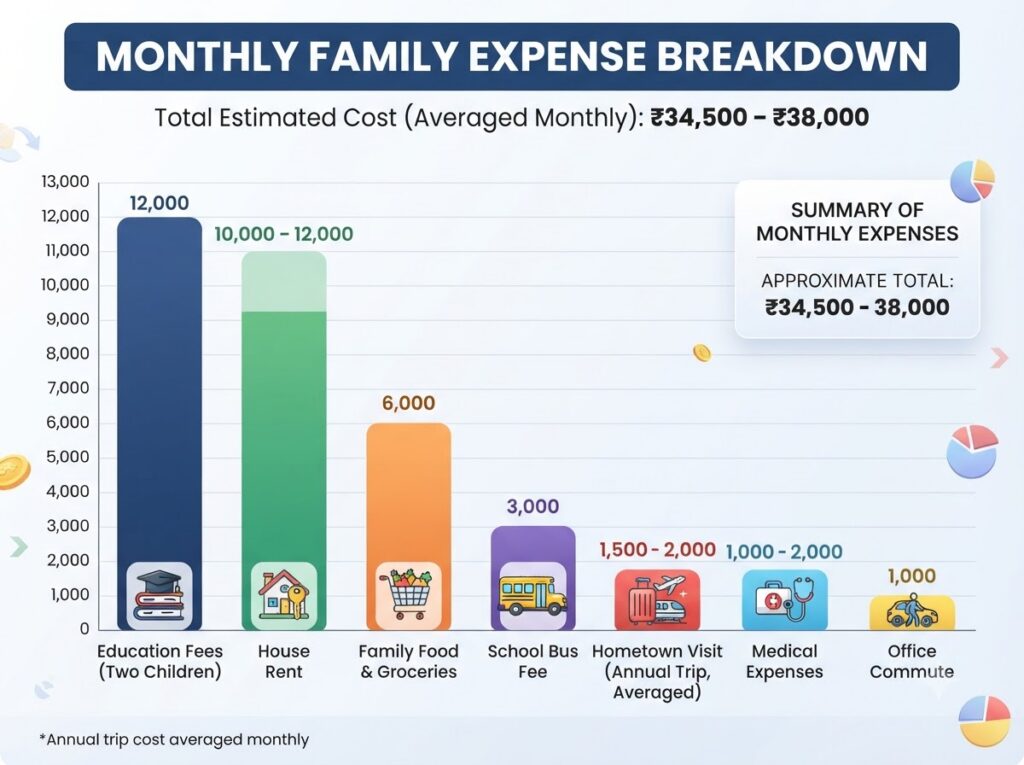
Expense Head, Monthly Cost (₹)
Education fee, two children, 12,000
House Rent, 10,000 – 12,000
School Bus Fee, 3,000
Family Food and Groceries, 6,000
Medical Expenses, 1,000 – 2,000
Office Commute, 1,000
Hometown Visit (annual trip, averaged monthly)*, 1,500 – 2000
Approximate Total, ₹34,500 – 38,000
“Once a year, return train tickets for the family to their hometown cost around ₹8,000.
Against a household income of roughly ₹5 lakh a year, barely ₹35,000 to ₹40,000 a month, this leaves families like Tiwari’s and Singh’s with little to nothing once the essentials are paid for. By both accounts, nearly 35 to 40 per cent of their income goes to education alone—tuition fees and the school bus combined. It is the single largest expense after rent, exceeding even food for a family of four.
“We are not poor,” Anita Singh says carefully, choosing the word the way someone chooses a word they have been forced to think about often. “But we are not what people call middle class either. We are somewhere in between, and that in-between has no support. No one designs a policy for us. No one gives us a break.”
“We Are In A Trap”
Asked whether this squeeze—the gap between a ₹5 lakh salary and the real cost of raising a family in Noida or Ghaziabad—could ever become an electoral issue, the answer comes back flat, almost rehearsed through repetition, because it is lived every day rather than debated occasionally.
“We are in a trap,” is how it is put. “Every day is a fight for survival. It’s a private job; there is no job security. No savings. We are living on hope—hope that our kids will do well and our life will change because of them.”
There is no pension to fall back on, no fixed tenure, and no union to negotiate for them. A private-sector job in this income bracket offers a salary slip and little else: no cushion if the company downsizes, no cushion if health fails, and no cushion if the economy turns. The family’s entire plan rests on the next generation doing better than this one, financed by a budget with nothing to spare.
Coaching That Helps, Schools That Have Failed
Nowhere is that gamble more visible, or more strained, than in how these families manage their children’s education outside the classroom.
Online coaching, Singh says, has eased the burden slightly. It costs less than a physical tuition centre and fits around a stretched household schedule. “It is not as effective as sitting with a real teacher,” she says. “But it is better than nothing.”
It has had to become “better than nothing” because, in her account, the government school system has failed the children who depend on it almost entirely.
“There are no classes,” she says. “Teachers are sent on other duties—election duty, survey duty, whatever the government needs that week—and the classroom is left as it is. The number of students in one class is very high. One teacher cannot manage fifty or sixty children alone, even if she wants to.”
For a family that cannot afford private school fees for both children, this failure of the public system does not remain an abstraction. It becomes another cost, quietly shifted onto a ₹35,000-a-month household through private coaching, however imperfect.
A Birthday, Planned Like A Project
The strain shows most clearly in the smallest expenses—not the school fees or the rent, which are fixed and expected, but the things a parent wants to give without having to think.
“Even to buy new clothes for the children on their birthday, we have to plan, we have to think, and then…” Singh stops mid-sentence. She does not finish it in words. Her eyes fill with tears.
It is not a dramatic story of deprivation. It is smaller than that, and harder to sit with for exactly that reason: a mother forced to turn a child’s birthday outfit into a line item, calculated and postponed and negotiated in a household where the paycheque has already been spent three times over before it arrives.
Fights With No Villain
Singh is clear that this is not a story about a husband who drinks away the family’s money, gambles, or spends carelessly. It is the opposite.
“There are fights and arguments in the family,” she says. “Because we cannot fulfil the children’s demands, or the family’s demands—clothes, a holiday, eating out once in a while. These are not big demands. But despite this, my husband is a teetotaller: no alcohol, no gutka, no bad habits at all.”
The implication is plain. There is no vice to blame, no personal failing to point to. The fights come from arithmetic, not character. A man who does everything right by the household’s own standards—sober, steady and present—still cannot make a ₹5 lakh annual salary stretch across rent, school fees, food and a child’s ordinary wants in a city like Noida or Ghaziabad.
A Crisis With No Name
Economists have long debated where India’s “middle class” begins and ends, and by most formal definitions, a household earning around ₹5 lakh a year sits comfortably within it. Tiwari and Singh’s accounts suggest the label no longer matches the lived experience behind it. Rising urban rents, school fees climbing faster than salaries, a public education system that has visibly receded from its own classrooms, and the near-total absence of a safety net for private-sector employees have combined to squeeze a demographic that once defined stability in Indian cities.
There is no single villain here. No one rent hike, no one fee increase, no one bad habit. It is the cumulative impact of ordinary costs colliding with wages and job conditions that have failed to keep pace, in a system that offers this bracket of earners neither the subsidies available to the poor nor the security enjoyed by the wealthy.
“We are told we are the backbone of the economy,” Tiwari says, closing his diary. “But nobody asks what it costs the backbone to hold everything up.”
For families like his and Singh’s in Noida and Ghaziabad, the answer is written every month: in a ledger that never quite balances, and in a birthday outfit that has to be planned months in advance, like a project.









This article powerfully exposes a harsh reality: a ₹5 lakh monthly income may look comfortable on paper, but soaring housing, healthcare, education, and everyday living costs are steadily eroding the quality of life for many middle-class families. True economic progress should be measured not just by income, but by affordability, security, and dignity. An important and timely read. 👏