

Bankipur Beyond the Numbers: How Prashant Kishore Won—and What Political Possibilities It Opens for Bihar

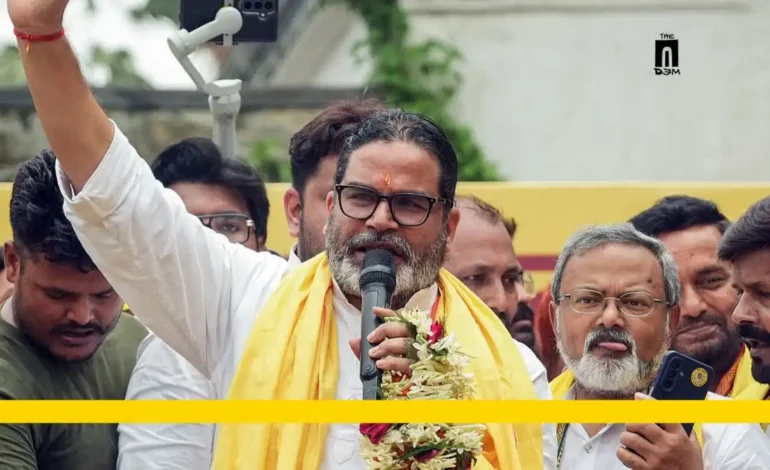
A few days before the Bankipur by-election’s polling date , The AIDEM carried an essay by senior journalist Nalin Verma titled The Prashant Kishore Paradox. It was less an exercise in electoral prediction than an exploration of Bihar’s political psychology. Verma argued that while many people had come to admire Prashant Kishore’s Jan Suraaj experiment, they remained unconvinced that it could overcome the entrenched political machinery of the established parties. Hope, he suggested, was repeatedly overtaken by a deeply internalised belief that the existing order would somehow find a way to prevail.The Bankipur verdict has unsettled precisely that assumption.
It should not be mistaken for a verdict on Bihar’s future; one by-election cannot determine the trajectory of an entire state. Yet it has punctured one of the most persistent assumptions in contemporary Bihar politics—that new political formations may inspire admiration, even enthusiasm, but not electoral success.
In that sense, Prashant Kishore’s victory represents something larger than the capture of an Assembly seat. It signals that political inevitability can still be challenged when citizens begin to believe that an alternative is not merely desirable but achievable.

Bankipur was therefore never merely a by-election. It became a referendum on whether Bihar’s politics could still surprise itself. Prashant Kishore’s victory over the BJP in one of its most durable urban bastions is significant not only because of the constituency he won, but because it demonstrates that sustained grassroots engagement, patient organisation and issue-based politics can still breach an entrenched political fortress.
Several factors have been identified by many senior journalists and observers, including The Indian Express’ sesasoned Bihar journalist Santosh Singh in the immediate aftermath of the election .Read alongside the larger democratic questions raised by Verma, they reveal a story that extends well beyond electoral arithmetic.

These points could be summed up as follows. One : The Jan Suraj Party did not run a mere election campaign lasting a few weeks in Bankipur, but sustained engagement with the constituency and the peoples issues there. Two : The BJP’s urban fortress began cracking under the stress of this sustained engagement. Three : Prashant Kishore’s political personality made a definitive turn towards becoming an active and astute politician moving beyond his former status as a strategist. Four : The engagement also led to the depletion and division in the vote pool of the principal opposition party, the Rashtriya Janata Dal (RJD).
The AIDEM is trying to address these factors in some detail and make some projections as to what this could mean for Bihar’s polity as a whole . First, the Jan Suraj engagement was built upon months of sustained work on the ground. It was a campaign, which travelled across Bihar listening rather than merely speaking. Unlike conventional electoral mobilisation that intensifies only after the announcement of polls, Jan Suraaj in Bankipur had already established a network of volunteers, neighbourhood committees and issue-based conversations. As Nalin Verma suggests, what appeared to many as an election campaign had, in reality, evolved into a broader social and political movement long before polling day. The by-election merely brought that organisational work into public view.

The BJP entered the contest with the advantages of organisation, resources and a constituency it had dominated for decades. Yet internal dissatisfaction, local factionalism and a campaign that appeared to rely more on institutional strength than political imagination weakened its appeal. What had seemed impregnable on paper proved far more fragile once voters sensed that a credible alternative had emerged. As Verma notes, the perception that change was possible became a political force in itself.
For nearly a decade and a half, Prashant Kishore was known as the man who helped others win elections. Bankipur marked his transformation into a politician willing to place his own credibility before the electorate. Voters were no longer evaluating an election consultant; they were judging someone asking for their mandate on the strength of a programme centred on governance, education and employment rather than caste arithmetic alone. In Verma’s reading, this transition from strategist to public leader gave Jan Suraaj a political authenticity that professional campaign management alone could never have achieved.
Perhaps the most consequential aspect of the campaign was psychological rather than organisational. Verma argued that Bihar’s electorate had long lived with a paradox: admiration for Jan Suraaj accompanied by the conviction that the entrenched political order would never permit it to succeed. Bankipur disrupted that fatalism. Once enough voters concluded that victory was genuinely within reach, the self-fulfilling cycle of pessimism began to collapse. The election thus became as much about defeating political resignation as defeating a rival candidate.
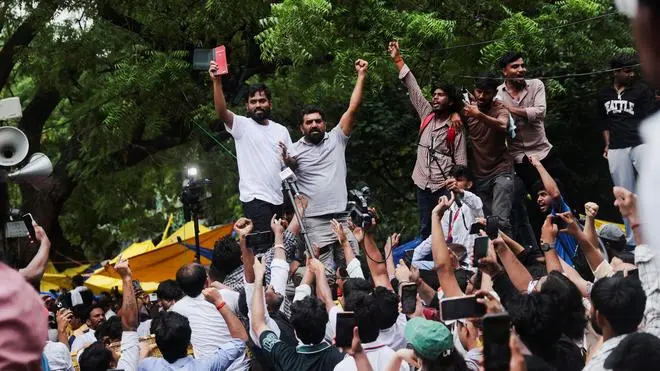
The timing of the nationwide protests led by the Cockroach Janata Party (CJP) protests demanding the resignation of Dharmendra Pradhan as union education minister as well as larger reforms in the education sector also proved politically significant in Bankipur’s context. In the days immediately preceding polling, the CJP movement’s sustained mobilisation around questions of democratic accountability, constitutional rights and public participation resonated strongly among sections of the Bankipur electorate, particularly students, first-time voters, professionals and the urban middle class.
While it would be simplistic to attribute the electoral outcome directly to these protests, they helped sharpen the public conversation around governance and democratic responsibility—issues that Jan Suraaj had consistently foregrounded. The protests reinforced the sense that politics need not remain confined to party calculations or caste equations, but could once again revolve around active citizenship and public engagement. In that sense, the atmosphere created by the CJP mobilisation complemented Jan Suraaj’s own campaign, lending greater urgency and credibility to its message at a decisive moment.
The significance of Bankipur extends beyond one constituency. Whether Jan Suraaj ultimately reshapes Bihar’s electoral landscape remains uncertain, but the contest has already altered its political discourse. Governance, accountability, merit and citizen participation occupied far greater space than they ordinarily do in Bihar’s election campaigns. As Verma suggests, the result has expanded Bihar’s political imagination by demonstrating that sustained grassroots engagement and organisational credibility can compete with entrenched electoral equations. It is also a reminder to established parties that organisational machinery cannot indefinitely substitute for public trust.
Bankipur may not have rewritten Bihar’s politics overnight. But it has reopened a democratic possibility that many had quietly stopped believing in. That, perhaps, is the most significance of Prashant Kishore’s victory. The Assembly seat may belong to Bankipur; the political question it has raised now belongs to the whole of Bihar.









This is more than an election story—it is a reflection on how public trust is earned and how political landscapes can change. Whether one agrees or disagrees with Prashant Kishore, the article raises important questions about leadership, voter aspirations, and the possibilities of a new political discourse in Bihar. A compelling and insightful analysis