

The Spectre of ‘End-Times Fascism’ Haunting the World


The prospect of ecological breakdown is already shaping political choices about who will be protected and who will bear the costs. In “End Times Fascism and the Fight for the Living World”, Naomi Klein and Astra Taylor examine how Silicon Valley billionaires, religious fundamentalists and ethno-nationalists are turning fears of catastrophe into a politics of exclusion.
The book’s importance lies in tracing how these groups’ projects reinforce one another, from privately governed enclaves to militarised borders, and in examining the movements that are organising for a shared future. Writer and social activist K. Sahadevan takes up these two strands in a two-part review. Read the first part here.

A Reading of “End Times Fascism and the Fight for the Living World” by Naomi Klein and Astra Taylor – Part 1
“A spectre is haunting the world—the spectre of ‘End-Times Fascism’. The foundational ideology of this far-right movement, spearheaded by a handful of immensely powerful individuals, is a terrifying and hegemonic form of survivalism.”
This is a concise summation of the warning issued to the global community by renowned activist-writers Naomi Klein and Astra Taylor in their book, “End Times Fascism and the Fight for the Living World”. The political formation they identify as ‘End-Times Fascism’ is driven by a coalition that brings together an extraordinarily potent combination of religious fundamentalism, advanced technological power, and ethno-nationalism.
Before examining the contents of the book, it is important to establish some background that will help readers understand the subject more deeply. The concept of the ‘Silicon Valley Exit’, introduced in 2013 by Balaji Srinivasan, an American entrepreneur of Indian origin and a staunch advocate of cryptocurrency, is now beginning to assume a tangible form. But what exactly is the vision of ‘Exit’ that Srinivasan proposed?

Srinivasan advocates the right of those with sufficient financial resources to opt out of the obligations associated with citizenship, including the tax systems and regulatory frameworks imposed by national governments. Through his vision of the ‘Silicon Valley Exit’, he envisaged an exclusive enclave, accessible only to the ultra-wealthy and governed by them. Its financial infrastructure would be built around cryptocurrencies, while private mercenary forces and AI-powered robotic systems would stand guard, ready to serve the interests of its privileged inhabitants.
Nearly a decade later, Srinivasan developed this idea of ‘Exit’ into the concept of the ‘Network State’, which he defines in a single sentence:
“A network state is a highly aligned online community with a capacity for collective action that crowd funds territory around the world and eventually gains diplomatic recognition from pre-existing states.” — The Network State in One Sentence, The Network State, Balaji Srinivasan, 2022.
Does this sound like the delusional fantasy of a technocrat? If so, consider PROSPERA City on the island of Roatán, Honduras, in the Caribbean. It is a privately developed ‘startup city’ designed to cater primarily to the ultra-wealthy. Construction began in 2021, and this enclave for the affluent operates under a distinctive economic, legal, and regulatory framework, with substantial autonomy from the Honduran government.
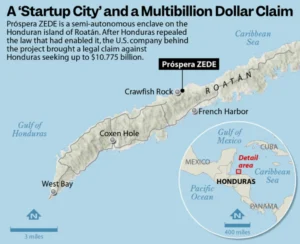
The idea of such startup cities is by no means confined to Prospera. Initial steps have already been taken towards establishing numerous corporate enclaves and privately governed urban settlements, variously described as ‘bunker towns’ or ‘freedom cities’. Other examples of this survivalist imagination include Mark Zuckerberg’s reported 5,000-square-foot underground complex in Hawaii and a 500-acre survivalist retreat in New Zealand owned by PayPal co-founder Peter Thiel.
These individuals, preparing for an apocalyptic ‘end-times’ scenario and building their own modern-day ‘arks’ to ensure their survival, are not merely ultra-wealthy techno-fascists. They are also part of a broader political coalition that includes religious fundamentalists, who believe that a final confrontation between good and evil is a necessary precondition for eternal salvation, and advocates of a supposedly ‘pure’ ethno-nationalism, premised on the rejection of genetic admixture.

Naomi Klein and Astra Taylor examine this phenomenon under the rubric of ‘apocalyptic fascism’, driven and financed by the ultra-wealthy. They meticulously document the strategic and policy interventions undertaken by these powerful actors to secure their own survival in the face of impending catastrophe, their growing influence over political leadership, and the measures they promote that threaten the global environment and life on Earth itself.
The book explores not only this formidable alliance, which offers humanity little more than dark and nightmarish visions of the future, but also the resistance taking shape against these apocalyptic fascists and the emancipatory possibilities that such resistance holds.
Naomi Klein and Astra Taylor are familiar names among politically engaged readers in India. Naomi Klein is widely known for her influential works, including No Logo, The Shock Doctrine, and Doppelganger. Astra Taylor, co-founder of the organisation Debt Collective, is the author of acclaimed books such as Democracy May Not Exist, but We’ll Miss It When It’s Gone and The People’s Platform.
Before examining the book in greater detail, it is essential to understand what the authors mean by ‘End-Times Fascism’. In their formulation, it is a form of fascism rooted in the recognition that something of enormous magnitude is coming to an end. Rather than confronting this unsettling reality with an attempt to transform the economic and social systems created by human beings—the very systems responsible for driving the present crises and accelerating ecological collapse—its proponents respond with unrestrained cruelty. They insist that human history itself has reached its terminal phase and that only a small, resilient fraction of humanity will be capable of surviving the catastrophe ahead.

According to this worldview, the survivors will inhabit fortified cities in the sky, privately governed corporate enclaves, or heavily militarised nation-states protected against the supposedly threatening ‘invaders’ beyond their borders. At its heart lies an old, deeply seductive apocalyptic fantasy: that a small, ‘chosen’ minority will be granted entry into a protected paradise, while the rest of humanity is abandoned to a cataclysm of biblical proportions—submerged beneath a deluge of destruction and consumed by unending flames.
Who are these supposedly exceptional and resilient individuals? What plans are they devising to secure their survival in the face of the impending catastrophe? How are they mobilising religious beliefs, technological power, and state institutions to advance their objectives?
Through this book, structured in four parts, Klein and Taylor seek to address these questions. At the same time, they turn their attention to the popular movements emerging in opposition to this apocalyptic vision—movements grounded in the recognition that protecting the planet and all forms of life requires collective responsibility, solidarity, and a shared commitment to the future of humanity.
(To be continued)










The greatest danger of modern fascism is the unholy alliance between billionaire power, religious fundamentalism and extreme nationalism. While the privileged prepare to protect themselves, the future of ordinary humanity and the planet is put at risk. Democracy, equality and collective solidarity must stand against this politics of exclusion. The survival of humanity cannot be reserved for a privileged few; it must be a shared responsibility.