


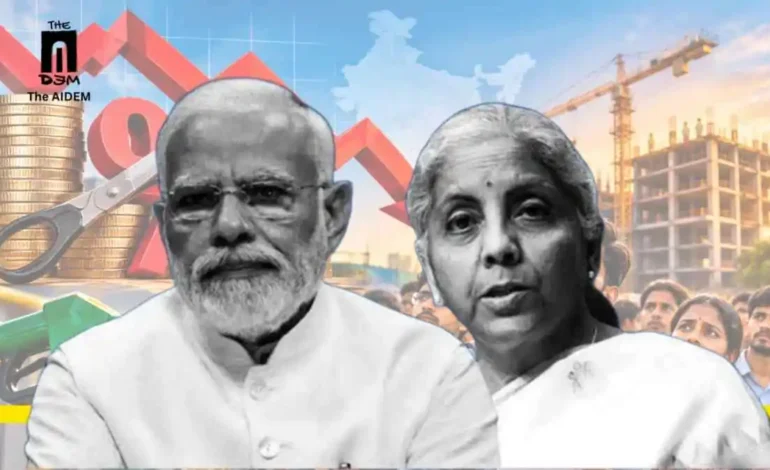
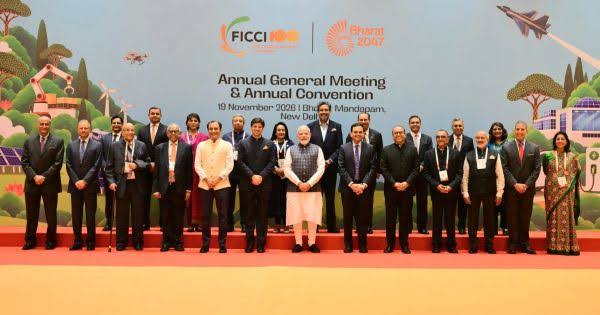
On November 19, 2026 , six years after India cut its corporate tax rate, Prime Minister Narendra Modi asked a room of industrialists why jobs and wages had not followed. The question answers itself, once you ask what has actually been holding the economy back.
At the annual general meeting of the Confederation of Indian Industry on November 19, Prime Minister Narendra Modi put a question to the room, and he sounded a little angry. “We cut the corporate income tax from thirty per cent to twenty-two,” he said. “Why have more jobs and higher wages not followed?”
The cut was announced in September 2019 by the finance minister, Nirmala Sitharaman, who also set a rate of fifteen per cent for new manufacturing companies. Her reasoning was tidy. Firms would keep more of their profit, they would pour it into plant and equipment, and the new capacity would create jobs. Six years on, the prime minister is asking why the jobs never arrived. The question is closer to a confession than an enquiry: the government set out to kickstart growth through tax relief, and it did not work.
To understand why, it helps to revisit our economic history.
Growth today, in India as elsewhere, is not held back by a shortage of supply. Demand is what drives it.
Supply, Then Demand
In the India of the nineteen-seventies and early eighties, there was plenty of demand for consumer goods and very little production to meet it. A customer waited ten years for a telephone connection. A scooter took five to eight years. The cause was policy. Officials and politicians sitting in Delhi decided how much each company was allowed to make, an arrangement known as the licence-permit raj, and it prevented factories from growing to meet the demand in front of them. Economists call this a supply-side constraint.
In 1991, a foreign-exchange crisis gave the government of Narasimha Rao its opening. It abolished the licence raj and set the country toward a free-market economy. For the next twenty years, the Indian economy grew at about six per cent a year. In the decade after that, growth rose to 7.7 per cent. Somewhere in the middle of this run, politics changed too: a coalition led by the Bharatiya Janata Party, with a right-leaning economic outlook and Modi as its prime ministerial face, came to power, and the fast growth continued.
The old problem, in other words, was solved. Today the limit on growth is not that factories cannot produce enough, or that companies lack the funds to expand their capacity. It is that demand is not growing fast enough to keep the engine running at speed.
Two Shocks
The climb of the growth curve was cut short by two man-made shocks, one after the other. On the night of November 8, 2016, Modi announced that the five-hundred and thousand-rupee notes would no longer be legal tender. Those notes made up eighty-six per cent of the value of all the currency in circulation. In rural and farm economies, nearly every transaction runs on paper cash, and the demonetisation choked those sectors for months. The economist Jean Dreze put it this way: demonetisation, he said, was like shooting the tyres of a racing car.
Then, in July 2017, the government introduced a centralised Goods and Services Tax. The rollout was troubled, and small and micro enterprises were hit hardest. Many of them supplied the large formal companies, and once those companies were on the GST system, their suppliers had to be as well. The compliance burden elbowed out many a micro enterprise, and millions of jobs went with them.
Together, the two shocks pulled the economy’s growth rate down by as much as two percentage points, which is what the former prime minister and economist Manmohan Singh had warned would happen. Farming and small business suffered, and unemployment rose. The damage showed up as a fall in demand for the goods and services of the formal economy.
The remedy for a demand shortfall is not complicated. If the economy is to grow fast again, people need more money to spend, and above all the rural poor and the middle class do. Economists recommended the most direct route: raise government spending on welfare programmes, which would put cash in those households and act as a catalyst for growth. The idea is time-tested. When Covid slowed the western economies, many of them did exactly this. The American government mailed a cheque for twelve hundred dollars to its citizens in the spring of 2020 and another for six hundred in December, so that demand for goods and services would not collapse.
The Opposite Prescription
The Indian government did the opposite. When the problem was on the demand side, it went and operated on the supply side. Sitharaman argued that the way to speed up growth was to give businesses a tax break. The surplus would become profit, the profit would become investment in new capacity, and the investment would become jobs. The corporate tax rate came down by eight percentage points. Indian industry gained roughly 1.4 lakh crore rupees a year in extra profit.
The timing was awkward. When she proposed this, growth had already slipped by as much as two percentage points. Demand was down, and the factories that already existed were running below capacity. A company with idle capacity has little reason to build more, whatever profit it makes. When this concern was raised, it went unanswered.
A company with idle capacity has little reason to build more, whatever profit it makes.
Who Paid
Over the same period, the government sharply raised the cess on petrol and diesel. The extra revenue came to about three lakh crore rupees a year. In effect, the 1.4 lakh crore the treasury gave up on corporate taxes was won back through the fuel cess. A right-wing government killed two birds with one stone. It gave a tax break to its core constituency, the corporate lobby, and more than made up the cost by taxing the middle class and the poor, who were already stressed. Most of the fuel in India is used by them, and they make up ninety per cent of the population.
Consider what this amounts to. The economists’ advice was that growth needs demand, that demand needs money in the hands of the ninety per cent, and that the government should therefore spend on the welfare of the poor and the middle class. The government set that advice aside. Instead of putting money in the hands of poor and middle-class Indians, it levied an additional tax on the same households, squeezing at least two to two and a half lakh crore rupees a year out of them as fuel cess. How does demand grow from there?
The prime minister is barking up the wrong tree when he asks the private sector about jobs. The additional cess on petrol and diesel killed the demand, sir. It is time to wake up and smell the coffee.
Translated from the Tamil original by the author using AI and further edited.







Corporate tax cuts have failed because India’s real problem is not a lack of corporate profits, but a lack of purchasing power among ordinary people. The Modi government gave tax concessions to corporations while squeezing the poor and middle class through rising fuel taxes. You cannot create jobs when people cannot afford to consume. Put money in people’s hands, strengthen demand and generate employment. An economy cannot grow by enriching corporations while impoverishing its consumers.