


“We May Not Have the Money to Defeat the BJP, But We Have Something More Important—Committed Cadres”
An interview with Naresh Jamatia, leader of the CPI(M)
For decades, tribal politics in Tripura was synonymous with the Left.
The Communist Party of India (Marxist) built an extraordinary political organisation among the state’s tribal communities through its mass organisation, the Tripura Rajya Upajati Gana Mukti Parishad (GMP). For generations, the organisation served as the principal political bridge between the Left and Tripura’s indigenous population.
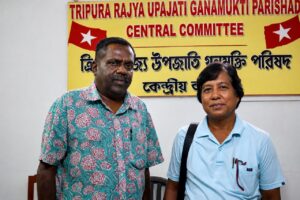
That political bridge, however, has been badly damaged.
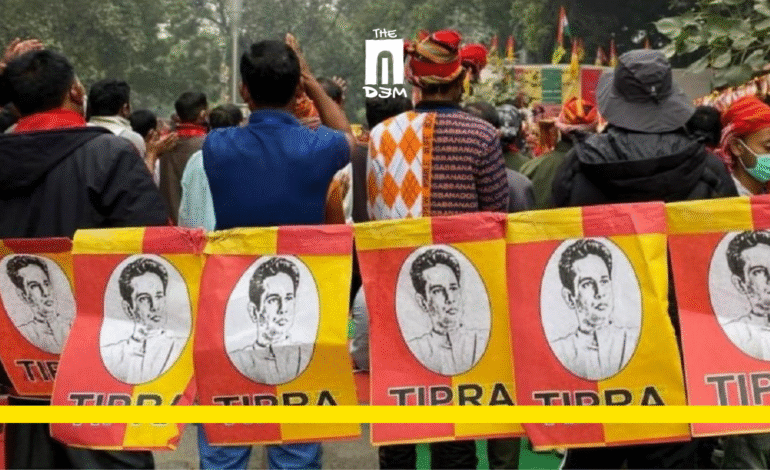
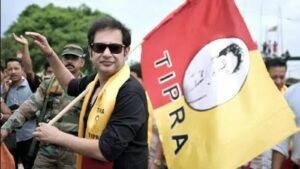
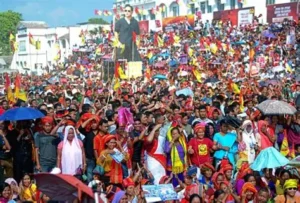
The emergence of Tipra Motha, founded by Pradyot Kishore Manikya Debbarma, a member of Tripura’s former royal family, has transformed the state’s tribal politics. The party has successfully entered what was once considered the Left’s political fortress.
The numbers tell the story starkly. The Left’s vote share in the tribal areas, according to CPI(M) leader Naresh Jamatia, fell from around 67 per cent a decade ago to just 9.67 per cent in the last election.
Today, the BJP and Tipra Motha are in government, while the CPI(M) occupies the principal opposition space with ten members in the 60-seat Assembly.
Yet Jamatia does not sound defeated.
He argues that the Left’s loss is neither irreversible nor permanent. Tribal youth, he believes, are beginning to see through what he calls the BJP’s “indirect” strategy of using identity politics and Tipra Motha to consolidate its influence.
For Jamatia, the coming village elections are therefore about more than local bodies. They are an opportunity for the Left to begin rebuilding a political base it once took for granted.
Q: Village elections are scheduled for early next month. Can the Left alliance make a comeback?
Naresh Jamatia: We are working towards it.
We have to confront both the BJP and the RSS, physically as well as intellectually. But we also have to recognise that Tipra Motha has emerged as a serious challenge.
Ten years ago, the Left had around 67 per cent of the vote in the tribal areas. In the last election, that came down to 9.67 per cent.
That decline cannot be explained simply by saying that the BJP or Tipra Motha took away our votes.
We have to examine our own mistakes.
Almost every major transformation in the tribal areas—better schools, roads, connectivity and healthcare—was brought about by Left governments.
Those policies changed people’s lives. Young people received better education. Their economic circumstances improved. They entered the middle class.
But when the social and economic character of a community changes, its political consciousness also changes.
We failed to understand that quickly enough.
The younger generation moved away from traditional Left politics, and we failed to keep them ideologically connected to us.
Today, in many places, Tipra Motha workers are preventing our candidates from filing nomination papers. They are doing this with the support of BJP goons.
Our comrades are being physically attacked.
Look at Jogendrapur.
Our workers were engaged in fish farming. Their ponds were poisoned in an attempt to destroy their livelihoods. Poor fish farmers suffered losses of around ₹2 lakh.
The government has not registered even one case.
Instead, false cases have been filed against the farmers.
This is part of a broader attempt by the Manik Saha government to eliminate the Left from the political field.
Q: Tripura once witnessed decades of insurgency. What were the underlying reasons for that conflict?
Jamatia: Before Independence, tribal people were the majority in Tripura.
That began to change after Independence.
The feudal mentality of the former monarchy made the situation worse. The people who had once been the majority gradually became a minority.
And once they became a minority, their rights began to be taken away.
The idea that tribal people would gradually lose all their rights if they remained within India began gaining influence in some areas.
That was the political background in which organisations such as the TNP, IPTF and TLF emerged.
Their activities continued for nearly 35 years.
During this entire period, the Left alliance was in power in Tripura.
The militants consequently received support from the Congress, which was ruling at the Centre.
People were killed. People were kidnapped.
Eventually, it was the CPI(M) that played the decisive role in resolving the conflict by establishing an autonomous council for the tribal areas.
Our comrades died defending the unity of India.
But while this was happening, the Congress pursued another course.
Large numbers of Hindus from Bangladesh entered the tribal areas and began occupying tribal land.
Even though laws prohibited the transfer and encroachment of tribal land, large-scale land grabbing took place.
There was support for this from the royal establishment.
My own village was affected.
It had only around 200 families, yet tensions between Bengalis and tribal people became extremely intense.
Six members of my own family were killed.
When TNP militants also began killing Bengalis, the ethnic conflict reached its most dangerous stage.
Later, successive Left governments recovered tribal land that had been lost.
We returned it to the original owners.
Even where compensation was required, we paid it and restored the land.
Q: The Left did more than any other political formation for the tribal communities. Why, then, did tribal voters abandon you for a party such as Tipra Motha?
Jamatia: We asked ourselves exactly that question after our defeat in 2018.
The party conducted a serious study of what had happened.
One conclusion was clear: development alone does not guarantee political loyalty.
Tipra Motha emerged from the former royal family.
A large section of the population still has an emotional attachment to the monarchy.
Tipra Motha understood this sentiment and successfully converted it into political support.
We also failed to understand something else.
Our own development policies created a new social class.
Look at Tripura today.
You can travel by road to almost any remote village.
The road connectivity created by Left governments is extraordinary.
Even remote villages have plenty of privately owned vehicles.
But we did not recognise in time that development was also creating a bourgeois mentality.
We created the conditions for social mobility, but we failed to adapt our political strategy to the society that emerged from it.
That ideological space was then occupied by the BJP and Tipra Motha.
And they had money.
The BJP leadership influences tribal elders in several ways.
The money is not always given directly.
It is often distributed through microfinance mechanisms.
After the money is channelled through these systems, BJP people themselves repay it.
It is a new form of corruption—one that is extremely difficult to challenge legally.
There is another important factor.
The Chief Minister personally calls senior officials from the tribal areas.
He speaks to them, maintains friendly relations and engages them in informal conversations.
Some officials have begun to believe that the BJP respects and recognises them more than the Left did.
But recognition matters enormously.
Tribal society is highly sensitive to such gestures.
When the Chief Minister of a state personally speaks to an official and makes him feel important, that sentiment reaches his family as well.
Some people changed their votes because of this.
Such things did not happen during Left rule.
Today, I believe that was one of our weaknesses.
Q: There are stories about senior leaders during the Left’s years in power exercising enormous informal influence, sometimes even reducing tribal ministers to figureheads.
Jamatia: (Laughs.) Yes, that happened.
There were Bengali leaders whose influence was so great that tribal ministers could not always act independently.
They exercised a kind of extra-parliamentary authority.
The people were watching.
We eventually understood what was happening, but we took too long to correct it.
In some cases, ministers became little more than figureheads.
We corrected many of these problems later.
But by then, the political damage had already been done.
The defeat of 2018 forced us into a major process of introspection.
Q: The Left is also accused of failing to attract young people. The problem appears particularly acute in tribal areas. What is your response?
Jamatia: Bringing new people into the party is important.
But protecting the ideological commitment of those already with us is equally important.
We are trying to change our working style.
We want young people in important positions. We want to give them real responsibilities.
I cannot claim that we have completely succeeded.
I personally participated in the CJP agitation and was present on the front lines. The response I received was extremely encouraging.
It demonstrated that young people, including Gen Z, are not necessarily opposed to our politics.
But we cannot expect them to remain with us through traditional political methods.
We need new methods.
We must field more educated young people in elections.
We need both a short-term political strategy and a long-term organisational plan.
We must begin cultivating second- and third-generation leaders now.
And they must remain connected to ordinary people.
Remember, even Dasarath Debbarma lost elections.
Did the Left disappear after that?
No. We returned.
The tribal youth today are opposed to the BJP.
They oppose Hindutva politics.
The BJP is trying to influence them indirectly through Tipra Motha.
But that strategy cannot continue forever.
The BJP leadership in Tripura has already demonstrated its incompetence.
Political leaders who do not understand administration leave enormous space for officials, and that creates conditions for corruption.
This government has reportedly utilised only around 13 per cent of the funds available for panchayats.
What does that mean?
It means people are being denied what belongs to them.
Young people understand this.
And they understand it not only in the tribal areas but also in the plains.
Unemployment is not an abstract political issue for them. They experience it personally.
The government has failed to introduce new courses in Tripura’s universities.
Even young people working within Tipra Motha talk to us about these problems.
There is another problem with the BJP.
Every time an election approaches, they make promises.
Once the election is over, those promises disappear.
Deception has become part of their political method.
It is also a characteristic of fascist politics.
After eight years of BJP rule, Tipra Motha itself is facing difficulties.
Tribal people are increasingly beginning to understand that they have become victims of identity politics.
That realisation, I believe, will eventually benefit the CPI(M).
Q: The demand for ‘Tipraland’ appeared periodically. What is its status today?
Jamatia: It was deliberately inflamed by former BJP Chief Minister Biplab Kumar Deb for short-term political gain.
Eventually, he himself became a victim of that politics.
The police under Biplab Deb had to open fire on people who were protesting for Tipraland.
The IPTF ministers who were part of his cabinet at the time were unable even to enter their own constituencies.
Biplab Deb tried to counter the movement by saying: first the country, then the party.
Tipra Motha took full advantage of the situation.
When Tipra Motha first emerged, it presented itself as a strong anti-BJP force.
Today, they have become servants of New Delhi.
The young people of Tripura are beginning to recognise this contradiction.
I believe that this realisation will become votes in the 2028 Assembly election.
Q: In the age of social media, would you agree that the CPI(M) and the Gana Mukti Parishad have failed to use the medium effectively?
Jamatia: Certainly.
We still have a long way to go.
But we are taking steps that will allow us to make substantial progress very soon.
Money is a major problem.
We are still a party of ordinary people.
We have made the Central Committee aware of our limitations.
With their decisive support, we will improve our communication and organisational systems.
We may not be able to defeat the BJP with money.
But we have something the BJP cannot buy so easily—committed cadres.
That is why, despite so many physical attacks, our workers continue to hold their ground at the grassroots.
Even when the police and other arms of the administration persecute us, the fact that people in Tripura are still willing to listen to and embrace our politics gives us hope.
That is our strength.
On that strength, the Left alliance—including the CPI and the Forward Bloc—is moving forward.
And I firmly believe that we will make substantial gains in these village elections.








A powerful and deeply revealing account of Tripura’s changing tribal politics. The collapse of the Left’s traditional support base shows that development alone cannot sustain political trust when questions of identity, land, history and representation remain unresolved. This interview offers an important reminder that genuine democracy must listen to people’s changing aspirations rather than take their support for granted. A timely and thought-provoking read. :::