
What Happens When the Milk Runs Dry? Designing India’s Climate-Ready Dairy Future

India’s dairy success story is record-breaking. The next revolution may have to be about resilience, not just production.
Take the Milk Away
That was the challenge posed to a room of nutrition scientists, veterinarians and systems researchers at Science Gallery Bengaluru during a workshop convened with Swissnex India. Participants first mapped India’s vast dairy economy—its diversity, supply chains and cultural weight. Then they were asked to erase milk from the equation and trace what unravelled.

The answers surprised the room. Remove milk, and it is not just a beverage that disappears. An entire rural economy built on cow dung as fuel and fertiliser goes with it. So does a food-security lifeline and an emotional inheritance tied to family livestock. “There’s really this systemic web,” one participant reflected. “The whole system shifts if you remove something.”
What Dairy Gives India
“Dairy milk continues to be an important source of protein. It is also affordable for many people and a culturally accepted part of the Indian diet,” says Dr Jyoti Sharma, Director of the Indian Institute of Public Health, Delhi.

No other type of milk matches dairy milk’s nutritional profile, she adds. “While plant-based alternatives such as soy milk come close, they lack certain essential amino acids and vitamin B12, key factors that make animal protein a higher-quality protein source.”
India has been the world’s largest milk producer since 1998, accounting for roughly a quarter of global output. Production rose by 63.5% over the past decade, from 146.3 million tonnes in 2014–15 to 239.2 million tonnes in 2023–24, growing at 5.7% a year—nearly three times the global rate. Per-capita availability has climbed to more than 471 grams a day, well above the global average of around 322 grams. Uttar Pradesh remains the top milk-producing state.
Dairy is India’s largest agricultural commodity, contributing 5% to the national economy and employing 80 million people. The cooperative sector alone spans 22 milk federations, 241 district cooperative unions, 28 marketing dairies and 25 Milk Producer Organisations, reaching about 2.35 lakh villages and 1.72 crore farmer-members. Women constitute nearly 70% of the dairy farming workforce, making the sector one of rural India’s largest sources of income.

This is usually how the story of Indian dairy is told: as a national success and a triumph of the White Revolution. But that framing treats milk as a finished product rather than the output of a system—and it is the system that is now under strain.
What Dairy Costs India
Livestock account for about 48% of India’s methane emissions, most of them from cattle. Methane traps nearly 28 times as much heat as carbon dioxide, and India is now the world’s third-largest methane emitter, according to the UN Environment Programme’s Global Methane Status Report 2025.

The industry is not just a contributor to climate change; it is also exposed to it—nowhere more so than in the state that produces the most milk. In Uttar Pradesh, 54% of buffalo rearers report that climate change is affecting their animals, the highest share among livestock owners surveyed nationally, as do 50% of those rearing crossbred or exotic cattle, according to CEEW. “Climate change is causing increased disease rates, restlessness, and mortality among bovines, while reducing productivity and threatening the livelihoods and nutritional security of cattle rearers,” the report states. New disease cases are up by 33%, while restlessness has risen by 20%. Shorter lactation periods and the earlier retirement of animals are, in turn, fuelling the country’s growing stray-cattle crisis. The Lancet estimates that rising temperatures could cut Indian milk production by as much as 25% by 2085.
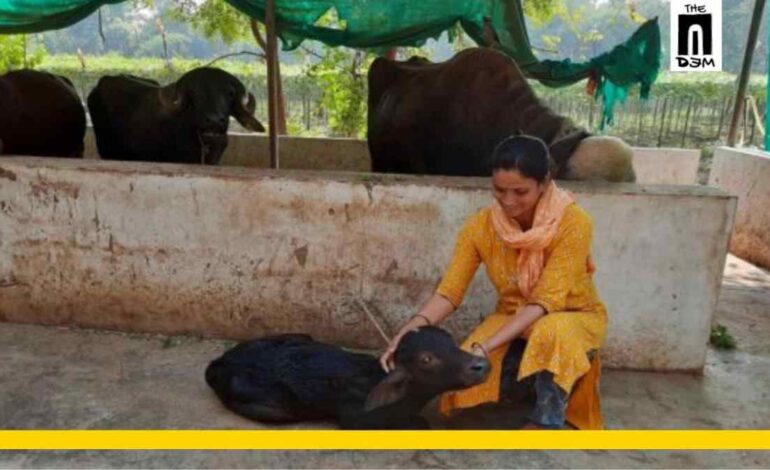
The numbers translate directly into farmers’ ledgers. In Agra district, Anil Tyagi, who runs a dairy cooperative supplying Parag, says summer yields decline: buffaloes that usually produce 4–5 litres a day fall to about three litres, while each cow produces roughly 1–2 litres less. Buffaloes are especially vulnerable: their darker, thicker skin absorbs more solar radiation, and they have fewer sweat glands, making it harder for them to regulate heat as temperatures climb. With the onset of El Niño, heat stress could lead to a fodder crisis. According to an ICAR study, heatwaves have already reduced the availability of green fodder for milch animals, and milk yields in Uttar Pradesh alone have fallen by up to 11%.
About a third of households in Uttar Pradesh cite the lack of land for fodder cultivation as a constraint—more than double the national average. A CEEW study flags the state as facing an “acute shortage” of fodder.

India cannot afford to shrink a sector that supports 80 million livelihoods, underpins nutrition and sustains a vast rural economy. Yet dairy in its current form both accelerates the climate crisis and is increasingly vulnerable to it. More than 69,000 livestock animals died in extreme weather events in 2022 alone, according to the Centre for Science and Environment. Globally, 75% of livestock could be exposed to dangerous heat conditions by 2100, according to the Food and Agriculture Organisation and the World Meteorological Organisation.
What a Climate-resilient Dairy System Would Require
Around the world, the rise of veganism has put dairy under pressure over its climate footprint. But Agathe Verhulst, a One Health researcher at the University of Bern, cautions against treating restrictions as the solution. “I don’t think that removing the dairy industry would have the biggest impact on stopping climate change,” she said. Instead, she advocates integrating dairy into a broader agricultural transition and seeing it as one input and output among many, rather than isolating it as a climate villain. By regulating where farm by-products and waste may be disposed of and providing wastewater-treatment infrastructure, she says, farming must be supported at a systemic level to make it truly climate-resilient.

Dr Utpal Tatu of the Indian Institute of Science argues that milk should be understood as a by-product of a system, not as a standalone product. At its core, he points out, milk is protein and fat derived from grass that only ruminant animals can convert into a form humans can digest. Change the breed, fodder or terrain, and the milk itself changes.
The idea is close to the French concept of terroir, used to categorise wine by the land from which it comes. It challenges the assumption that milk from Zurich and milk from Bengaluru should taste the same.
It also underpins the “One Health” principle Dr Tatu has spent years building into rural India through village-level health initiatives: that animal health, human health and environmental health cannot be meaningfully separated. Treating them as distinct systems, he suggests, is the root error.

Anirudh Sheth, who researches the pastoral economy, pushes the point further: milk comes from landscapes and from the people who sustain them. By “people”, Sheth does not mean only pastoralists in the field. Having spent years researching the camel pastoral economy in Kachchh, Gujarat, he means the entire human infrastructure that keeps the system running: geneticists conducting artificial insemination, extension workers and cooperative managers.
“Every production system is a context,” he says, “and that context comes from either a purpose or a constraint.” As he puts it, “Cow milk isn’t nutritionally superior to buffalo milk, but India’s dairy infrastructure has been systematically built around the cow, not the buffalo”—an accident of industrial and nationalist design, he argues. In his reading, both the White Revolution and the Green Revolution were engineered responses to a single constraint: how do you feed close to one billion people within an acutely resource-constrained system?
That constraint shaped the animals, breeds and infrastructure India developed. This means that the system was a design choice and can, in principle, be redesigned—this time around a different constraint: climate resilience.
Rewriting the Rules of Survival
On the ground, this redesign is already visible as local heat action plans begin to include livestock. The adoption of artificial insemination in cattle is also growing, driven by economic necessity and climatic vulnerabilities—the primary challenges preventing livestock resources from reaching their full potential, according to the Department of Animal Husbandry and Dairying.
The Uttar Pradesh Heat Action Plan 2025 outlines several key measures: preparing information materials such as posters and pamphlets, conducting training sessions for departmental and field workers, and ensuring that all veterinary hospitals maintain adequate stocks of essential medicines.

On Beejom, her 40-acre farm with around 300 cattle, Aparna Rajagopal is trying to create a model that others can replicate. She believes climate adaptation must cease to be tied to individual weather events and become a year-round discipline.
“Everything is continuously recalibrated—from what the animals eat and how they are grazed to when and for how long they are allowed outside, as well as how their enclosures are prepared,” she says. “Climate change is not going to go away.” Rajagopal, who also runs a natural organic farm, says she no longer grows crops according to the seasons. “I don’t grow according to the season at all; I only grow according to the temperature now.”
In Nandigram, Noida, Uttar Pradesh, an animal shelter housing 800 cattle is preparing to build a fountain and a sprinkler system in line with state government advisories.
Return to Indigenous Cattle
Ashutosh Tripathi, Assistant Professor at Sardar Vallabhbhai Patel University of Agriculture and Technology in Meerut, argues that the solution is not further genetic upgrading towards high-yielding exotic breeds, but a return to indigenous ones.
Tripathi argues that Sahiwal and similar cattle demonstrate measurably greater heat tolerance and can conceive even at the peak of summer, when Holstein Friesians often cannot. Given India’s cultural and legal constraints—including Uttar Pradesh’s cow-slaughter law, which means cows are not culled and replaced as they are in industrial systems in the West—he says cattle should be evaluated by their lifetime lactation yield rather than by the higher but shorter-lived output of an exotic breed.

“On paper, an exotic cow can give 40 litres a day,” he says, “but because she gives birth only once every four years, my real average is only about 10 litres a day over those four years.”
That reasoning helps explain why households in Uttar Pradesh planning to expand their herds overwhelmingly favour buffaloes over crossbred cattle—a regional divergence from the national trend, according to CEEW’s analysis. It is also partly a function of the law: buffaloes, which are not protected by the cow-slaughter law, remain saleable in a way that cows do not, making them what villages call kaala dhan, or black wealth.
Embrace India’s Regional Specificity
Another change Sheth advocates is recognising regional specificity. “I feel India needs to embrace its regional and contextual specificity.” Goat milk is a staple in morning tea in rural Gujarat and already moves at scale through informal networks serving local tea shops and households. Marketed in the same way in Bihar, he argues, it would fail because the product’s value is inseparable from its regional context.
He points to A2 milk, marketed in India as a premium, easily digestible variant, as a case study. “There is a reason why, in your refrigerator and mine, there is not a stock of A2 milk,” he says. “The A2 project is not for 1.4 billion people.”

Sheth extends the argument for regional specificity to the entire category of “milk” itself. His plea is simple: drink the milk produced closest to you—whether goat, camel or yak—but he objects to the impulse to scale these varieties nationally using the same industrial logic applied to cow and buffalo milk.
Back to the Room
By the end of the workshop, the removal exercise had done what it was designed to do: it made a familiar, everyday product strange again. Milk, participants concluded, is not simply a nutrient or a commodity; it is a proxy for land use, animal welfare, labour economics and a rural economy far larger than the beverage itself.
Whether India’s dairy sector can keep growing at nearly three times the global rate while sharply reducing its climate footprint remains an open question. But the workshop participants agreed on one point: moving forward means taking the climate consequences of milk as seriously as the product itself.
Himanshu Arya is an independent journalist and writer covering climate. This article was produced as part of the Asian College of Journalism’s Climate Change Media Hub Mentorship Programme, supported by Interlink Academy, Germany.









Climate-ready India cannot be built by sacrificing farmers and rural livelihoods. When heat and water scarcity threaten dairy production, it exposes a deeper failure of policy and priorities. India needs climate justice—not just climate rhetoric. Farmers, ecosystems and food security must come before corporate profit.
Make the ending more forceful
Add a sharper political call
Make it shorter for social media