

Why the World Continues to Punish Haiti for Its More Glorious Revolution ?

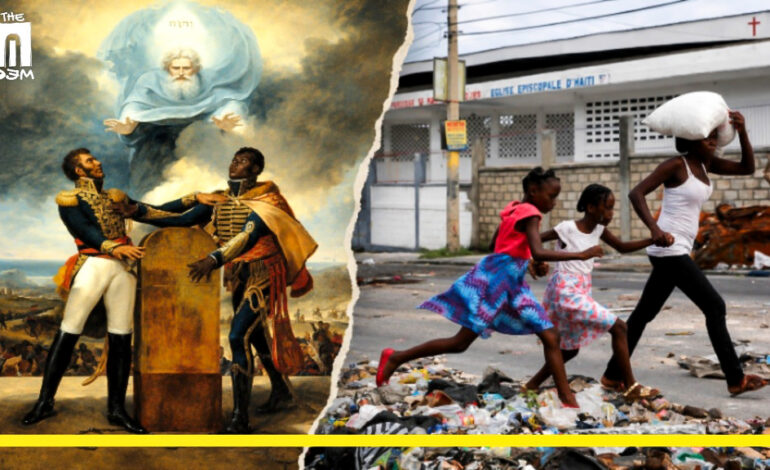
Forged by a radical revolution that terrified colonial empires, Haiti was systematically crippled by French debt extortion and international isolation. Today, as global media and institutions look away from its deep-seated crisis, the enduring tragedy demands reckoning.
An understated newspaper clipping from Geneva tells a harrowing tale of modern catastrophe: “At least 5,700 killed or wounded in Haiti gang violence this year: UN.” Below the bold headline, chilling statistics emerge—over 1,000 women and girls raped, hundreds kidnapped, an entire society collapsing under the boot of armed militias.
For the casual reader turning the page, it is just another distant tragedy from a troubled corner of the Global South. But for anyone willing to look deeper, this headline is not merely news of a contemporary humanitarian emergency; it is the screaming, unhealed scar of a historic crime.
Today, Haiti is frequently labeled a “failed state,” a convenient descriptor used by Western policymakers and media outlets to suggest inherent domestic dysfunction. Yet, this label is a malicious inversion of reality. Haiti did not fail; it was systematically broken. Its current desolation is the predictable, engineered outcome of a global order built on racial capitalism, imperial retribution, and callous international indifference.

Haiti continues to grapple with a deepening political, humanitarian and security crisis even today. (Image Source: The Newyork Times).
A More Glorious Revolution
To grasp the magnitude of Haiti’s tragedy, one must first recall its triumph—a revolution that remains arguably the most radical, pure, and glorious event in modern human history, yet is deliberately marginalized in global historiography.
While the American Revolution of 1776 preserved chattel slavery and the French Revolution of 1789 stumbled through hypocrisy while declaring universal rights for some, the Haitian Revolution (1791–1804) translated the loftiest ideals of the Enlightenment into uncompromising, universal reality.
Led by brilliant tacticians like Toussaint Louverture, Henri Christophe, Alexandre Pétion, and ultimately driven to total emancipation by Jean-Jacques Dessalines, enslaved Africans accomplished the unthinkable.
Armed with little more than sugarcane machetes, unbreakable resolve, and an unshakeable belief in their human dignity, they defeated the three great imperial superpowers of their day: the British, the Spanish, and the formidable armies of Napoleon Bonaparte. When Dessalines’s forces triumphed at the historic Battle of Vertières in 1803, they shattered the bedrock myth of white supremacy.
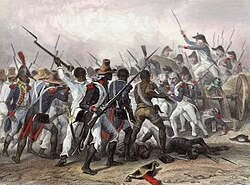
The Haitian Revolution (1791–1804) that culminated in Haiti’s independence and the establishment of the first independent Black republic in the modern world. (Image Source: Wikipedia).
Yet, this unprecedented triumph became Haiti’s original sin in the eyes of the global community. Slave-holding empires—including the United States, Britain, and France—viewed the mere existence of a thriving, free Black republic as an existential threat to their economic and racial hierarchies.
Rather than celebrating human liberty, the world locked its doors. The United States refused recognition for nearly six decades, while European powers threw a diplomatic and economic cordon sanitaire around the young nation.
The Gargantuan Extortion
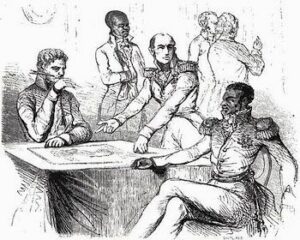
France’s 1825 indemnity ordinance. (Image Source: Wikipedia).
If isolation was designed to starve Haiti economically, the French indemnity of 1825 was designed to bleed it dry for eternity.
In a move dripping with imperial cruelty, France sent warships bristling with cannons to Port-au-Prince, forcing the young republic to agree to an astronomical ransom of 150 million francs—later reduced to 90 million—to compensate former French slave owners for their “lost property,” meaning the human beings who had liberated themselves.

Facsimile of the banknote for the 30 million francs Haiti borrowed from a French bank. (Image Source: Lepelletier de Saint-Remy, Étude et Solution Nouvelle de la Question Haïtienne).
To pay this extortionate “independence debt,” Haiti took out massive loans from French banks, plunging itself into an inescapable cycle of foreign debt that it spent over a century paying off.
Funds that rightfully belonged to building schools, hospitals, and infrastructure were siphoned directly into European vaults. Beyond European financial extraction, the 20th century brought relentless geopolitical interference, including the 19-year brutal U.S. military occupation (1915–1934) and subsequent backing of repressive dictatorships.
The nearly three-decade dictatorship of François “Papa Doc” and Jean-Claude “Baby Doc” Duvalier systematically devastated Haiti through terror, kleptocracy, and institutional destruction.
Papa Doc consolidated absolute power using a brutal private militia known as the Tontons Macoutes, weaponized Vodou to enforce psychological submission, and triggered a mass brain drain via violent purges.
His son, Baby Doc, continued the tyranny through grand-scale plunder of the national treasury, corrupt state enterprises, and the destruction of rural food security. By the time Baby Doc was forced into exile in 1986, the dynasty had left Haiti with a corrupted judiciary, a shattered economy, and a total absence of democratic culture, laying the structural groundwork for the nation’s ongoing instability.
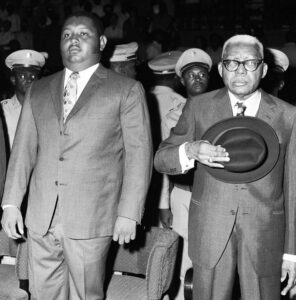
The Duvalier Era: François “Papa Doc” Duvalier and his son Jean-Claude “Baby Doc” Duvalier ruled Haiti for nearly three decades. (Image Source: The Haitian Times).
This devastating cycle of democratic suppression reached a poignant climax with the tragic political trajectory of Jean-Bertrand Aristide.
A charismatic former priest who rose to the presidency in 1990 as the champion of Haiti’s impoverished masses, Aristide found himself trapped between domestic oligarchic sabotage and hostile foreign intervention.
When his administration committed the ultimate political sin in 2003 by formally demanding that France pay over 21 billion dollars in restitution for the 1825 independence debt, his fate was sealed; domestic rebellions backed by foreign maneuvers culminated in his forced ouster in 2004, once again proving that whenever a Haitian leader dares to demand historic justice or dismantle structural inequality, external powers swiftly step in to crush the experiment.
The Cones of Silence
What makes Haiti’s current crisis uniquely tragic is not just its genesis, but the deafening apathy with which the modern international community and global media greet its suffering.
As the UN rights chief highlights thousands killed or wounded, thousands of women subjected to systemic sexual violence, and entire neighborhoods held hostage by armed gangs, the global response remains characterized by moral cowardice and selective humanitarianism.

Civilians in Haiti continue to bear the brunt of the country’s prolonged security and humanitarian crisis. (Image Source: The Guardian).
In major Western media networks, Haiti is rarely afforded the nuanced investigative depth or sustained analytical focus given to conflicts elsewhere.
When Haiti appears in headlines, it is typically reduced to flat, racist tropes: natural disasters, corruption, and eternal chaos. This lazy journalism actively obscures root causes, absolving Western imperialism and ongoing geopolitical interference of any responsibility.
The United Nations and multilateral institutions, too, have displayed an abysmal record of paternalism and failure in Haiti.
From the cholera epidemic introduced by UN peacekeepers following the 2010 earthquake, to successive cycles of failed security interventions, the international community treats Haiti not as a sovereign nation deserving of partnership, but as a perpetual charity case or a security threat to be contained.
A Ray of Hope
Yet, even in its darkest hour, Haiti’s spirit of resistance refuses to be extinguished.
Civil society groups and grassroots organizations continue to fight courageously for democratic self-determination, demanding an end to gang terror. Moreover, the global conversation on historic accountability is shifting. Across the Caribbean, through CARICOM, nations are stepping forward to demand reparatory justice.

The 51st regular meeting of the conference of CARICOM Heads of Government (5-8 JULY 2026). (Image Source: caricom.org).
The recent landmark petition filed by Jamaica before King Charles III, seeking accountability for historic slavery, represents a seismic crack in the wall of imperial impunity.
It creates a powerful precedent that invalidates the tired excuse that “centuries-old crimes carry no modern liability.” If Britain can be petitioned for its legacy of bondage, France’s historic extortion of Haiti demands an even more urgent reckoning.
Full reparatory justice for Haiti is not a charitable handout; it is a legally and morally binding restitution for a debt extorted at cannon-point.

Haitian-Americans demanding reparations for Haiti during a protest in front of the White House on May 19, 2018. (Image Source: Mundo Obrero Workers World).
The headlines screaming from Geneva about thousands dead and wounded in Haiti should horrify the global conscience. They are a daily reminder that the world watched as a glorious nation, which birthed the modern era of human rights and freedom, was slowly suffocated by racism, debt, and imperial design.
Haiti does not need patronizing pity or militarized intervention designed to prop up corrupt puppets; it needs restorative justice, genuine international solidarity, and the space to reclaim its revolutionary destiny.
Until the global community reckons with its own complicity in Haiti’s ruin, the blood spilled on the streets of Port-au-Prince will remain a damning indictment of a world that has still never forgiven Haiti for daring to be free.










Haiti’s story is not simply a story of a country in crisis; it is a story of what happens when a people dare to win freedom and the powerful refuse to forgive them for it. The Haitian Revolution shattered the foundations of slavery and colonial racism, yet the new republic was punished through isolation, crippling debt and generations of foreign interference. This powerful piece forces us to look beyond the convenient “failed state” narrative and confront the historical forces that helped create Haiti’s present tragedy. Haiti does not need pity—it deserves justice, dignity, sovereignty and the right to determine its own future. A necessary and deeply thought-provoking read by Faisal CK.