

Desire, Biopower and the Libidinal Economy of Caste

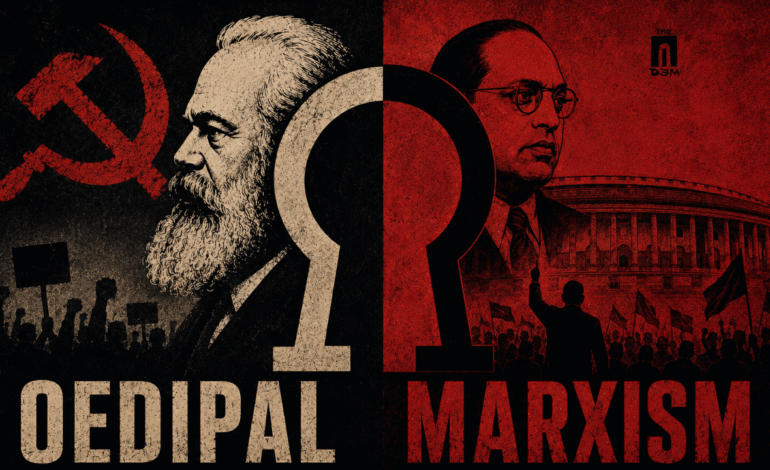
Part 2: The Oedipal Marxism
This is Part Two of The Oedipal Marxism, Solomon Mubash’s series on the crisis of Indian Marxism. Having traced how the Left ceded the inner domain in Part One, Mubash now turns to Reich’s question, why the oppressed so often march behind their oppressors, and argues that the Hindu Right won not by capturing parliament first, but by capturing desire: reading caste itself as a system of biopower long before Foucault gave the West a name for it.
The Reichian Question: Desire and Fascism
The scandalous question posed by Wilhelm Reich in his masterwork “Mass Psychology of Fascism” remains highly relevant. If Marxism was correct, if fascism was merely the last, desperate stage of finance capitalism, a tool of the ruling class to crush the workers, then why did German workers, the supposed revolutionary troops, flock to the Nazi flag in millions? Why did they not rise against the capitalists but instead march joyfully behind Hitler? The same question echoes here. Despite the diabolic economic inequality and caste oppression, why do the Indian masses keep the Left away and march behind Modi?
Reich warned that poverty does not automatically make people revolutionary; if people are raised in structures of fear and blind obedience, crisis will make them look for a dictator to save them, not a democracy to liberate them. Reich argued that fascism and the state don’t start brainwashing people when they are adults; the work is done in childhood by the authoritarian patriarchal family. The authoritarian patriarchal family that Reich identified is indeed the Indian norm, reinforced by centuries of caste, joint family structures, and religious prescriptions. But this family is itself a territorialisation machine, a device that codes desire into fixed identities, fixed hierarchies, fixed flows of deference and domination. The father as moral authority, the suppression of adolescent sexuality, the sanctity of kula dharma, the valorisation of discipline, the internalised shame around the body, these are not merely repressive structures in the Freudian sense. They are productive structures. They produce specific kinds of subjects who enjoy their own submission, who find intense pleasure in the rituals of caste purity, in the security of the patriarchal order, in the collective ecstasy of religious festival, in the righteous hatred of the other.
When the Hindu Right emerged as a mass force in the 1980s and 1990s, it did not need to create authoritarian psychology from nothing. It only needed to capture and reroute existing desiring-flows that the Left had utterly failed to engage. The RSS shakha did not invent discipline; it reterritorialised the existing disciplining of the male body in the patriarchal family onto the nation. The Ram temple movement did not invent the desire for a cosmic father; it took the longing for the absolute authority of the father that every Indian male carries in his psychic structure and projected it onto Lord Ram as the wounded, militant, cosmic father awaiting rescue from the “clutches of a Mughal Babar.”
The Left, by contrast, had no answer because it had refused to even ask the question of desire. It saw the masses as rational actors who would respond to economic incentives. It did not see that the masses were desiring subjects whose desires had been captured by the fascist war machine. The Left’s rationalism was not only politically useless; it was epistemologically blind. It could not see what the Right saw with perfect clarity: that the inner domain is not a residue to be dissolved but a battlefield to be won.
By quietly entering the Inner Domain of Indian society, the Right built an organic, everyday hegemony. They did not start by capturing parliament; they started by capturing the everyday common sense of the masses. While the Left indulged in protracted negotiations about the Calcutta thesis and American imperialism, the RSS was racking up gains in the Inner Domain.
Indian Libidinal Economy
The inner-outer split is not just a cultural division, but an architectural setup of the entire Indian libidinal economy (how human desire is organised and directed toward power). The outer domain is the molar realm: the world of large aggregates, rigid stratifications, binary choices, and centralised institutions. In this space, the state attempts to organise human beings into neat, countable, and manageable categories. The modern Indian state, whether run by the Right elite, the technocratic Left, or bureaucracy, uses Western language here. It speaks in terms of universal law, development indices, and scientific planning. But because it is purely molar, it treats human beings as bloodless, administrative units. It cannot touch or satisfy human passion, grief, ancestral trauma, or existential longing.
Chatterjee’s Inner Domain, the realm of faith, ritual, myth, language, and family, is what Deleuze calls the Molecular realm. It is the space of micro-politics, where raw human desire flows before it is organised into official laws or political party platforms.
The Hindu Right’s genius was that it did not start as a macro-political party trying to win the molar state. It started as a molecular intervention. Through organisations like the RSS, local shakhas, temple restoration programmes, temple committees, and festivals, the Right entered the molecular flows of the Inner Domain. They found the anxieties, loneliness, and fractured identities of the masses and reterritorialized them into a toxic, weaponised form of nationalism. They created what Deleuze calls micro-fascism – a fascism that takes root not in the halls of parliament, but in the daily desires, domestic habits, and spiritual fears of the individual.
Hindutva’s political neurotic is the tragic individual caught in this structural split: their body and economic survival are managed by a secular, bureaucratic state apparatus in the outer domain, while their soul and desires are captured by a micro-fascist machinery in the inner domain.
To break this split, a progressive Marxist front cannot simply demand that the inner domain be abolished in the name of a cold, Westernised rationality. That is an act of epistemic suicide.
Instead, the solution is to launch a molecular counter-offensive inside the Inner Domain itself. The Left must build a Rhizomatic Marxism that plugs directly into the liberating, egalitarian currents already flowing underground within subaltern culture, the anti-caste spiritualities, the radical Ambedkarite politics, and the historical memories of horizontal solidarity.
The Left must recognise Ambedkar as India’s first and perhaps the most sophisticated libidinal micro-politician. Libidinal micro-politics is the art of analysing and organising human desire, emotion, affect, and psychology at the level of the underground, long before they harden into political affiliations or economic classes. RSS, as the fountainhead of political Hindutva, operates in this libidinal realm.
Ambedkar was a master of this micro-political realm because he recognised a profound truth that traditional, macro-focused and Eurocentric Indian Marxists missed: The primary fortress of oppression in India is not the state capitol or the feudal estate, it is the interior architecture of the human mind. To maintain caste purity, the Brahminical order had to control the wildest, most untamable human drive: romantic and sexual desire. Ambedkar’s entire life was dedicated to the molecular project of re-wiring subaltern desire; transforming shame into pride, inferiority into political agency.
In the Indian context, Contrary to the West, the biopolitical management of populations was not invented by the modern industrial state. It was already encoded centuries ago into the material infrastructure of the caste system. The Brahminical social order engineered a total system of biopower long before the West, using the biological control of bodies to maintain structural domination.
Caste is the ultimate form of Anatamo-politics. Through the complex grammar of purity and pollution, the caste system enforces a rigorous, daily discipline on the physical body of the subaltern: the subaltern body is spatially confined to the colony. The micro-somatic laws of the caste convert the subaltern body into a site of permanent visible docility. The primary mechanism of the caste system, as Ambedkar famously identified, is compulsory endogamy. By strictly controlling reproduction, the Brahminical hierarchy ensures that the population’s biological borders remain completely closed and static. It manages the biological pool to ensure that wealth, land ownership, and cultural capital are inherited down a closed hereditary line, while landlessness, menial labour, and social degradation are biologically trapped within the subaltern population pool.
When the Indian Marxists in general and the Left governments in Kerala and West Bengal in particular treated caste purely through the lens of data, census counts, and income metrics, they were operating entirely within the molar, bureaucratic apparatus of modern Biopower. It reduces the historical, bodily trauma of caste to a clean, administrative chart. The caste body is not merely a physical entity; it is a psychosomatic formation, a body historically inscribed with the grammar of purity and pollution, shame and pride, visibility and invisibility. This body carries within it the ancestral trauma of untouchability, the micro-somatic memory of spatial segregation, and the libidinal architecture of desire shaped by endogamy.
The 10% EWS reservation implemented by the LDF government in Kerala and the CPI(M)’s support for income-based reservations are clear instances of biopolitical normalisation. Historically, reservation in India, conceived by Ambedkar and expanded by Mandal, was a highly disruptive, anti-biopolitical weapon. It was designed to force the historically excluded, stigmatised subaltern body into the restricted corridors of state power. It recognised caste as an anatomo-political system of bodily degradation. By substituting caste (a hereditary, biological, and spatial reality) with income (a fluid, individual financial condition), the Left government in Kerala and CPI(M) de-biologise the history of oppression and becomes a co-conspirator in Hindutva’s micro fascism at the molecular level. It pretends that an upper-caste family’s economic precarity is analytically identical to centuries of systemic untouchability, spatial segregation, and forced menial labour.
But a contextualised Subaltern Marxism must have rejected this bloodless abstraction. It asserts that you cannot understand the material reality of the Global South without recognising that caste is an infrastructure, a physical, somatic, and spatial mode of production and exclusion. By treating reservation as a simple anti-poverty scheme, molar Marxists ignore the historical, embodied reality of untouchability and spatial segregation, effectively executing an act of epistemic violence against the very masses they claim to represent.
The Right achieved total dominance by occupying the Molecular Inner Domain- the space of affect, faith, memory, and domestic anxiety- and reterritorializing it into a weaponised micro-fascism. Molar Marxism abandoned this territory, viewing it as a backward zone of “false consciousness” that would disappear with scientific education.
Subaltern Marxism (as argued by Shozab Raza) acts as an insurgent counter-offensive within this exact space. Instead of demanding that the subaltern discard their inner life for an alien, Westernised rationality, Subaltern Marxism couples directly into the liberating, horizontal currents already flowing underground within subaltern culture. It connects with what Ambedkar called Dhamma- the ethical, communal, and anti-hierarchical desires of the oppressed.
In this context, the EWS reservation is unmasked as a sophisticated class-caste offensive by the ruling elite. It is an attempt to use the state’s apparatus of power to legally protect upper-caste demographic dominance, while simultaneously laundering their cultural capital as state-certified “merit” and ensuring the upper-caste monopoly over both the institutional machinery of the state and the cultural soul of the everyday mind
Read the Opening article here
Part 3: The Oedipal Trap and the Ontological Wound of Caste, follows








This is a powerful interrogation of how caste is not merely a social hierarchy, but a system that shapes desire, power, bodies and everyday political life. The idea of a “libidinal economy of caste” exposes how deeply inequality can become embedded in what society is taught to desire, reject and normalise. A sharp and necessary intervention into the politics of caste and power.