

Chengara, Language, and the Routinisation of Charisma

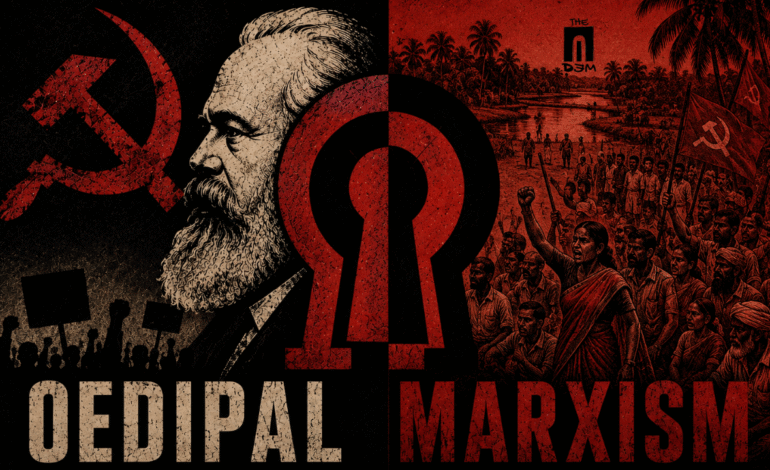
Part 4: The Oedipal Marxism
This is Part Four of The Oedipal Marxism, Solomon Mubash’s series on the crisis of Indian Marxism. Turning to the 2007-08 Chengara land struggle, where Dalit women defied the Left and were met with a blockade rather than solidarity, Mubash traces how the vanguard’s own vocabulary, “Harijan,” “SC/ST,” “landless labourer”, has helped contain the very subjects it claims to liberate, and how Kerala’s CPI(M) hardened from a rebellious “war-machine” into a routinised “state-form.”
The Chengara Rupture: When Dalit Women Refused the Father
The Chengara land struggle of 2007-2008 was precisely a rupture because Dalit women rejected the Left’s framing. They did not come to the Party as petitioners seeking economic relief. They came as political agents, occupying land and demanding not only survival but sovereignty, not only wages but dignity. The Party did not know how to deal with them, so it crushed them. By crushing such struggles and failing to establish horizontal connections with them, the Party dug its own grave.
The Party-Form has absorbed the historical, deeply rooted habits of the upper-caste landlord (Janmi) and cross-wired them with the cold discipline of a Stalinist bureaucracy. The result is a technocratic state that treats the subaltern not as historical actors but as unruly children who need to be managed, disciplined, and house-trained. When the subaltern masses express a wild, autonomous desire, such as the land occupations at Chengara or Arippa, they act outside the party’s manual. The paternalistic party reacts like an anxious, angry father. Paternalism replaces rights with charity. Through mega-projects like KIIFB, welfare kits, and digital classrooms, the party positions itself as the benevolent patriarch. The message is clear: the subaltern body must remain docile. It converts the radical rage of the Dalit and backward communities into a state of permanent, anxious gratitude. This was how the Karana Bhoother acquired flesh and blood, the revolutionary spirit frozen in the oedipal cage.
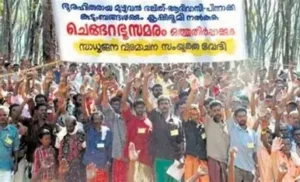
In Chengara, approximately 10,000 families occupied Harrison Malayalam’s rubber estates, demanding five acres of land and rehabilitation. These women refused to be passive “Harijans” receiving state charity; they occupied land as political agents. The state’s response revealed the violence underlying bureaucratic paternalism. The Joint Action Council of Trade Unions, affiliated with major political parties including the Left, imposed a blockade on the camp, cutting off access to food and medicine. The trade unions, theoretically the vanguard of working-class struggle, acted here as instruments of caste-class containment.
The Chengara struggle was against Capital (Harrison’s Plantation) and the Caste-State (the Left Government), but it was specifically against Brahminical Patriarchy because it targeted the modus operandi of that system: the erasure of Dalit women’s history, the weaponisation of their bodies, and the spatial segregation of their existence. In this specific context, Brahmanical patriarchy means that the modern administrative state has absorbed the old grammar of caste dominance and male authority. It uses technocratic and bureaucratic mechanisms to achieve the same ancient goals: the containment of subaltern bodies, the protection of elite monopolies over core resources, and the enforcement of absolute compliance under the guise of paternalistic care. When the women of Chengara refused to leave that land, they were not just fighting for five acres; they were fighting for the right to exist in a space not designated by the “new Brahmin” or the Bureaucrat. That is the essence of breaking the “Oedipal tie”: refusing to be the daughter of the Father-State and becoming the sovereign subject of one’s own life.
By forming an autonomous movement outside the Party hierarchy, the Chengara agitators broke the Oedipal tie, demonstrating that the struggle for land is inherently a struggle against both Capital and Brahminical Patriarchy. They showed that genuine emancipation requires horizontal solidarity among the oppressed, not vertical integration into Party structures. The Party, unable to incorporate this autonomous energy, crushed it. That crushing was not a tactical error; it was the logical expression of an epistemology that cannot recognise the ontological wound, that sees land as an asset rather than dignity, that treats the Dalit woman as a client rather than a comrade.
The Discursive Production of the Subaltern
To truly de-Oedipalise Indian Marxism, we must engage in what Michel Foucault called the “archaeology of knowledge”, uncovering how the subaltern is not merely oppressed by power but is literally produced by language. The subaltern does not exist as a pre-discursive fact; they are “arrested” into being through a series of linguistic categories that serve the interests of the describer. To speak of the subaltern is already to participate in this production, unless we constantly refuse these arrested terms.
The vocabulary of Indian politics functions as a series of captures, each designed to freeze the subaltern into a manageable, non-threatening identity.
“Harijan” is the paternalistic arrest: Gandhi’s term, meaning “children of God,” embodies a magnificent yet boiling paternalism. By elevating the untouchable to a kinship with divinity, it effectively denies their political militancy. It transforms a subject of rage, rebellion, and consciousness into a passive object of moral pity, a child awaiting the grace of the upper-caste father, paternal bureaucrat, or Oedipal leader.
“SC/ST” is the bureaucratic arrest. This is the language of the Secretariat. It flattens thousands of distinct histories, cultures, struggles, and specific agonies into a single administrative category. In the arborescent logic of the state, the SC/ST become data points in a welfare register, stripped of the rhizomatic complexity of their actual social lives.
“Landless Labourer” is the Marxist arrest. By reducing the subaltern to an economic category, orthodox Marxism commits a violent exclusion. It overlooks ontological degradation, the fact that a Dalit is not merely exploited for their labour but degraded in their very being. A worker can strike for wages, but a landless labourer trapped in a caste hierarchy is fighting for the right to exist as a human being, a reality that the economic category cannot contain.
“Backwards” is the developmentalist arrest. This term is perhaps the most deceptive. It frames the subaltern as someone lacking or behind in a linear race towards Western-style modernity. It suggests they need “upliftment” (development) rather than “liberation” (politics). It hides the fact of active oppression behind the mask of passive backwardness.
A rhizomatic Indian Marxism must practise radical linguistic disobedience. It must recognise that the vanguard has used these terms to keep the subaltern in their place, as clients of the state, as voters for the party, as subjects of the bureaucrat. Following Gayatri Spivak’s warning that the “subaltern cannot speak” within dominant discourse, the task is not to speak for them but to dismantle the categories that silence them. We must move from the arrested term to the asserted term, where the Dalit, the Adivasi, and the worker who lives by their sweat reclaim the right to name their pain and dreams. Only by refusing the language of the Father (the State, the Party, the Paternalist) can the subaltern emerge as a revolutionary subject in their own right.
The Routinisation of Charisma: From War-Machine to State-Form
When a revolutionary party achieves prolonged state power within a constitutional framework, it undergoes a structural mutation. It transforms from a counter-hegemonic force into a managerial elite. In Kerala’s specific history, this is not a simple story of good versus bad leaders but a complex institutional shift. The structural trajectory of the CPI(M) in Kerala leading up to the 2026 electoral shift offers a classic case study in what Max Weber termed the “routinisation of charisma” and the iron law of bureaucracy.
“Routinisation of charisma” is a foundational sociological concept that explains how the radical, unpredictable energy of a charismatic leader or movement is eventually captured, stabilised, and transformed into a routine legal-administrative bureaucracy. In twentieth-century Kerala, this charisma belonged to the early peasant uprisings, the legendary trade union leaders, and mass mobilisations against landlords. This power was rhizomatic, fluid, emotional, rebellious, and deeply connected to the popular desires of the subaltern. Charismatic authority is inherently anti-institutional. It does not care about balanced budgets, administrative files, or bureaucratic protocols; it cares about radical transformation and breaking the old world.
When a Marxist vanguard transitions into a stable governing party, the routinisation manifests through specific structural shifts. The revolutionary who once led underground strikes is replaced by the professional-managerial class, the technocrat, the party bureaucrat, and the careerist student politician. The ultimate proof of routinisation is when the party’s primary political argument changes from “We will transform social relations and smash caste-capital alliances” to “We are highly efficient managers who can build bridges, secure global investments, and balance the welfare budget.” Charisma has been thoroughly secularised into project management.
The tragic irony of Weber’s concept is that routinisation kills the very spark that made the movement successful in the first place. By trading the messy, unpredictable, horizontal energy of mass struggles (the “Mother-soil”) for the safety, predictability, and vertical command of a fortified bureaucracy (the “Father-State”), the party creates a magnificent administrative machine. But it is a machine with swollen legs. It can calculate, manage, and govern, but because its charisma has been completely routinised into a legal-bureaucratic structure, it can no longer inspire, adapt, or ultimately liberate.
The deep, emotional faith that cadres once had in the revolution does not disappear; instead, it is captured by the apparatus. It is converted into strict, uncritical obedience to the party hierarchy. Ideological debates are replaced by administrative reports, and party congresses become rituals of acclamation rather than sites of organic, creative friction. When applied to the institutional history of a revolutionary party like the CPI(M) in Kerala, this explains how a highly energetic, disruptive “War-Machine” inevitably hardens into a rigid, predictable “State-Form.”
The Realignment of the Party-State Nexus in Kerala
In classical Marxist-Leninist organisational theory, the Party State-Secretariat functions as the collective intellect, generating policy through democratic centralism, while the legislative wing acts as the executor of that collective will. However, the governance model of the late Pinarayi Vijayan administration inverted this paradigm through technocratic centralisation.
Policy formulation shifted from the collective, deliberative spaces of the Party forums to an insular, techno-bureaucratic caucus located within the Chief Minister’s Office and its own exclusive extensions. This caucus, largely composed of senior bureaucrats and specialised consultants, relied on data-driven, managerial metrics rather than dialectical feedback from grassroots-level cadres. Consequently, the party’s organisational structure underwent a subtle transition. Instead of serving as platforms for fierce ideological debate and strategic re-evaluation, they increasingly functioned as spaces for the ratification of executive decisions. Internal dissent was not always overtly crushed; rather, it was structurally neutralised through the introduction of managerial consensus, rendering counter-arguments irrelevant to the technocratic design.
Philosophically, this shift marks the moment the party ceased to be a “War-Machine” fighting against bourgeois state structures and instead became an integral part of Louis Althusser’s Ideological State Apparatus. The party became indistinguishable from the administrative apparatus it was historically mandated to contest. It mastered the art of governance, proving highly effective in distributing social security pensions, organising disaster relief, and managing public healthcare crises. However, as Antonio Gramsci noted in his critique of the “Passive Revolution,” when a radical party limits its role to the efficient administration of an existing system, it displaces the possibility of structural transformation. The state governed, but it did not liberate; it managed the existing social matrix rather than dismantling the deep-seated hierarchies of caste, landlessness, and economic precarity.
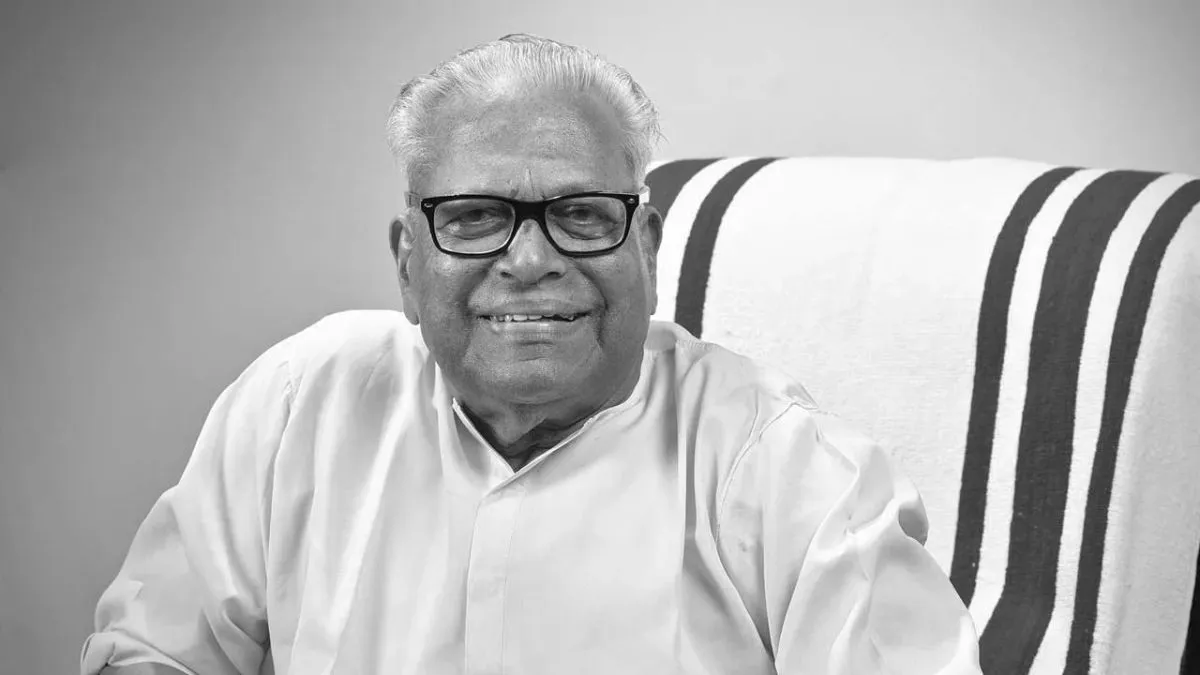
The marginalisation of legacy leaders who historically represented the agrarian and trade-union struggles, exemplified by the late-career containment of figures like V.S. Achuthanandan, was not merely a personal political battle. It represented the systemic victory of the professional-managerial class over the experiential and ideological cadre. When the Chief Minister’s Office became the singular “source of truth,” the party cadre was re-professionalised into a volunteer workforce tasked with popularising government schemes. The comrade was stripped of their role as an active political Subject capable of reading and critiquing social realities and was instead assigned the role of an administrative cheerleader.
This structural insulation created an epistemological blind spot: the leadership could calculate the distribution of welfare benefits down to the last decimal point, but they could no longer feel the silent, growing resentment of the subaltern classes who felt excluded from the actual corridors of power.
Read the Opening article here
Part 5: KIIFB, the 2026 Collapse, and the Peasant’s Desiring-Machine, follows


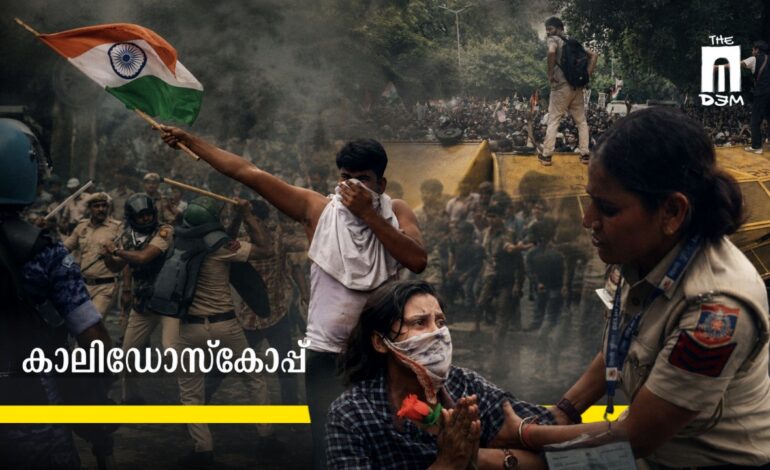





Solomon Mubash’s powerful reading of Chengara goes straight to the heart of a political failure: the moment the oppressed stop waiting for someone else to speak for them, established power begins to panic. Chengara was never just a land struggle—it exposed the persistence of caste, hierarchy and political paternalism within institutions that claim to speak for justice. The real crisis is not the charisma of a leader, but the routinisation of power that turns movements into mechanisms of control. Democracy demands more than representation; it demands that the oppressed themselves remain the authors of their political destiny.