

India’s Growth Paradox: Amid Claims of a Booming Economy, a Generation Struggling for Jobs

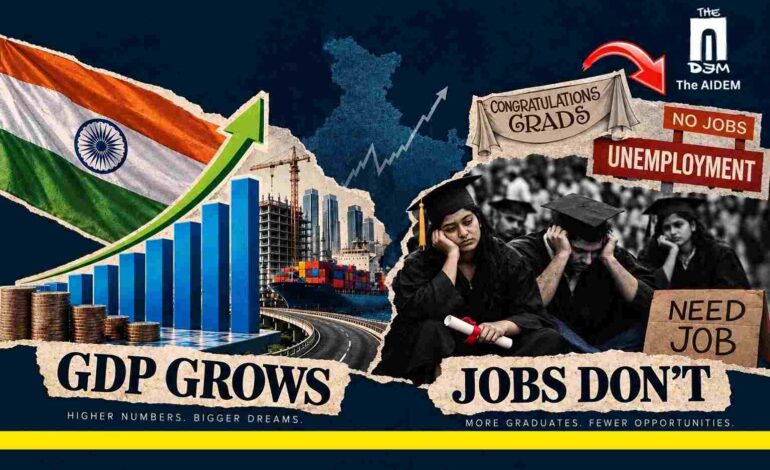
India is producing graduates faster than its economy can provide them with meaningful employment. Every year, millions of young Indians graduate with expectations of embarking on their careers, only to confront an economy that is not generating enough jobs to match their aspirations, leaving their ambitions stalled at the threshold of opportunity.
India’s employment challenge is not simply about creating jobs, but also about ensuring that education translates into meaningful employment. The International Labour Organization (ILO)–Institute for Human Development’s India Employment Report 2024 found that youth unemployment among university graduates stood at 29.1% in 2022, rising to 34.5% among female graduates in India.
More recent data from the Government of India’s Periodic Labour Force Survey (PLFS) put the overall unemployment rate among young people aged 15–29 at 9.9% in 2025. Although these figures measure different groups and cannot be compared directly, they highlight why the transition from education to employment remains a pressing issue for India’s labour market.
In 2025, India presented an economic paradox: strong economic growth coexisted with persistent concerns about employment opportunities. While India remained one of the world’s fastest-growing major economies, the challenge of translating economic expansion into adequate employment continued to attract attention.
For the millions of educated and aspiring young Indians who are either unemployed or underemployed, celebrations of macroeconomic achievements ring hollow. Far from being merely a statistical anomaly, this disconnect between headline growth and actual job creation at the grassroots constitutes one of the most consequential challenges to India’s long-term development, social stability and global competitiveness.
The scale of this problem is enormous; each year, more than 12 million young people enter the Indian labour force, representing a demographic wave with the potential to become a substantial dividend. However, this potential is increasingly becoming a source of deep disillusionment.
Recent data from the Ministry of Statistics and Programme Implementation (MoSPI) highlight the continuing challenge of youth and educated unemployment in India. According to the Periodic Labour Force Survey (PLFS) Annual Report 2025, the unemployment rate among young people aged 15–29 stood at 9.9% in 2025, while the unemployment rate among educated persons aged 15 and above (those with secondary education or higher) was 6.5%.
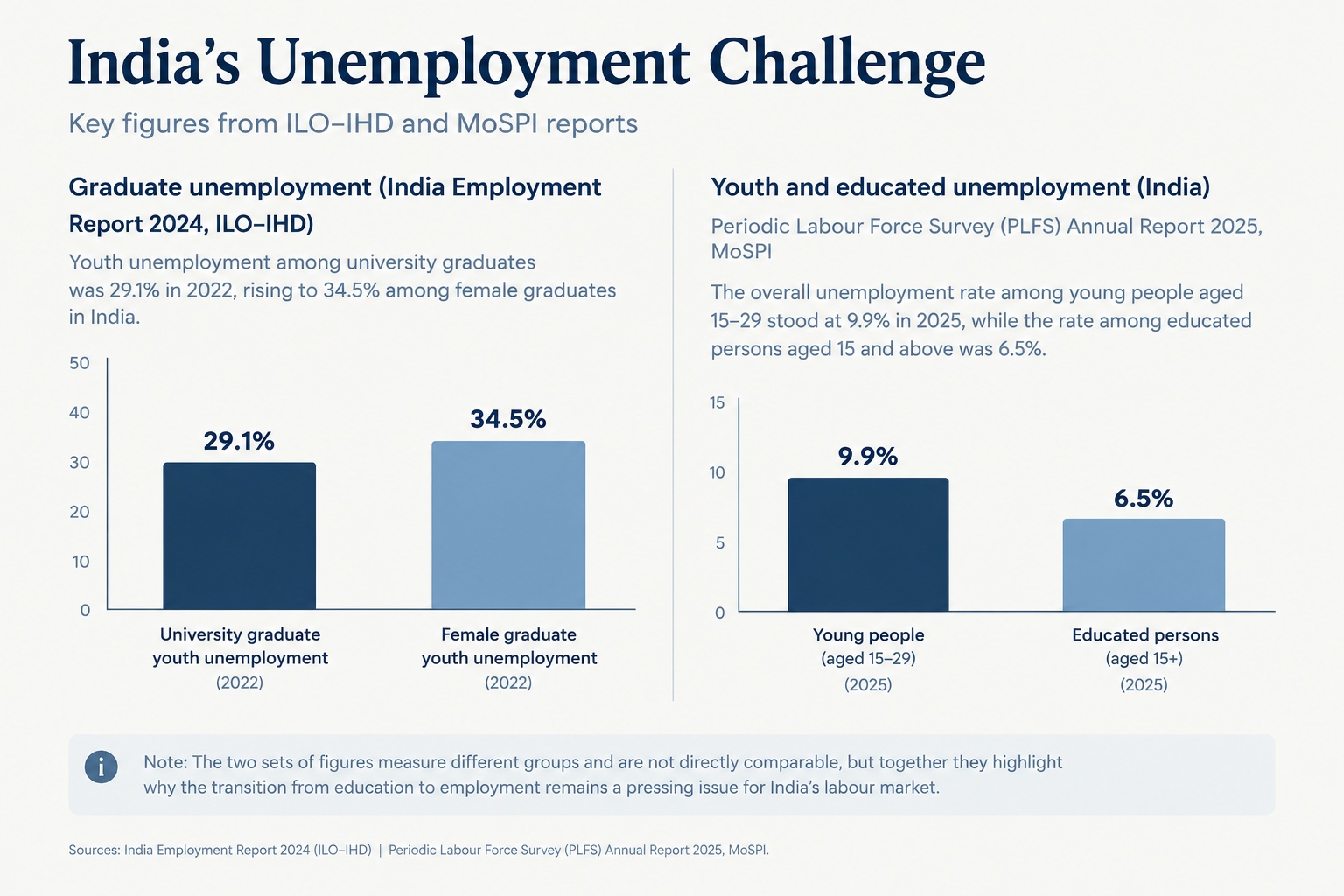 Unemployment among university graduates and female graduates in India in 2022, alongside unemployment rates among young people aged 15–29 and educated persons aged 15 and above in 2025. [Sources: India Employment Report 2024 (ILO–IHD) and PLFS Annual Report 2025 (MoSPI)].
Although these rates declined from 10.3% and 7.0%, respectively, in 2024, the figures underline the continuing importance of creating adequate employment opportunities and improving the transition from education to work.
The 9% Dream Will Not Be Built on Services Alone
Economic growth is a central pillar of Sustainable Development Goal 8, and India has registered substantial expansion, growing at approximately 7.5% annually. But the ambition is higher: growth of 9–10%. Achieving this will require a transformation in the principal engines of growth.
So far, India’s economic expansion has been driven largely by services, which account for roughly 62% of GDP. Such a model may suit wealthy, sparsely populated economies. For a country of India’s population and income level, however, it cannot absorb the vast numbers entering the workforce.
The experiences of China, Japan and South Korea demonstrate the importance of manufacturing as a route to sustained growth and large-scale employment, offering lessons that India would do well to consider.
Japan’s industrial strategy offers an instructive example. While much of the world operates on either 110 volts, as in the US, or 220 volts, as in India, Japan uses a 100-volt system.
This is often cited as a means of protecting the domestic market for Japanese manufacturers, enabling them to establish large production facilities, achieve economies of scale and compete effectively in global export markets. But such insulation comes at a cost: a country that closes itself off risks forfeiting the benefits of rules-based international trade.
Thailand followed a different path. By imposing local-content requirements on multinational manufacturers such as Toyota and Honda, it encouraged them to develop integrated domestic supply chains.
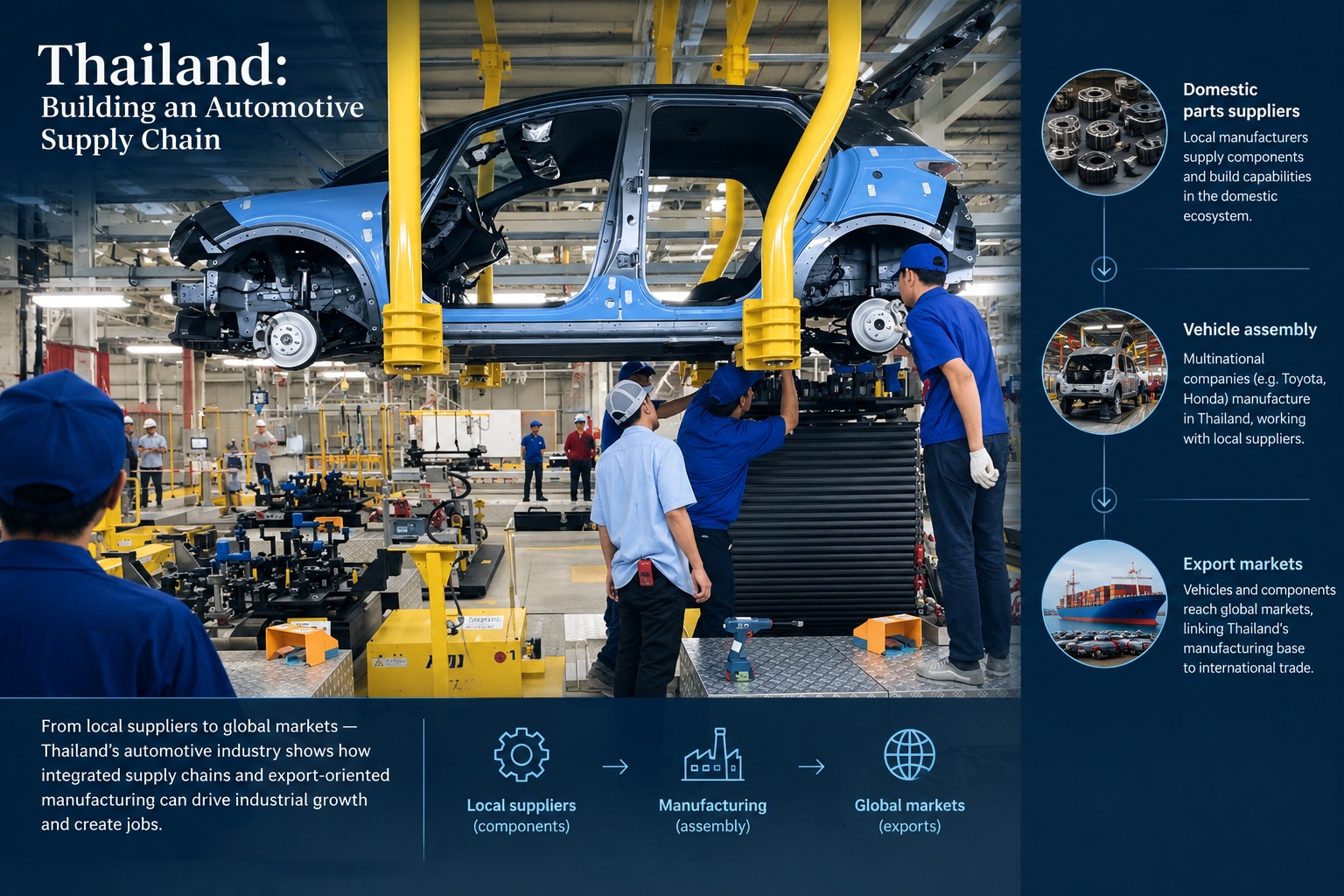 Thailand, often dubbed the “Detroit of Asia,” has built a major automotive manufacturing hub by connecting multinational automakers with domestic suppliers and global export markets—demonstrating how integrated supply chains can support industrial growth and job creation.
By linking these requirements to export performance, it also compelled them to compete in international markets. The result was the emergence of one of Asia’s largest automobile industries, earning Thailand the description of the ‘Detroit of Asia’.
The stakes are particularly high for young people. Although global unemployment fell to a record low of 4.9% in 2025, this headline figure conceals deep inequalities.
In 2024, some 259 million young people aged 15–24, or one in five worldwide, were outside education, employment or training. Young women bore the heaviest burden, being twice as likely as young men to find themselves in this position.
Why Are India’s Jobs Not Keeping Pace?
If the objective is economic growth that generates employment, it is necessary to confront the structural constraints holding India back. Three problems stand out.
First, automation presents both opportunities and risks. The employment implications of artificial intelligence (AI) are becoming increasingly significant.
 Microsoft’s 2025 Work Trend Index highlights the growing role of AI agents in Indian workplaces, as businesses prepare to integrate AI into everyday workflows. [Source: Microsoft, 2025 Work Trend Index Annual Report].
The IMF’s 2025 report on India estimated that approximately 26% of Indian workers were employed in occupations highly exposed to artificial intelligence, with around 12% working in occupations facing a greater risk of displacement.
However, exposure to AI does not automatically translate into job losses; some occupations may benefit from improvements in productivity. The central concern is whether workers can acquire the skills necessary to adapt as the nature of work changes.
Secondly, India’s manufacturing sector continues to face difficulties in absorbing a large workforce. According to the Economic Survey 2025–26, manufacturing accounted for 11.4% of total employment in 2023–24, while its share of nominal GDP stood at 12.6% in FY 2024–25.
This highlights the gap between manufacturing’s contribution to economic output and its capacity to generate employment on a large scale. The World Bank has also identified labour-intensive industries such as textiles, apparel, leather and footwear as important sources of employment, particularly for women.
Its analysis found that, in 2020, labour-intensive sectors accounted for more than 40% of formal manufacturing jobs while contributing less than 20% of formal manufacturing gross value added. These figures underline the potential of labour-intensive manufacturing to generate employment when supported by appropriate infrastructure, skills and export opportunities.
China put its vast surplus of rural labour to work through Township and Village Enterprises, bringing factories to the countryside rather than compelling workers to migrate to cities. Vietnam’s Doi Moi reforms of the 1980s replaced central planning with an export-led, investment-friendly economic model.
India, however, has witnessed only limited change despite flagship initiatives such as Make in India and the Production Linked Incentive schemes. Manufacturing’s share of GDP and, more importantly, of total employment remains stubbornly low.
Policy has tended to favour capital-intensive sectors such as electronics and automotive assembly, which are economically valuable but do not generate employment on the scale India requires. Labour-intensive industries such as textiles, footwear and food processing still lack the supporting ecosystem that competitors such as Vietnam and Bangladesh have developed.
Lastly, graduate employability remains a serious concern, particularly where employers’ expectations do not align with the skills graduates possess.
Mercer Mettl’s India’s Graduate Skill Index 2025 reported that 42.6% of Indian graduates applying for jobs met its employability benchmark in 2024, down from 44.3% in 2023. Employability for non-technical roles also declined from 48.3% to 43.5% over the same period.
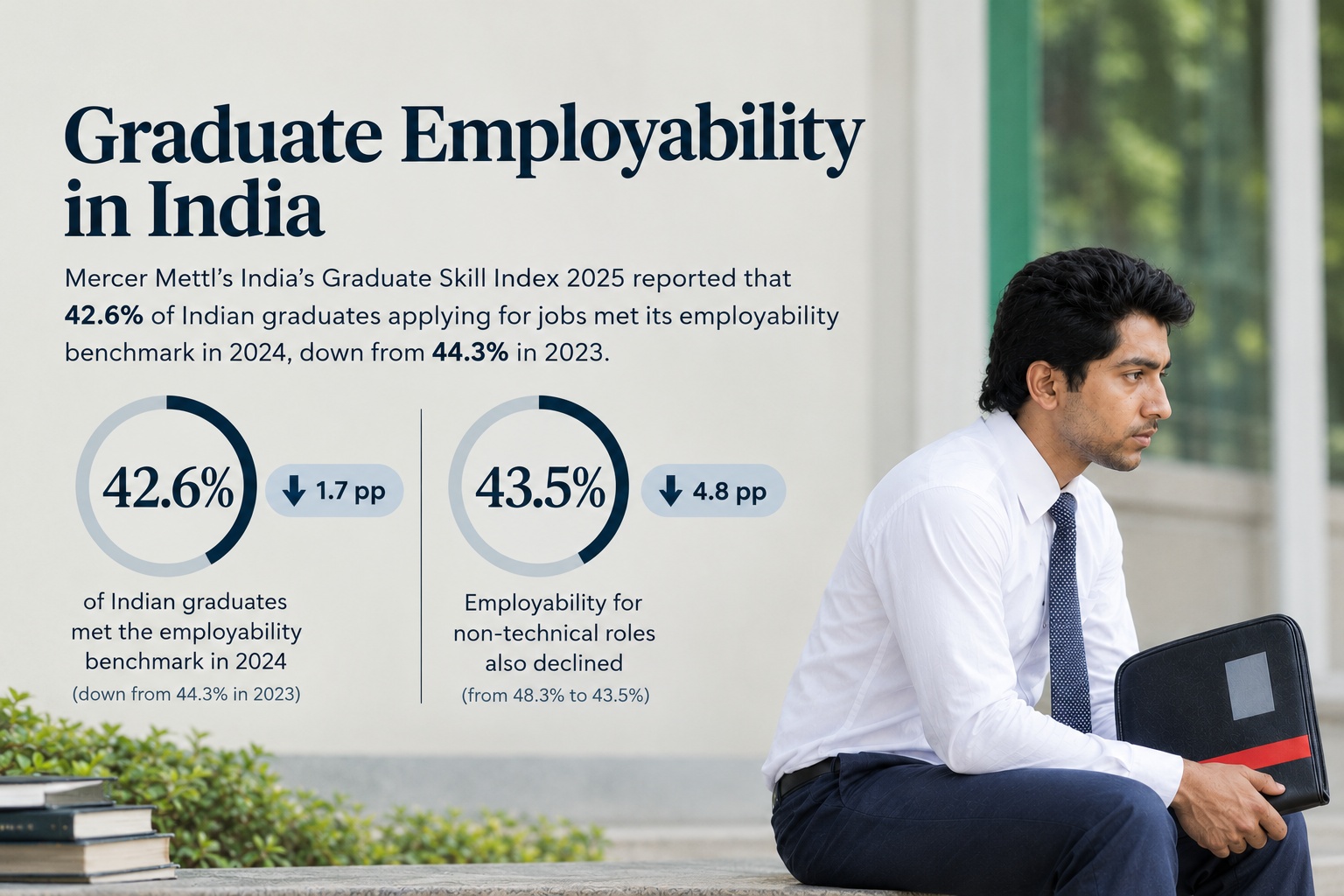 A widening gap between academic qualifications and industry expectations raises urgent questions about the quality, relevance and outcomes of higher education in India.
These findings point to the importance of strengthening practical learning, communication, critical thinking and industry exposure alongside academic knowledge. The challenge, therefore, is not simply to expand access to higher education, but to ensure that education prepares students for the changing demands of the labour market.
Fixing the Fault Lines: A Job-Led Growth Strategy
Addressing this crisis will require a fundamental reorientation of economic policy, shifting the emphasis from simply expanding the economy to ensuring that growth is inclusive and employment-generating. Four measures stand out.
First, India must empower its micro, small and medium enterprises (MSMEs) as engines of job creation. These enterprises form the backbone of the economy and constitute one of its largest sources of employment, yet they are too often celebrated in speeches while receiving inadequate policy support.
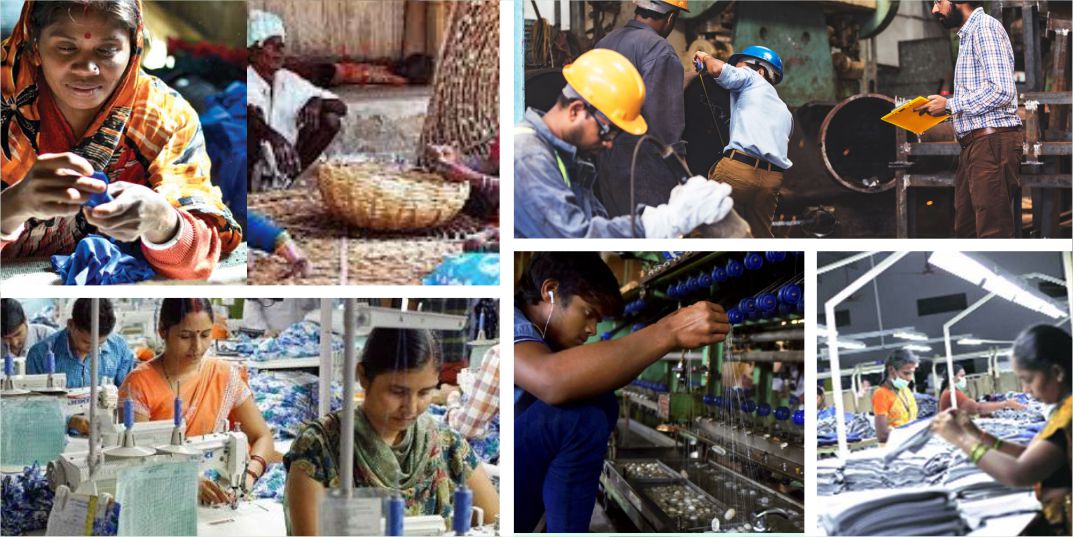 India’s MSMEs: The Backbone of Employment and Economic Growth
They require easier access to credit, technology and formal markets. Reducing the burden of regulatory compliance and integrating them into national and global value chains would enable them to expand, recruit more workers and compete effectively.
Secondly, skill development must be reimagined through a National Mission for Skill Development 2.0. Training programmes have largely been supply-driven, producing certificates that employers often attach little value to.
They must instead become demand-led and be developed in close partnership with industry. A nationwide apprenticeship programme, modelled on the German system, could provide practical, on-the-job training and establish a direct pathway from the classroom to the workplace.
Thirdly, policy support must be directed towards labour-intensive sectors with high employment elasticity. These include traditional strengths such as textiles and tourism, as well as emerging green industries.
From the installation and maintenance of renewable energy systems to waste management and electric vehicle manufacturing, the green transition presents a major opportunity to create millions of jobs in emerging sectors.
Lastly, India needs labour laws and social security arrangements suited to the twenty-first century. The framework must strike a balance between flexibility for employers and security for workers.
Most importantly, it should provide a portable social safety net covering gig and informal workers, with healthcare, insurance and pension benefits that remain available to them regardless of their employer.
 A gig delivery worker navigates flooded streets, underscoring the need for stronger social security and labour protections for India’s gig workforce.
Viksit Bharat versus Aspirations of the Commons
India stands at a critical juncture, where its economic achievements must translate into meaningful opportunities for its people. High GDP growth may strengthen the country’s standing in the global economy, but it cannot be regarded as an unqualified success if millions of educated young people continue to struggle to find employment.
The widening disconnect between economic expansion and job creation underscores the need to reconsider the priorities of development. Growth must be measured not only by how much an economy produces, but also by how effectively it generates stable livelihoods, improves living standards and enables people to participate in the country’s progress.
Achieving this will require coordinated efforts by the government, industry and educational institutions. Strengthening labour-intensive manufacturing, aligning education with industry requirements and extending social security to vulnerable workers can help bridge the gap between economic growth and employment generation.
Equally important is ensuring that technological progress complements human capabilities rather than leaving workers behind. These measures are not merely responses to unemployment; they are also investments in India’s productive capacity, social stability and long-term economic resilience.
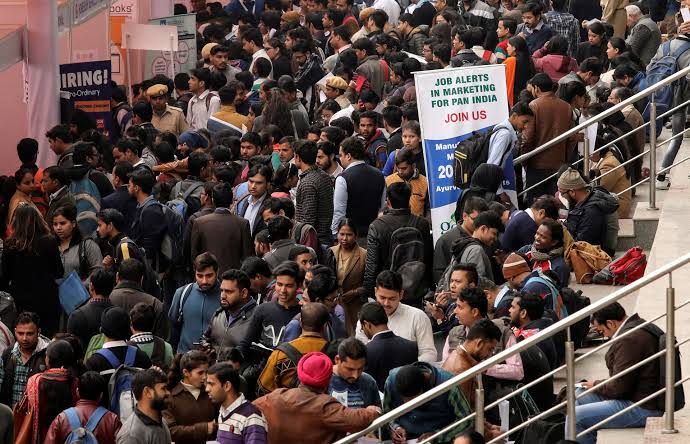 A massive crowd of job seekers at an employment fair in New Delhi, India amid growing concerns over youth unemployment.
Ultimately, India’s ambition of becoming a Viksit Bharat cannot rest on impressive growth figures alone. It must be underpinned by an economy that creates opportunities across regions, income groups and skill levels, enabling young people to translate their aspirations into achievements.
This is where Sustainable Development Goal 8, which calls for decent work and sustained, inclusive economic growth, assumes particular significance. India’s demographic dividend can become a genuine advantage only when its people possess the skills and opportunities necessary to contribute meaningfully to development.
The real measure of India’s economic success will not simply be how fast its economy grows, but how many lives that growth enables to advance.









India’s booming economy means little if its youth are struggling for jobs, decent wages and a secure future. GDP figures and grand promises cannot hide the ground reality of unemployment, underemployment and growing economic insecurity. A demographic dividend becomes a demographic disaster when a generation has education and ambition but no meaningful opportunities. Real development must be measured not by statistics celebrated by those in power, but by jobs created, wages earned and lives improved. India’s youth deserve opportunities, not just slogans about a rising superpower.