

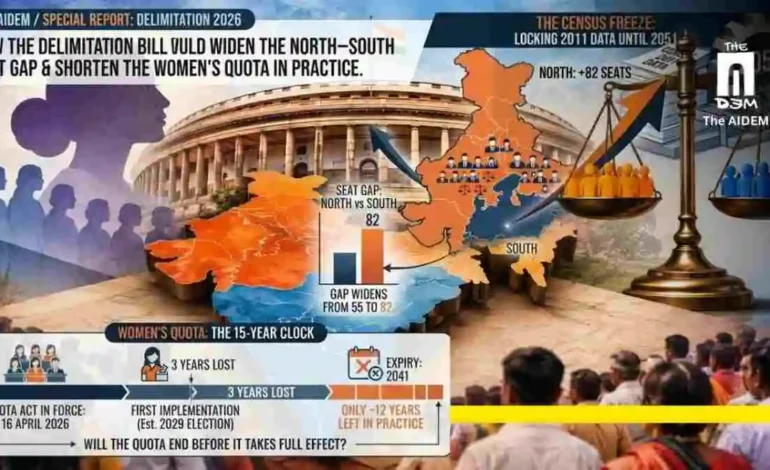
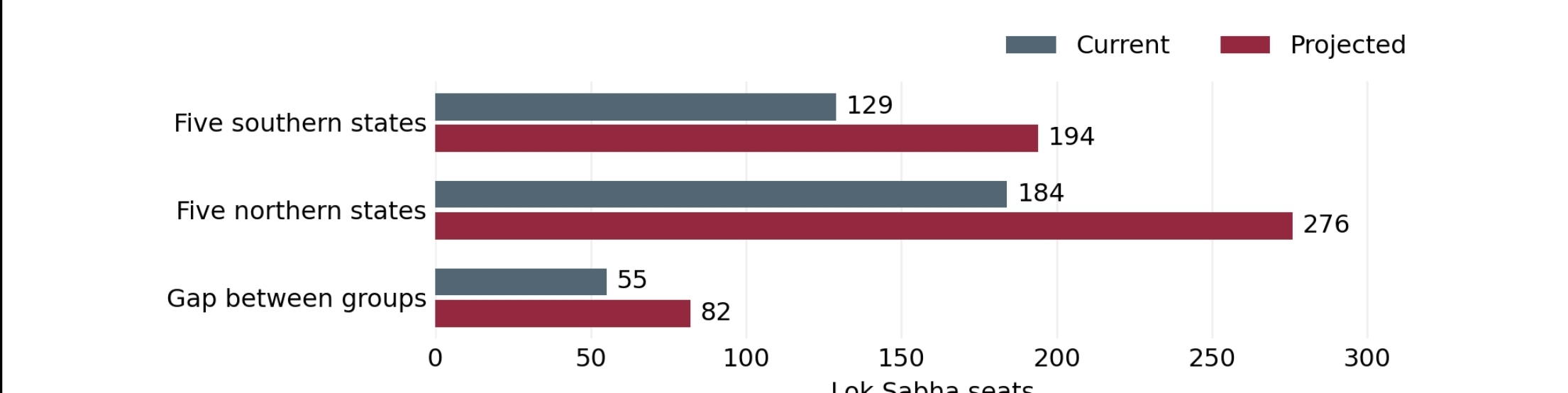
What happens to the balance of power in the Lok Sabha when every state gets 50 per cent more seats? The Centre’s Delimitation Bill would widen the Lok Sabha seat gap between five northern and five southern states from 55 to 82, according to original tabulations by Maadhyam in its 28 November 2026 briefing.
Cleared by the Union Cabinet on Friday and due before Parliament next week, the Bill would expand the Lok Sabha and State Assemblies by 50 per cent. The Centre says the expansion would allow the one-third women’s quota to take effect after the first delimitation under the proposed law.
The Centre proposes a 50 per cent expansion of the Lok Sabha and state Assemblies, with new constituency boundaries likely to be drawn from the 2011 Census. Maadhyam warns that the plan would carry existing disparities into a larger House and lock the new electoral map in place until 2051.
The Bill follows the defeat of the Constitution (131st Amendment) Bill in the Lok Sabha on 17 April. The April Bill would have given Parliament discretion to choose the census for delimitation through an ordinary law. The new Bill prescribes a uniform increase, carries forward the interstate allocation broadly based on the 1971 Census and uses the latest census figures published when the amendment comes into force to draw constituency boundaries. Those figures are likely to be from 2011. The resulting allocation and boundaries would remain in place until 2051.
The Arithmetic of a Flat Increase
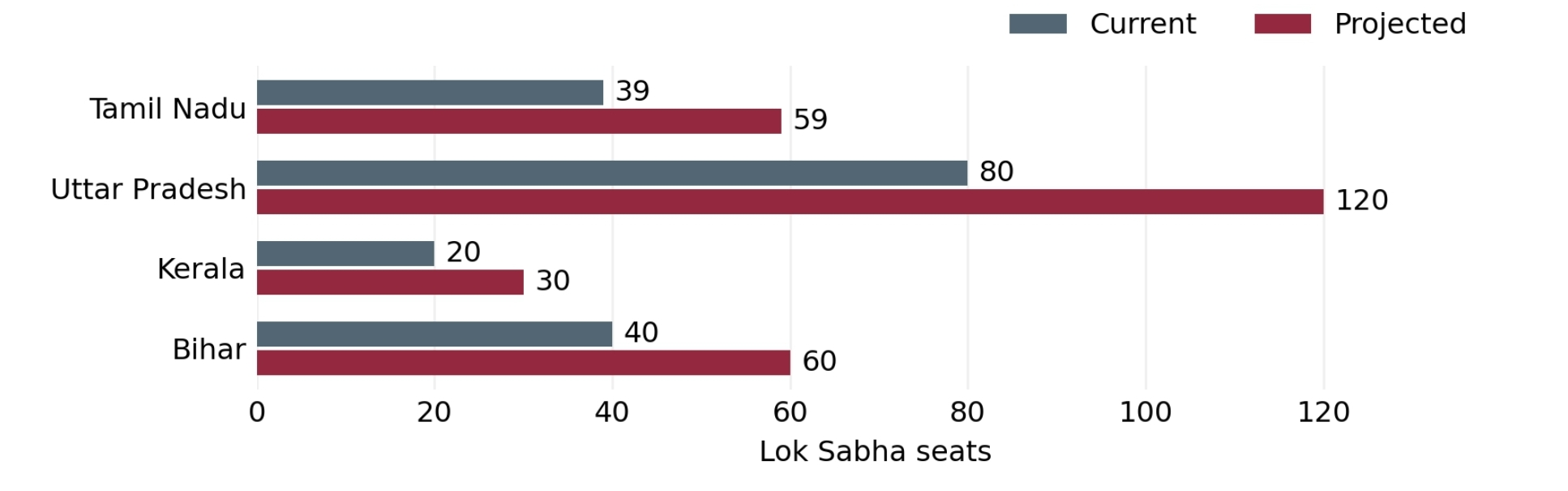
The percentage shares would stay broadly similar, while the larger delegations would gain more seats in absolute terms. Maadhyam argues that this matters in parliamentary divisions, including votes on constitutional amendments. It also points to estimates of roughly 19.2 lakh people per MP in northern states against 13.5 lakh in southern states to illustrate the disparity in representation. A uniform increase would lower the number of people per MP while broadly preserving that disparity, leaving unresolved the question of equal vote value under Article 81.
The longer freeze addresses a demand raised by regional parties including the DMK and the NCP (Sharadchandra Pawar). Maadhyam questions the value of setting 2051 as the new horizon while expanding the House now. It cites former Chief Election Commissioner S.Y. Quraishi and political analyst Yogendra Yadav as having argued for deferring both expansion and delimitation until 2051, around the period when some projections put India’s population peak or stabilisation.
Who Draws the New Constituencies
With the interstate formula fixed, the Delimitation Commission’s most consequential decisions would concern where constituency boundaries are drawn within states. Maadhyam points to concerns raised over the exercises in Assam and Jammu and Kashmir and warns that the new lines could concentrate caste or religious communities in a few seats, dilute their influence elsewhere and make some constituencies harder for opposition parties to win.
The companion Delimitation (Second) Bill provides for the Union government to constitute the commission after the law comes into force. The body includes the Chief Election Commissioner or an Election Commissioner nominated by the CEC. Maadhyam argues that the Union government’s influence over appointments to the Election Commission under the 2023 law makes scrutiny of the boundary-drawing process especially important.
The 2011 Census Would Shape Reserved Seats Until 2051
The new map would also determine how many Lok Sabha and Assembly seats are reserved for Scheduled Castes and Scheduled Tribes. Under Articles 330 and 332, the applicable population figures would come from the latest census published when the amendment takes effect, likely the 2011 Census. The arrangement would hold until 2051. Existing special provisions for Scheduled Tribe representation in the Assemblies of Arunachal Pradesh, Meghalaya, Mizoram, Nagaland and Tripura would continue until the subsequent readjustment.
Maadhyam argues that SC and ST communities could receive fewer reserved seats than they might under an allocation based on the 2027 Census. It also warns that settling the framework now would narrow the scope for a debate on legislative reservation for Other Backward Classes once the caste enumeration is available. The briefing cites a precedent for increasing reserved representation within the existing House. After the 2001 Census, Lok Sabha seats reserved for SCs rose from 79 to 84 and those for STs from 41 to 47, with the overall strength unchanged.
A 15-year Quota With Three Years Already Spoken For
The Centre presents the expansion as a way to implement the women’s quota before the publication of the next census. The Bill would bring the quota into effect after the first delimitation under the amendment, provide for rotation of reserved seats and leave sitting Houses intact until dissolution. The revised Article 334A covers the Lok Sabha, state Assemblies and the Assemblies of Delhi, Puducherry and Jammu and Kashmir.
The 15-year period runs from 16 April 2026, when the Constitution (106th Amendment) Act came into force. If the quota first applies to a Lok Sabha election in 2029, roughly 12 years would remain before it expires in 2041, unless Parliament extends it by law. In states where it takes effect later, the period would be shorter still. Maadhyam argues that Parliament could have implemented the quota earlier by removing the census and delimitation conditions, and questions why the new Bill retains the original expiry date.

More MPs and MLAs With Little Debate Over How the Houses Will Work
The Bill would raise the Lok Sabha’s constitutional ceiling from 550 to 850, with up to 815 members from states and 35 from Union territories. The present elected House has 543 seats. The Assembly ceiling would rise from 500 to 650, alongside the proposed 50 per cent increase in each Assembly. The April Bill contained the higher Lok Sabha ceiling but did not provide for a corresponding expansion of state Assemblies. Maadhyam says there is no public record of state governments being consulted on that change.
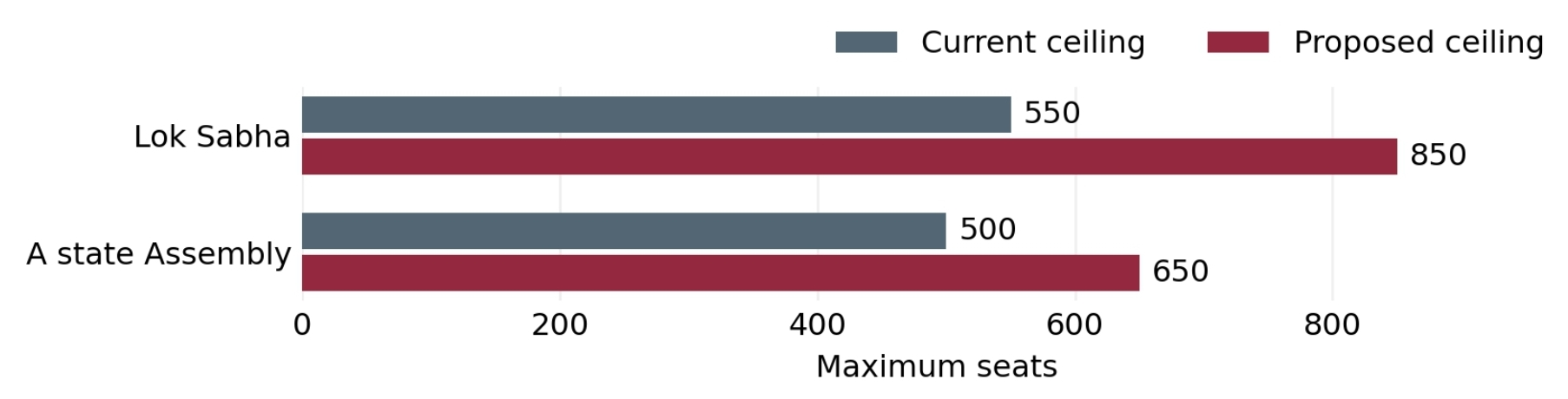
The briefing contrasts the proposed expansion with earlier increases in elected Lok Sabha seats, from 489 to 494, then to 520 and finally to 543. It also points to the long-standing cap on the elected US House of Representatives and to reductions in the size of the Italian and Hungarian parliaments. With limited sitting days and speaking time, Maadhyam argues, women, first-time MPs and representatives from marginalised communities could struggle to be heard in a much larger House. A wider numerical gap between the Lok Sabha and Rajya Sabha would also reduce the upper House’s relative weight in a joint sitting.
The same question applies to Assemblies that already meet infrequently. Maadhyam asks whether stronger panchayats, municipalities and state legislatures, along with professional staff for elected representatives, would do more to improve representation than adding hundreds of seats at both levels.
State Ratification and the Case for Public Scrutiny
The Bill also changes the presidential electoral college. Elected MLAs from Jammu and Kashmir would join those from Delhi and Puducherry in voting for the President, a change with implications for the 2027 presidential election. The 1971 Census would continue to be used to calculate vote weights under Article 55 until 2051. Article 368 requires a special majority in each House and ratification by at least half the state legislatures for changes to Articles 54 and 55. Maadhyam argues that the change in states’ Lok Sabha representation also triggers the ratification requirement.
Maadhyam says the government held no public consultation in the months after the April defeat and argues that proceeding this way runs against the 2014 Pre-Legislative Consultation Policy. It is asking MPs to reject the Bill or, at a minimum, send it to a parliamentary committee for scrutiny and public hearings. The existing freeze runs until the relevant figures from the first census after 2026 are published. Maadhyam says that interval gives Parliament and the states time to debate how to implement the women’s quota, how to draw constituency boundaries and how to distribute representation across the Union.
Sources: Maadhyam’s briefing of 28 November 2026, the Constitution (132nd Amendment) Bill, the Delimitation (Second) Bill, PRS Legislative Research’s April Bill tracker and Gazette notification S.O. 1922(E).





Delimitation must strengthen democracy, not become a tool to weaken federalism or create a political imbalance between North and South India. Punishing states that have controlled population growth is fundamentally unfair. Even more concerning, women’s reservation must not be delayed or reduced in practice through political calculations. Representation is not a favour granted by the government; it is a constitutional right. Any such major reform demands transparency, consultation and equal respect for every state. Democracy cannot survive when political power is distributed for electoral advantage rather than justice.