

Anne Royall

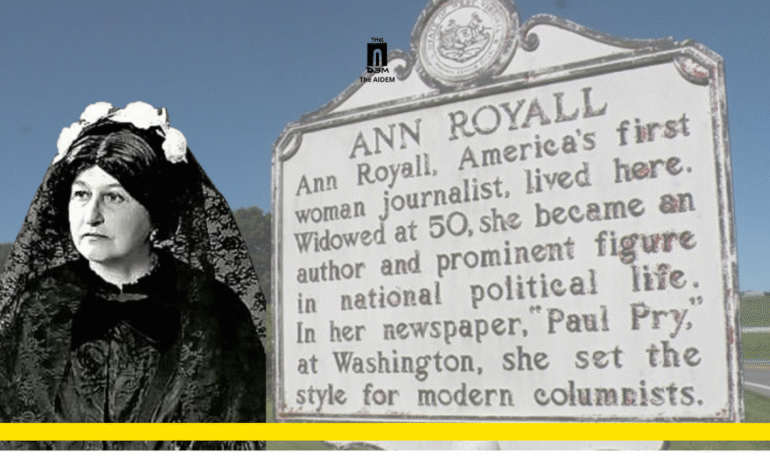
What does it take for a woman to challenge power when the law, society and the establishment itself stand against her?
The third article in The AIDEM’s Fearless Women Journalists series, authored by K. A. Beena, tells the remarkable story of Anne Royall; an early American woman journalist who turned her newspaper into a weapon against corruption, challenged those in power, and refused to be silenced.

Anne Royall was a journalist who, despite being branded a “common scold” and a public nuisance and punished by a court, went on to run her own newspaper and secure a remarkable place in the history of American journalism. Long before Theodore Roosevelt popularised the term “muckraker” for those who exposed corruption, Anne Newport Royall (1769–1854) had used her pen to make corrupt figures in the power centres of Washington, D.C., tremble. She was one of America’s earliest professional women journalists and an accomplished travel writer. Yet history also records her as a person convicted under the archaic law against being a “common scold”—a woman accused of causing disturbances in public.
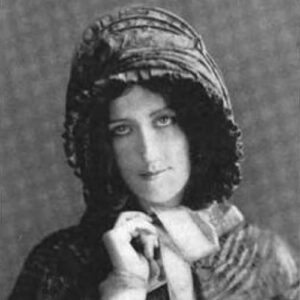
The life story of this journalist also offers valuable insight into nineteenth-century American democracy.
Anne Royall’s early life was filled with hardship. Born in Maryland and raised in the frontier regions of Pennsylvania and Virginia, Anne’s life changed when she and her widowed mother went to work in the household of Major William Royall, a wealthy man. Recognising Anne’s interest in books, William Royall educated her. He taught her history, politics and philosophy—subjects that women of the time could scarcely imagine studying. He opened his private library to her, giving her access to the works of celebrated writers, including Voltaire and Shakespeare. In 1797, Anne married William Royall, who was more than twenty years her senior.
When Major Royall died in 1812, however, Anne’s life was once again plunged into darkness. His relatives took the matter to court. After years of legal battles, Anne lost the major share of the inheritance she would otherwise have received from her husband’s estate. Although she was financially ruined, she was not prepared to accept defeat.
In 1824, at the age of fifty-five, Anne Royall began travelling across the United States. By combining travel and journalism in her writing, she became one of America’s earliest women travel writers. She journeyed across the country on foot and by stagecoach and published her travel accounts in several volumes. They were far more than conventional travel narratives. They sharply criticised politicians and corrupt officials and served as valuable records of the economic and social conditions of the United States at the time.
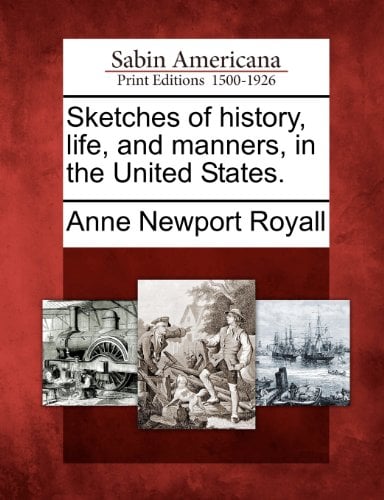
Published under the name “A Traveller,” Sketches of History, Life, and Manners in the United States (1826) offered a vivid glimpse into contemporary American life. She wrote repeatedly about inadequate infrastructure, poorly maintained roads and the need for better transportation facilities.
After settling in Washington, D.C., Anne became a constant source of trouble for those in power. She repeatedly argued that religion and government should remain separate. She became embroiled in a bitter dispute with Presbyterians who held religious services in a building near her home. Anne alleged that they were harassing her and openly confronted them.
Her opponents went to court in an effort to silence her. Many prominent figures of the time portrayed her either as a “madwoman” or a “public nuisance.” Anne was prosecuted under the archaic “common scold” law, which had been used mainly against women.
In 1829, a court found Anne Royall guilty of being a “common scold.” In earlier times, the prescribed punishment for the offence had been immersion in water using a “ducking stool.” By then, however, the court considered that punishment obsolete. Anne was fined ten dollars. Two reporters from the Washington newspaper National Intelligencer paid the fine on her behalf.
The court’s verdict did nothing to discourage Anne.
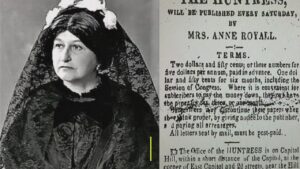
In 1831, she started a newspaper called Paul Pry. She worked as both its editor and reporter. Her friend Sally Stack and a few orphaned girls helped her with the production and distribution of the newspaper.

She used the paper as a means of exposing every conceivable evil in politics. She uncovered fraud, corruption and nepotism in government land transactions and among public officials. After Paul Pry ceased publication in 1836, Anne Royall launched The Huntress. It continued to be published until 1854. Until the end of her life, she fought against the merging of religion and government.
Anne Royall’s style resembled what is today described as aggressive investigative journalism. Her journalistic methods and the formidable challenges she confronted astonished even the male journalists of her time. Her approach was to ask direct questions without embellishment or evasion. Whether she was confronting a president or an ordinary citizen, Anne made no concessions. Along with reporting the news, she possessed a special talent for blending her own opinions with biting satire. She did not hesitate to publicly denounce wrongdoers as “miscreants” and “corrupt men.” Anne spoke constantly on behalf of the poor, widows, orphans and the neglected. She turned her newspaper into a weapon for bringing the problems of those at the bottom of society to the attention of the centres of power.
Another distinctive feature of Anne Royall’s journalism was her practice of meeting politicians in person and questioning them directly. From the time of James Monroe to that of Franklin Pierce, she personally met and wrote about numerous prominent political leaders and government officials. Instead of adopting a formal manner, she used an approach that was remarkably candid and personal.
There is a famous story about Anne Royall’s encounter with American President John Quincy Adams.
President John Quincy Adams was said to have gone early in the morning to bathe naked in the Potomac River. According to the story, Anne arrived one morning after he had entered the water and sat down on his clothes, declaring that she would not move until he granted her an interview. The President was eventually forced to answer Anne’s questions while remaining in the water.

This amusing story has been repeated in biographies of Anne Royall and in many later accounts of her life. However, its details have not been confirmed through reliable primary records from the period in which the alleged incident occurred. It should therefore be regarded as a famous anecdote in the history of journalism rather than as an established fact.
Anne fought fearlessly through her newspaper at a time when it was extraordinary for a woman to own and run a publication and challenge the centres of power. She faced numerous obstacles in keeping the newspaper alive. Raising enough money to print it was a constant struggle. Financial hardship followed her throughout her life. There were occasions when she had to accept assistance from others, including supplies of printing type needed for the newspaper.
Anne Royall was not merely the editor of her newspaper. She was personally involved in gathering and writing news, supervising production and selling the paper. A small group, including Sally Stack and the orphaned girls, assisted her.
Anne Royall also faced physical attacks because of her writing and uncompromising positions. Records of her life state that a man who opposed her religious views once pushed her down a flight of stairs. Neither such attacks nor social ostracism weakened her courage.
Anne’s three-volume work The Black Book created considerable controversy. It contained her candid observations about the people, places, and political and social circumstances she encountered during her travels.
Her book Letters from Alabama, published in 1830, is a valuable historical record of life in the early years of the state of Alabama. The book grew out of letters she had written to her friend and lawyer Matthew Dunbar while she was living in Alabama.

Anne continued her journalistic work until her death in 1854 at the age of eighty-five. At a time when the range of subjects considered suitable for women writers was extremely narrow, she was a courageous journalist who wielded her pen against corruption in politics and government. She was more than a news reporter: she was a journalist who fearlessly proclaimed her opinions and findings without being intimidated by anyone. By combining travel with journalism, she proved herself to be both an outstanding travel writer and a journalist who persistently questioned those in power. Women with Anne Royall’s determination were rare in the early history of American journalism.
She was laid to rest in the Congressional Cemetery in Washington, D.C.
Ducking Stool*
The ducking stool was an extremely strange and humiliating form of punishment that once existed in Europe and America. It was used primarily to punish women.
A ducking stool consisted of a chair attached to a long wooden beam. The apparatus was installed on the bank of a river or pond. The accused person was forcibly strapped into the chair, which was then operated like a lever to plunge the person repeatedly into the water and lift them out again.
It was used to punish women who quarrelled with their neighbours or created disturbances in public. Such women were called “common scolds.” The purpose was to humiliate them publicly and inflict physical punishment. Being plunged into water during extremely cold weather could cause serious health problems and even death.
Read the First Article of the series here
Read the Second Article of the series here








Anne Royall’s story is a powerful reminder that fearless journalism has never been comfortable for those in power. She challenged politicians, exposed corruption, questioned authority and used her newspaper as a voice for the poor, widows and the forgotten. Even when she was branded a troublemaker and dragged into court, she refused to be silenced. K. A. Beena brings alive the remarkable journey of a woman who proved that a journalist’s greatest strength is the courage to ask uncomfortable questions. A compelling story of journalism, resistance and a woman who chose truth over fear.