

Exit Liquidity: How India’s Retail Army Is Absorbing a Historic Foreign Flight From Dalal Street

India likes to tell itself a growth story. Gross domestic product expanded 7.8 per cent in the quarter ended June 2026, matching the previous quarter’s pace and confirming India’s status as the fastest-growing large economy on earth. Full-year growth for 2025–26 came in at 7.7 per cent, the sharpest since the post-pandemic rebound.
None of these claims has stopped foreign investors from heading for the exits, or Indian equity holders from sitting through two of the roughest years the market has delivered in a generation. Since their September 2024 peak, the Sensex and Nifty are down roughly 16 to 17.5 per cent in dollar terms.
Over the same period, the broader MSCI Emerging Markets index is up about 46 per cent, Shanghai has gained 50 per cent, Taiwan has surged 77 per cent, and South Korea’s Kospi has more than doubled. India didn’t just underperform its peers — it went in the opposite direction while the rest of the emerging market universe rode the AI and semiconductor boom higher. The country holding the growth headlines has been one of the worst-performing major equity markets on the planet.
The only reason the fall hasn’t been sharper is that Indian households have quietly agreed to buy what foreign institutions are selling — in record volumes, without much regard for whether that’s a good trade.
A Fourteen-year Low, Dressed Up As A Domestic Strength Story
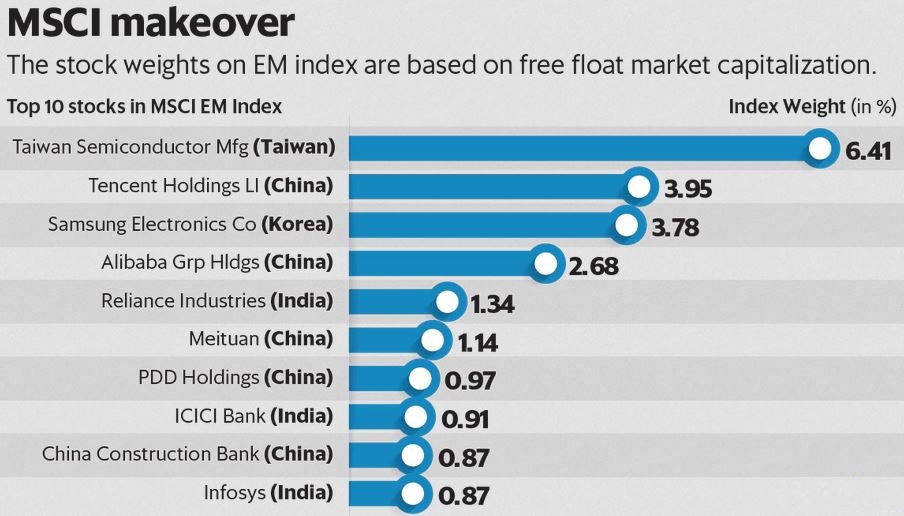
Start with the retreat that best captures how far sentiment has turned. India’s weight in the MSCI Emerging Markets index — the benchmark that trillions of institutional and passive dollars track — peaked near 19–21 per cent in late 2024, when the country briefly ranked as the index’s second-largest constituent. By May 2026 that weight had collapsed to around 11.9 per cent, knocking India down to fourth place, behind Taiwan (roughly 26 per cent) and South Korea (roughly 23 per cent), both of which have been rewarded for their exposure to AI hardware that India simply doesn’t have.
The scale of the foreign exit behind that collapse is not a footnote; it is the story. FPIs pulled a net ₹1.6 to 1.7 lakh crore out of Indian equities in 2025 — at the time, the worst annual outflow on record. 2026 has been worse. By mid-August, cumulative outflows for the year already stood at roughly ₹2.3 to 2.4 lakh crore — in the region of $28–29 billion, blowing past the entirety of the previous “record” year within five months. March 2026 alone saw an estimated ₹1.1 to 1.2 lakh crore leave the market. Foreign ownership of Indian listed companies has been driven down to roughly 14–15 per cent — its lowest level in more than a decade — and, for the first time on record, domestic institutions now own more of the Indian market than foreigners do.
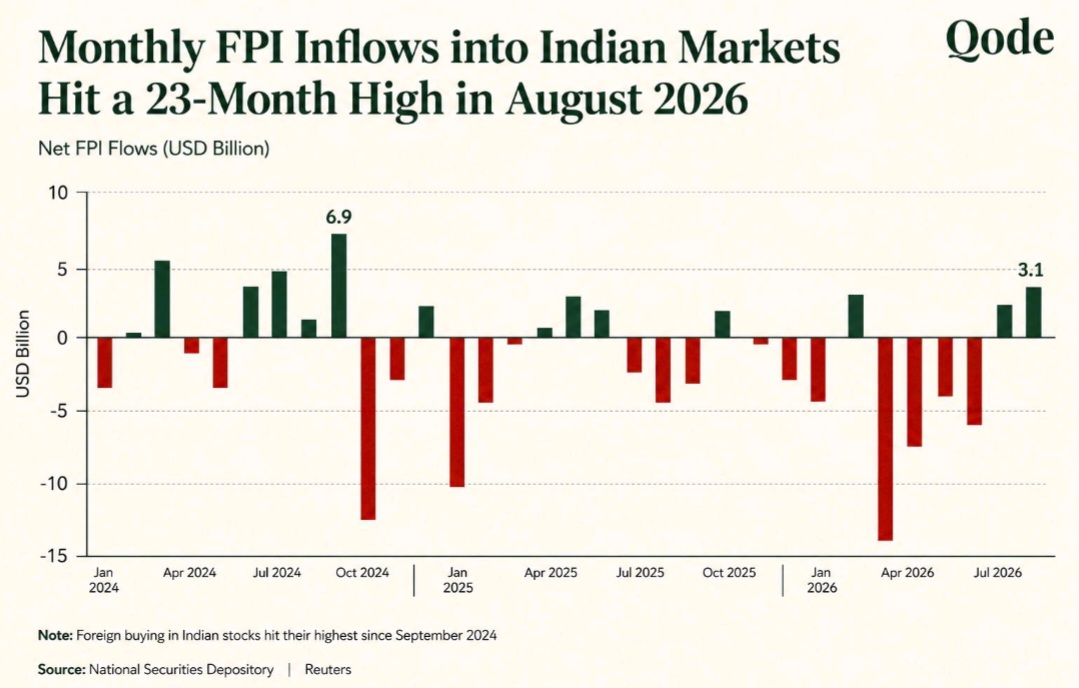
That last fact tends to get spun as evidence of a maturing, self-sufficient domestic market. It can just as easily be read the other way: professional foreign capital, with the fullest information and the least emotional attachment to the India story, has been voting with its feet at a pace it never has before, and Indian retail money — through record systematic investment plan flows now running above ₹31,000–32,000 crore a month, up from roughly ₹26,000 crore a couple of years ago — has stepped in to absorb the difference. Domestic institutions are estimated to have soaked up close to 90 per cent of this year’s foreign selling. That is not a market being validated by its own citizens so much as it is a market where the buyer of last resort has shifted from sophisticated global funds to millions of individual savers on autopilot, many of whom have never lived through a genuine multi-year drawdown.
“Cheaper” Is Not The Same As “Cheap For A Good Reason”
It is true, and worth stating plainly, that the Nifty 50’s price-to-earnings ratio — around 20 as of early September 2026 — sits roughly 8 per cent below its five-year median and well under its ten-year median near 23. Anyone looking only at that multiple could call the index undervalued relative to its own history.
But a market re-rates lower for reasons, and those reasons here are not reassuring. Corporate India has strung together nine consecutive quarters of sub-10-percent revenue growth. Earnings estimates for the current and following fiscal years have been revised downward more than almost any other major region tracked by global asset managers. A market getting cheaper because growth expectations are being cut is not the same as a market getting cheaper because it was previously irrational — and treating the first as an all-clear signal, as some of the SIP-driven retail enthusiasm implicitly does, risks mistaking a falling knife for a bargain bin.
Two external pressures have made the re-rating more painful than it needed to be, and both expose how little control Indian policymakers actually have over the forces battering the market. The US 10-year Treasury yield has climbed toward 4.8 per cent, near three-year highs, as a hawkish Federal Reserve and heavy government borrowing keep long-term rates elevated, draining the appetite for riskier emerging-market bets. And a war involving the United States, Iran and Israel has kept crude oil stubbornly above $90 a barrel, hammering the rupee toward ₹95 to the dollar (from the low-80s barely two years ago) and dragging retail inflation back up to 4.45 per cent in July — still inside the RBI’s tolerance band, but a sharp reversal from sub-2-percent readings earlier in the cycle, in an economy that still imports the overwhelming majority of its crude.
Banking: A Self-inflicted Crisis That Management Is Only Now Unwinding
HDFC Bank remains the starkest illustration of how badly a well-run institution can mismanage a merger. Shares in India’s largest private lender have fallen around 26 per cent over the past year, trading near ₹710 against a 52-week high above ₹1,020, even as the stock’s price-to-earnings ratio has compressed into the mid-teens a multiple that would have been unthinkable for this franchise a few years ago. The root cause was entirely self-created: the 2023 merger with parent HDFC Ltd left the bank with a credit-to-deposit ratio that spiked toward 110 per cent, forcing management to chase expensive, low-margin term deposits just to fund a loan book it had bolted onto its balance sheet. Deposits are finally growing faster than loans around 15 per cent year-on-year in the June 2026 quarter versus 11–12 per cent loan growth — and the ratio has eased toward 95 per cent, but that is more than three years after the merger closed. Shareholders have effectively financed management’s integration mistakes with a stagnant stock price, and the bank is only now, belatedly, cleaning up its own balance sheet.
Kotak Mahindra Bank’s underlying problem was worse in kind, if shorter in duration: a regulator publicly stripping a top-tier private bank of the right to onboard customers digitally or issue new credit cards, after finding that Kotak had “consistently failed to address serious deficiencies and non-compliances” in its IT risk management for two straight years. That ban was lifted in February 2025, and the stock has since recovered to deliver a roughly 8 per cent gain over the past 12 months — a reprieve, not vindication. The episode is a reminder that some of India’s most prized private banks have been running IT infrastructure not fit for the scale of deposits and transactions they hold, and that the market’s memory of such lapses is short.
Information Technology: Cheap Multiples, And A Growth Engine Running On Fumes
Infosys and TCS both illustrate the same underlying truth from different angles: India’s marquee IT exporters, the sector that built much of the country’s reputation as a services powerhouse, are now growing at rates that would have been considered a crisis a decade ago. Infosys’s own guidance calls for just 3 to 3.5 per cent constant-currency revenue growth this financial year. Its stock has fallen roughly 23–24 per cent over the past year, and its price-to-earnings ratio, at 15–18 times, now sits below its own 10-year median — cheap, certainly, but cheap because the market has concluded that the growth premium this sector commanded for two decades is gone.
TCS has fared no better on the tape, sliding from a 52-week high near ₹3,330 to around ₹2,270 — a decline of roughly a third even after securing a record $10.2 billion in large deal wins over nine months. That disconnect between bookings and share price is itself telling: investors no longer trust that deal wins convert into margin expansion, after watching operating margins disappoint quarter after quarter. When a March 2026 US tariff announcement triggered a sector-wide sell-off, TCS fell 6 per cent in a single week — a reminder of how exposed India’s largest, most “defensive” IT company still is to decisions made in Washington.
Energy: Policy Whiplash Dressed Up As Support
ONGC’s travails capture something distinctly Indian: a state-owned energy major whose earnings can be redirected to the exchequer at a fortnight’s notice. The windfall tax introduced in 2022 has been revised up and down more than a dozen times since, tracking global crude prices with little predictability for the company trying to plan capital expenditure around it. The May 2026 royalty cut that lifted ONGC and Oil India shares was welcomed by brokerages precisely because it broke from that pattern of ad hoc extraction but a single favourable policy move does not erase a multi-year record of the state treating upstream producers as a fiscal shock absorber whenever crude prices rise. ONGC shares trade around ₹232–234, at a rock-bottom price-to-earnings ratio of roughly 7 and a dividend yield near 5.6 per cent numbers that reflect a stock priced for continued state interference, not one about to be re-rated any time soon.
Reliance Industries, still India’s largest listed company at close to ₹17.7 lakh crore, has essentially gone nowhere for two years, its shares near ₹1,284–1,300, roughly flat with where they traded before this entire downturn began. The core oil-to-chemicals business remains a drag, and the company’s answer — launching an ice cream brand to chase a ₹27,000–30,000 crore market against Amul and Kwality Wall’s — says as much about the search for growth outside the legacy energy business as any strategy document could.
Consumer And Retail: The Demand Slowdown Is Real And The Valuations Haven’t Fully Absorbed It
If there is one sector where “growth is missing” is simply true rather than a market-technical story, it is consumer staples. Hindustan Unilever’s underlying volume growth slowed to around 2 per cent in a recent quarter — by some accounts, the weakest reading outside the pandemic years as rural households keep trading down to unbranded, cheaper alternatives even after 2025’s GST rate cuts were supposed to provide relief. The stock has fallen roughly a fifth over the past year to around ₹2,010, well off a 52-week high near ₹2,750–2,900. For a company that built its investment case on decades of pricing power and rural penetration, a decade-low volume print is not a rounding error.
Trent shows what happens when a market decides a stock’s story was too good to be true. The Zudio-led retailer is still growing revenue at 18–20 per cent a year, a pace most retailers would kill for, and has pushed past 1,300 stores. But the market had priced in far more than that, sending the stock to an all-time high near ₹8,345 in October 2024. When a single quarterly update in July 2026 showed 19 per cent growth against Street expectations of around 22 per cent, the stock crashed 12 per cent in a day. Even after a 1:2 bonus issue and a market cap now roughly half its 2024 peak, Trent still trades at 70–90 times earnings — a multiple that leaves essentially no room for the company to disappoint again, in a sector where competition from cheaper, faster-moving rivals is only intensifying.
Auto And Manufacturing: A Demerger, A Cyberattack, And The Fragility That Both Exposed
The most consequential event in Indian manufacturing over the past year barely registers in most retrospectives of the sector: Tata Motors, one of the country’s most storied industrial names, no longer exists as a single company. It was split on October 1, 2025, into a commercial-vehicle entity and a separate passenger-vehicle-and-JLR entity — a restructuring management framed as “value unlocking” but which also happened to arrive just as Jaguar Land Rover’s British operations were hit by a devastating cyberattack. The attack, disclosed in late August 2025, forced a five-to-six-week production shutdown across the UK, India, Slovakia and Brazil, cost JLR an estimated £196 million in direct exceptional expenses and, by some analysts’ estimates, inflicted total losses as high as £2 billion — enough to wipe out a full year’s prior profit at the unit. Tata Motors Passenger Vehicles swung to a loss, and management slashed JLR’s full-year EBIT margin guidance from 5–7 per cent all the way down to 0–2 per cent. That a single ransomware-style incident at one subsidiary could inflict damage of that magnitude on one of India’s flagship industrial conglomerates is precisely the kind of concentrated, poorly hedged operational risk that valuation models rarely price in until it’s too late. Both successor stocks remain down roughly a quarter from a year ago, at ₹305–311 and ₹310–317, respectively, even as July 2026 sales data show a tentative recovery.
Bharat Forge, for what it’s worth, is the one name here that has genuinely bounced back — up 62 to 76 per cent over the past twelve months to around ₹1,960–1,985, after crashing to roughly ₹1,100 in April 2026 when Washington announced tariffs as high as 27 per cent on Indian goods. The recovery came only after a February 2026 trade deal cut those tariffs to 18 per cent and a wave of defence orders, including the indigenous ATAGS artillery programme, diversified the company away from its dependence on US auto exports. That the turnaround required both a favourable geopolitical agreement and a pivot toward government defence contracts underscores how little control an export-dependent manufacturer has over its own fate when trade policy in Washington can move its stock 25 per cent in either direction inside a single trading session.
The Bottom Line
Strip away the headline GDP number, and the pattern across nearly every sector examined here is the same: a genuine operational failure or governance lapse (HDFC Bank’s post-merger deposit crunch, Kotak’s IT compliance breakdown, JLR’s cybersecurity exposure), a policy environment that swings unpredictably between punitive and supportive (the windfall tax, US tariffs), or a growth story that ran so far ahead of itself that even a modest miss triggers a double-digit one-day crash (Trent). None of that is captured by a GDP print, and none of it is resolved by pointing to a P/E ratio that looks cheap relative to its own recent, overheated history.
What has kept the market from reflecting the full weight of these problems is not corporate resilience but retail patience: more than ₹31,000 crore a month, flowing in from households on autopilot, buying into precisely the market that professional foreign capital has been fleeing at a historic pace. That is not proof the foreign investors are wrong. It is, at minimum, a reason for the millions of Indians funding their retirements through SIPs to ask why the smartest and best-informed money in the world has spent two straight years walking out the door even as they keep walking in.
Figures in this piece reflect market data, company disclosures, and AMFI/NSDL releases available as of early September 2026, and are subject to change with subsequent trading sessions and quarterly results.










This is a sharp and timely look at how India’s retail investors are increasingly carrying the burden of foreign capital flight from Dalal Street. When global investors pull out in historic numbers, rising retail participation can create an illusion of stability while quietly shifting the risks onto ordinary investors. The bigger question is not just who is buying, but whether India’s markets are becoming increasingly dependent on the savings and confidence of its small investors. A must-read for anyone concerned about the changing structure and accountability of India’s financial markets.