


India’s new labour codes have been presented by the Union government as a historic step towards modernising the country’s labour laws. But behind the promise of simplification and greater efficiency lies a far more consequential transformation of the relationship between workers, employers and the state.
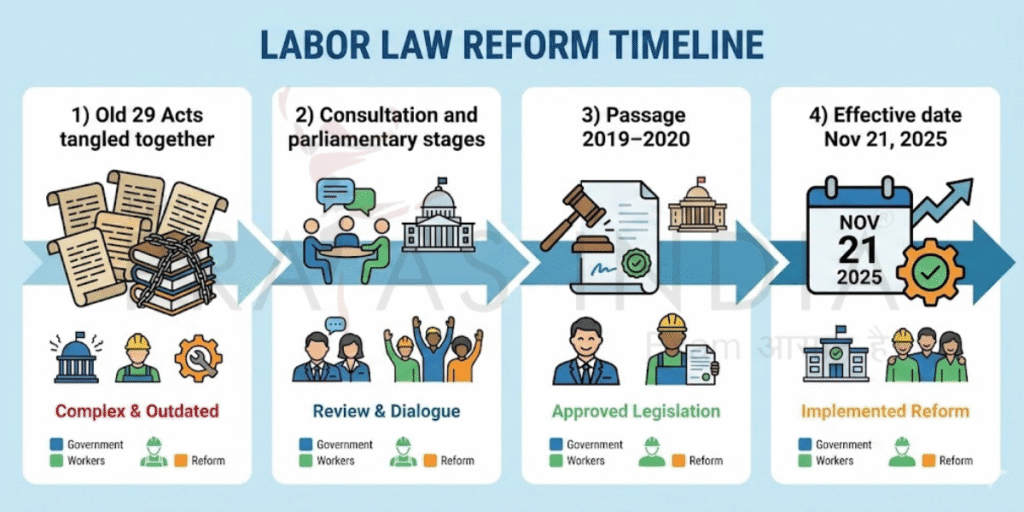
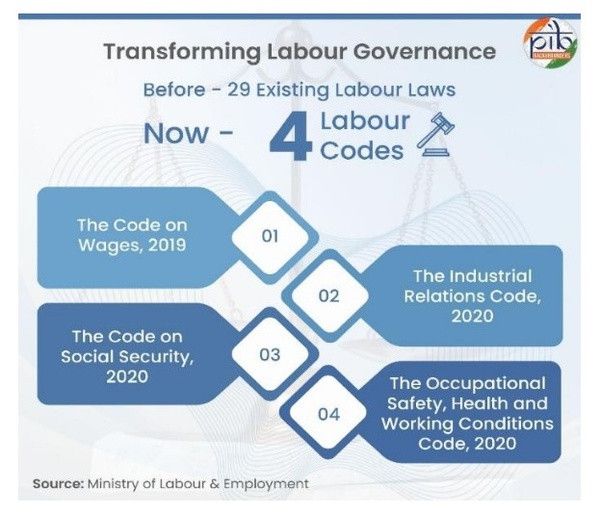
Brought into effect on 21 November 2025, nearly five years after their passage in Parliament, the four codes consolidate 29 central labour laws into a new regulatory framework. At a time when more than 85 per cent of India’s workforce remains in informal employment and newer forms of work, including gig and platform employment, are rapidly expanding, the changes raise fundamental questions about job security, collective bargaining and workers’ rights. The government maintains that the reforms will improve workers’ welfare while making it easier to do business. The more contentious question is whether this promised flexibility will come at the expense of protections built up over decades.
Others viewed the timing as politically expedient but nonetheless necessary. Yet, beyond these immediate reactions lies a more fundamental question: Does the language of simplifications conceal a deeper restructuring of labour protections, one that may widen exclusions, weaken collective bargaining, and shift the balance of power further in favour of employers? Their enforcement marks a shift away from India’s long-standing model of tripartite, consensus-based labour governance towards a framework that prioritises executive discretion and employer flexibility. The debate surrounding the labour codes is therefore not centred on whether reform is necessary, few dispute that India’s labour laws require updating, but on how reform has been conceived, negotiated, and operationalised. The distance between the government’s reform narrative and workers’ apprehensions reflects a deeper trust deficit in labour policymaking.
From Tripartism to Executive-Centred Reform
A defining feature of India’s Labour Law tradition has been its reliance on tripartite consultation among the state, employers, and workers. The Indian Labour Conference (ILC) has functioned for decades as the principal forum through which major labour reforms have been debated and negotiated. Landmark decisions, including the formulation of Standing Orders (1945) and the development of a methodology for calculating minimum wages (1957), emerged from this consensus-driven process (VVGNLI 2012). India ratified ILO Convention No. 144 on tripartism on 27 February 1978 and has maintained commitment through national tripartite forums (Ministry of Labour & Employment 2022).
Its sudden abandonment after 2015 and the formulation and enactment of the Labour Codes without its consultations not only mark a departure from this tradition but also erode the normative framework of consensus-building that has long underpinned Indian labour policy. Although the government has cited alternative consultations with stakeholders, the absence of a formal tripartite forum weakened the participatory character of reform. Concerns surround the Second National Labour Commission (SNLC), whose recommendations form the basis for consolidating multiple labour laws into a smaller set of codes. From the very start, the commission faced criticism for being unrepresentative.
The parliamentary passage of the Codes added to these concerns. They were approved during an Opposition boycott, with minimal discussion in either house, despite the fact that these Codes replaced long-standing labour laws. While procedurally valid, the process raised questions about whether labour reform is increasingly being shaped through executive initiative rather than negotiated consensus.
The Promise and Limits of Simplification
India’s labour laws were frequently criticised for being complex, overlapping, and difficult to enforce. A central claim about India’s new labour law framework, Code on Wages (2019), in particular, was to streamline earlier wage-related laws into a single, coherent framework. However, the introduction of two distinct terms – “employees” and “workers”, each defined separately under Section 2 of the code, has generated ambiguity at the definition level. Earlier legislation, such as the Minimum Wages Act 1948, relied on a single, uniform category of “employee” to determine wage entitlements. The differentiated definitions under the new code risk reintroducing precisely the fragmentation that consolidation sought to eliminate. Legal ambiguity at this threshold may translate into uneven wage coverage, compliance obligations, and dispute resolution mechanisms, particularly in sectors characterised by subcontracting and informality.
Flexibility and Industrial Relations
The Industrial Relations Code 2020 introduces two changes with far-reaching implications for employment security: the formalisation of fixed-term employment (FTE) and the relaxation of thresholds requiring government approval for layoffs, retrenchments, and closures.
Fixed-term employment is a category that did not exist under the Industrial Disputes Act, 1947. It is presented as a progressive measure that offers employers flexibility while ensuring workers are treated on par with permanent employees throughout the duration of their contract. According to the Ministry, FTE workers are guaranteed comparable wages, leave entitlements, and regulated working hours, as well as social security benefits (Government of India, 2020). It raises concerns whether this introduction of FTE serves as a tool for worker welfare or, more importantly, as a mechanism that institutionalises the long-standing demand of employer organisations for “hire and fire” flexibility. Legal analysts argue that this Code effectively mainstreams a form of employment that allows firms to hire workers directly on short-term contracts tailored to seasonal or fluctuating production needs, only to release them without consequence once the contract expires. “In this respect, FTE operates as a more formalised variant of contract labour” (Murugan, Selvi, & Shreela 2025). Unlike certain state-level regulations, which mandate that contract workers completing over 480 days of service across two consecutive years must be regularised, the new labour code provides no comparable provision for Fixed Term Employees. If there is indeed an attempt to promote fairness and security across diverse forms of employment, why does the Code refrain from extending similar protections to FTEs?
A second and equally consequential shift in the Industrial Relations Code (IRC), 2020 is the decision to raise the threshold for seeking government permission before layoffs, retrenchment, or closure. Under the old Industrial Dispute Act 1947, any factory or establishment with 100 or more workers had to obtain approval before taking such drastic steps. This rule acted as a basic safety net for organised workers. It ensured that employers could not suddenly shut down operations or remove workers without oversight, and it allowed time for negotiations, compensation, or even preventing unfair closures.
The new code raises this threshold to 300 workers, meaning only large establishments will now need to seek permission. A huge number of medium-sized factories – many of which employ 150 to 200 workers – are no longer covered. While employers argue that the earlier limit discouraged hiring, the revised threshold excludes a substantial number of medium-sized establishments from regulatory oversight. For workers in such units, the relaxation of safeguards heightens their vulnerability to sudden retrenchment or closure without negotiation or delay.
Gig Workers
The Code introduces “gig worker” and “platform workers” as new legal categories, describing them as individuals who operate outside traditional employment or who earn through digital platforms, reflecting the growing prominence of digital labour platforms (The Government of India 2020). This recognition marks a departure from earlier exclusions, yet the code offers limited clarity regarding employment relationships and enforcement mechanisms.
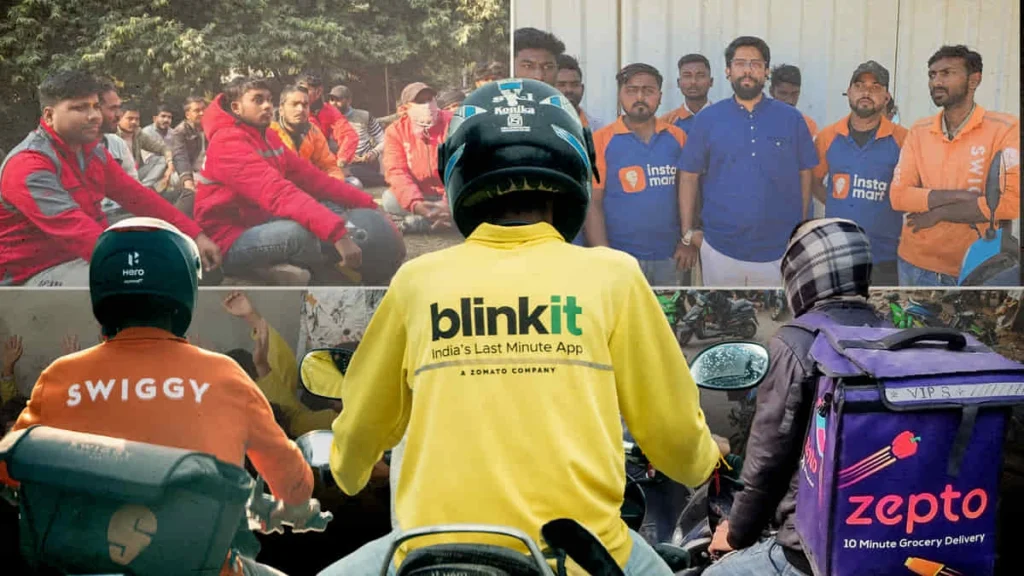
The proposed social security fund, financed through aggregator contributions of 1–2% of their annual turnover, has been welcomed in principle. However, the absence of a time-bound implementation framework and uncertainty regarding the adequacy of funding raise doubts about its effectiveness. There are also concerns about whether this mandated contribution of 1–2% of annual turnover from aggregators, although seemingly small, may also reshape platform economics in unintended ways. Companies may pass these costs on to consumers, trim worker incentives, reduce bonuses, or simply engage fewer gig workers to maintain profitability. Any of these responses could shrink gig opportunities or lower net incomes, ironically undermining the very workers the law aims to support. Recent moves by states such as Karnataka, Telangana, Bihar, and Rajasthan to introduce their own gig worker welfare laws have also increased pressure on the Centre, signalling that the demand for social protection is outpacing regulatory readiness. It also remains uncertain whether gig workers will be able to claim benefits under both the state-level laws and the new central framework, or if the national scheme will ultimately supersede and nullify state initiatives. Without proper alignment, this dual system could lead to a confusing and uneven regulatory environment – especially for large platforms operating across multiple states, which may be forced to comply with varying and potentially conflicting rules.
Women Workforce
The Occupational Safety, Health and Working Conditions (OSHWC) code formally permits women to work night shifts with their consent, which appears progressive on the surface, but the missing piece is crucial: the code does not mandate employers to provide basic safety measures such as transportation, supervision, secure facilities, or emergency support. In the organised corporate sector, these protections already exist as standard practice, but the real test lies in the country’s vast informal economy, where nearly 90% of women workers are concentrated, often in unregulated, home-based activities. In these contexts, consent may reflect economic compulsion rather than genuine choice, and the absence of enforceable safeguards increases the risk of exposure.
These concerns highlight a broader structural imbalance: the codes create rights on paper but do not always create the conditions necessary for those rights to be realised. If safety obligations are not enforceable, the gap between legal promise and everyday reality for women workers may only widen, particularly for those in low-income, informal or precarious occupations.
Conclusion
The notification of India’s labour codes marks a significant regulatory moment, but not necessarily a consensual or settled one. This process closely mirrors neoliberal reform strategies seen worldwide, centralising legislative power, weakening collective bargaining institutions, and emphasising “ease of business” over participatory governance. In this sense, a deeper question arises: whether Labour codes represent not only a legal shift but also an ideological one, where efficiency is valued above democratic negotiations. The real issue lies not in whether reform is needed, but in how it is implemented. A deeper tension becomes visible when the labour codes are examined as a whole. The reform rests on the assumption that easing regulatory constraints will stimulate employment by encouraging firms to expand and formalise. Simultaneously, however, the dilute institutional mechanisms that previously moderated employment volatility and mediated adjustment costs have been weakened. The underlying expectation appears to be that labour market flexibility, once introduced, will translate into employment security through economic growth. These expectations sit uneasily with the structural features of India’s labour market, where informality, contractualization, and asymmetries in bargaining power already shape employment relations. So, a modern labour regime must strike a workable balance between flexibility and fairness.
A more constructive path forward requires acknowledging both truths: employers do need operational freedom in a changing economy, but workers also need credible protection in a market already marked by informality and vulnerability. Reform, to be sustainable, must be seen as legitimate. That means deeper engagement with unions, transparent assessments of impacts, and a willingness to recalibrate policies as realities unfold. In this sense, the labour codes represent not an endpoint, but an unresolved beginning in India’s evolving labour regime.
References:
- Press Information Bureau (2025): Government makes the four labour codes a reality for new India (PRID: 2192463), Government of India, New Delhi.
- V. V. Giri National Labour Institute (2012): Evolution of minimum wage policy and regulatory framework (NLI Research Study Series), VVGNLI.
- Ministry of Labour & Employment (2022): India & ILO, Government of India, New Delhi.
- Government of India (2020): The Code on Social Security, 2020 (No. 36 of 2020). Ministry of Law and Justice, New Delhi.
- Murugan, P. B., Selvi, P., & Shreela, M (2025): A handbook on India’s labour codes and Tamil Nadu rules: What it means for workers and their rights, India Labour Codes.










India’s new Labour Codes raise serious questions about the future of workers’ rights, job security and collective bargaining. Labour reform cannot become a tool to weaken workers while prioritising corporate interests. True progress means fair wages, safe working conditions, social security and dignity for every worker. A nation’s economic growth is meaningless if the people who build its wealth are denied justice and protection. Workers’ rights must never become casualties of economic reform.