


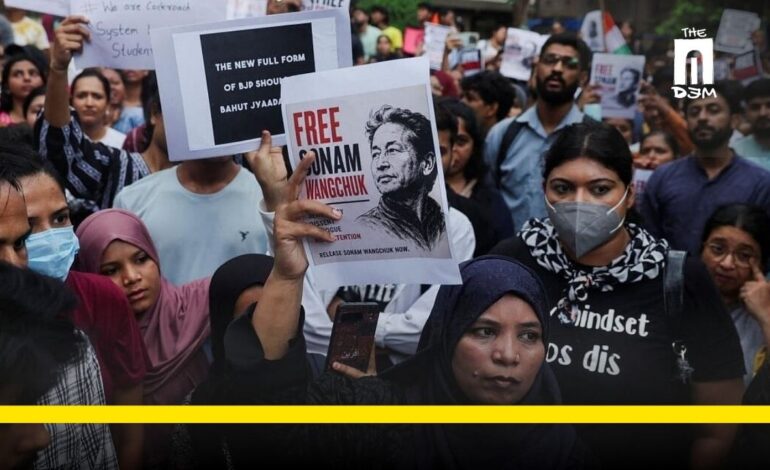
It’s funny that we live in times when I cannot spell out clearly the one winning protest signboard from Jantar Mantar’s barricades without asterisks. “F*** Fascists,” it said, loud and proud. The one thing that can be said without disguise, though, is this: what the right wing is most scared of—and rightfully so—is the left. In India, after the Left lost power in Kerala, we have no ostensible Left party in power. But when power is usurped by a State that is tone-deaf to anything but the person at the helm, when the police become an instrument of repression and courts incarcerate protesters with no bail in sight for years on end, then the only force such a regime has reason to fear is the ideologically committed.
Therefore, on the streets of Jantar Mantar, what I saw, beyond Sonam Wangchuk and Abhijit Dipke, was the steely and effective presence of the ideological Left . The only reason a student could brandish a “@@@@ fascists” banner is because members of the Student Federation of India, the All India Students’ Federation and the All India Students Association—21 of them—were on hunger strike for over 20 days. Their tents, in a quiet corner, were fronted by banners of Bhagat Singh and Che, alongside pamphlets and circulars on the New Education Policy, revolutionary ideals and ideas that have stood the test of time.
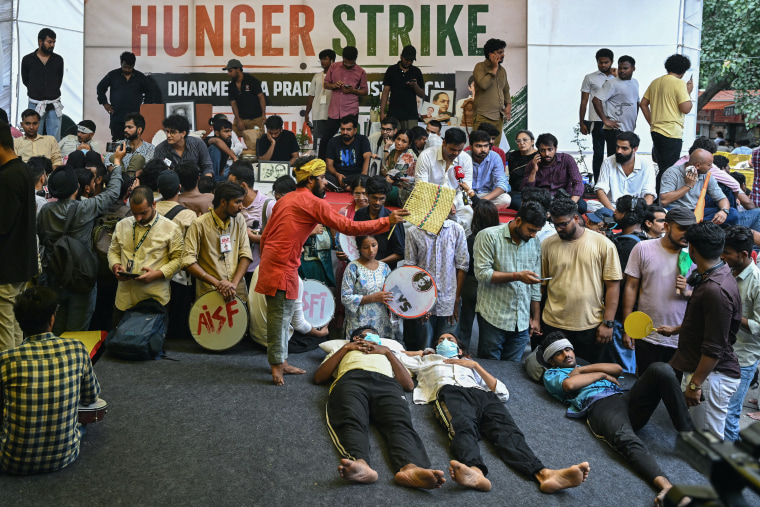
Their corner was flanked by prominent figures from progressive movements—Prakash Raj and Shabana Azmi—as well as committed Left leaders like Brinda Karat, Nivedita Menon, the ever-more fabulous and committed writer Arundhati Roy.
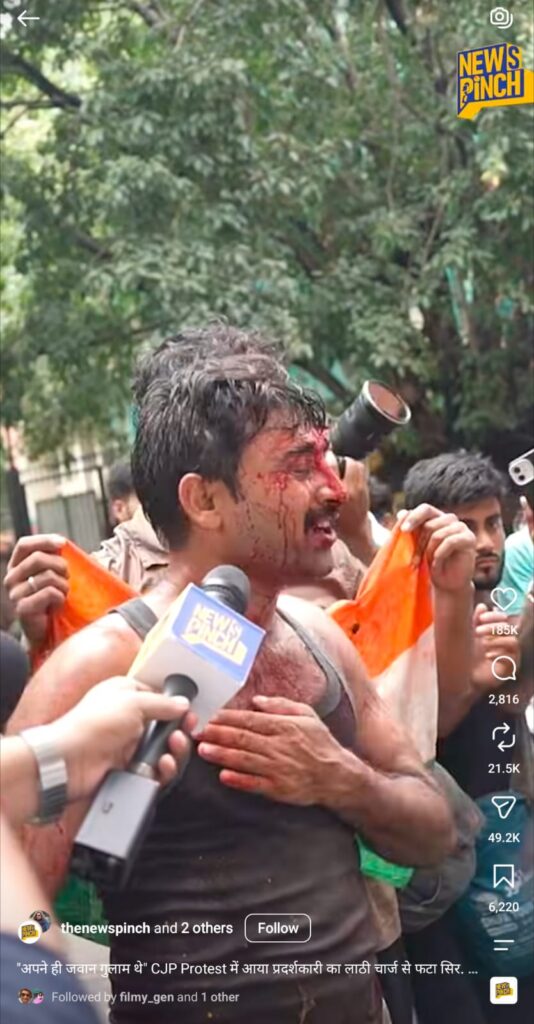
The police and paramilitary did their draconian duty, beating some students until blood streamed from their heads. They tried everything—they put up barricades eight feet high and welded them together. The crowds managed to break them down.
A man with blood gushing from a head wound was filmed talking back to the police: “Hum toh shaheed hain, har yug mein janam lenge.” We are martyrs; we will be born in every generation. “Har yug mein janam lenge, tumhari aukad bata denge.” We will rise in every generation to put you in your place. “Aap samajhte ho aapne maar diya, hum har yug mein janam lenge, ghulam nahin, maalik hain aur har janam mein aapko aapki aukaad bata denge.” You think you can kill us. We are, and will always be, your masters.
Meanwhile, more tepid leaders, whom I shall not name, used the Cockroach Janta Party podium to trot out lectures on peace. Some in the media also went down this well-worn rabbit hole: “the peaceful protesters.”
I was at the protest one day before D-Day. There were over a lakh people, and it was the most beautiful and civilised sight imaginable. It was managed by well-heeled Left cadres. By “well-heeled”, I refer to ideological commitment. They had paper and plastic fans. They spotted grey-haired people and started fanning us, passing around bottles of water and chana to eat, forming queues, making way for one another, writing slogans, being considerate and waiting for others to pass.
But peace, in draconian times, is an ideal that only the ideologically scared, unsure or wavering will uphold as a first principle. When your skull is cracked and you are still staring down the police officer, this is not the definition of peace. It is a war by the State against the people. Peace cannot be upheld as the only ideal. It is also the badge of status quoists too fearful of barricades, commitment and the laying down of life.

And this is where students have shown that they are thirsting for commitment and ideological grounding. They’re coming to Jantar Mantar with copies of the Constitution and posters of B. R. Ambedkar. This is a commitment to an ideology first, and at any cost. It’s not about tepidly made promises to turn the other cheek. There are memes and photographs that speak of students tired of having nothing to hold on to and nowhere to go. I asked a policeman yesterday whether, in his heart, he wasn’t committed to the students. He looked away, then ahead at his boss standing some distance from us, and said quietly, “I’ll answer that question when I’ve taken off my uniform, madam.”
For now, some from the Cockroach Janta Party have been called to the negotiating table. There are all kinds of speculations in a country full of conspiracy theorists: “this is a front for the Aam Aadmi Party”; “the protests will die down and the government will then come down harder”; “the government is too strong and the opposition is in tatters, so nothing much will change.” But the thing about protests like this is that they puncture time, flip the fear directed at them and turn it back on the government. And they allow people to believe, briefly, that anything is possible. That moment is what the right fears above all: the loss of absolute control and the rupturing of the veneer that it is invincible, or even popular.
Whatever the present holds—compromise, the end of a month-long stakeout at Jantar Mantar—what the country cannot unsee is the willingness of a growing and critical mass of young people to commit themselves to the ideals of the Indian Constitution, and especially to the right to question and to be defiant. This bedrock is most certainly left-oriented, organised and unstoppable. It does not have to acquire power immediately, or by the usual route of party, election and then government.

Power does not reside in a pliant police force and institutions where there has been a hostile takeover. Power lies in the ability of a bleeding student to stand before a nonplussed policeman and say, “@#$@ you, I will show you your place.” Taking my cue from the students at Jantar Mantar, I will add that the draconian-in-charge may not have a taste for T. S. Eliot and the prophecy his poem East Coker holds out. But maybe he should lean in to what the barricades are saying so loudly, echoing what Eliot evoked more than a century ago.
“And what you do not know is the only thing you know
And what you own is what you do not own
And where you are is where you are not.”
How terrible for the haves, for those who think they have “arrived” and have “got there”, the frightening proposition of having to look at the barricades, at a future where they cannot remain where they are now.
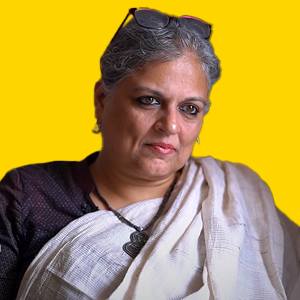








*Revati Laul reminds us that democracy survives when ordinary citizens refuse to stay silent. Jantar Mantar is more than a protest site—it is a living archive of hope, resistance, and the fight for accountability. A thoughtful and timely piece.*