



When a young Muslim woman wears a traditional Kerala Kasavu saree, steps onto an Onam oonjal (swing), or joins in public dance during regional festivities, she performs an act that echoes far beyond the boundaries of cultural celebration. Within the socio-political landscape of contemporary Kerala, this visual of unpermitted, autonomous female joy triggers an intense, visceral counter-reaction from orthodox religious hierarchies. From pulpit decrees branding her actions as moral corruption to coordinated digital harassment targeting her virtue, the clerical response is swift, punitive, and desperate.
At first glance, this institutional hostility appears to be a defence of religious purity and modesty. However, a deeper critical examination reveals that the cleric’s outrage has little to do with divine law and everything to do with preserving structural power and patriarchal authority. The public visibility of autonomous women exposes the fragile foundation of patriarchal authority: an authority built entirely on the illusion that female sexuality, movement, and identity exist only by clerical permission. The moment a woman claims her own pleasure, chooses her own attire, and asserts her belonging to a shared regional culture, she dissolves that illusion.
To fully understand the mechanics of this resistance and the panic it provokes, we must move beyond surface-level socio-political commentary. By synthesising frameworks from critical theory – the psychoanalysis of Jacques Lacan, the performativity of Judith Butler, the biopolitics and disciplinary analytics of Michel Foucault, and the schizoanalysis of Gilles Deleuze and Félix Guattari – we can dissect how the female body is transformed from an object of institutional discipline into a site of radical sovereignty.
The Lacanian Dimension: The Symbolic Phallus, Castration, and Clerical Anxiety
To understand why the cleric regards female autonomy not merely as disobedience but as an existential threat, we must turn to the psychoanalytic framework of Jacques Lacan. In Lacanian theory, a fundamental distinction is drawn between the physical organ (the penis) and the Symbolic Phallus. The Phallus is not an anatomical entity; it is the ultimate signifier of power, law, completeness, and authority within the Symbolic Order.
The Phallus as the Illusion of Control
The religious cleric functions as a representative of the “Name-of-the-Father”; the institutional embodiment of moral law and societal order. His claim to authority rests on the collective assumption that he possesses the Symbolic Phallus: the right to grant permission, enforce boundaries, cover, unveil, and sanction human behaviour. Within a patriarchal religious framework, female compliance mirrors this phallic authority back to the cleric. When women submit to his decrees, they validate his position as the supreme arbiter of truth and order.
The Psychology of Castration
In Lacanian terms, castration is not the physical severance of tissue but the radical exposure of a lack; the sudden realisation that one does not, and never did, possess the Symbolic Phallus. When a young Muslim woman steps onto the Onam swing or asserts her sexual and cultural autonomy, she performs an act of symbolic castration.
By enjoying her body and heritage without seeking clerical sanction, she demonstrates that his permission is entirely unnecessary. The cleric’s authority dissolves in real time. The panic that follows, the immediate impulse to brand her actions as “sin” or “moral degeneration”, is a psychological defence mechanism. Unable to process the loss of his symbolic power, the cleric projects his ego-shattering castration onto the woman, framing his personal loss of control as an offence against the divine.
Re-signifying the Phallic Threat
Every public assertion of female pleasure disrupts the phallic economy, in which a woman’s worth is not defined on her own terms but by how well she reflects, validates, or serves the phallic subject’s desire and authority. When the text observes that these women are “cutting that phallus down to size,” it highlights a psychoanalytic truth: phallic power endures only as long as it goes unchallenged. By refusing to let their pleasure be bartered or dictated by fathers, husbands, or clerics, these women strip the patriarch of his signifier, reducing his formidable decrees to powerless noise. This Symbolic castration is not physical harm; it is the radical reduction of an overinflated authority. By walking past the cleric’s prohibition without fear, the woman strips his words of their weight and reduces the ideological discourse around his magnified phallus to a mere piece of flesh, even without a bone. Just as a currency loses its value if people refuse to trade in it, the phallic economy collapses the moment individuals stop seeking phallic permission for their existence, pleasure, or cultural belonging.
Butlerian Performativity: Subverting the Matrix of Intelligibility
While Lacan explains the psychological panic of the patriarch, Judith Butler’s theories of gender performativity illuminate the structural vulnerability of the system itself. In her masterpiece “Gender Trouble”, Butler dismantles the notion that gender or identity is an innate, biological, or divinely fixed truth. Instead, identity is performatively enacted and constructed through the stylised repetition of acts, gestures, dress, and speech over time, and enforced through rigid social regulation.
The Matrix of Intelligibility
Societies operate under what Butler terms a “matrix of intelligibility”, a cultural grid that determines which bodies and behaviours are deemed legitimate, legible, and acceptable. Within orthodox clerical discourse, a “virtuous Muslim woman” is legible only through specific performative citations: modesty, domesticity, spatial confinement, and unquestioning deference to religious authority. The cleric insists that these performative codes are natural and divinely mandated.
Subversive Citation and the Kasavu Saree
Butler points out that because gender and identity depend on continuous performance, they are inherently unstable. Resistance does not require escaping culture entirely; rather, it occurs within performance via subversive iteration.
When a young Muslim woman wears a Kasavu saree, a traditional garment deeply tied to Kerala’s regional identity, or participates in Onam, she engages in a radical act of performative cross-citation. She brings semiotic codes the religious establishment deems incompatible into direct contact. By performing her regional identity alongside her lived reality as a woman, she destabilises the rigid boundary the religious institution has created. She proves that identity is not a monolith dictated from a pulpit, but a fluid, dynamic, and self-authored performance.
When a woman asserts pleasure publicly, whether through dance, cultural participation (such as celebrating Onam), or autonomous choices in dress and lifestyle, she operates outside the phallic grid. She experiences joy that neither seeks clerical permission nor serves a patriarchal function.
Exposing the Construct
By successfully enacting this subversive performance, Muslim women reveal that the cleric’s dress codes and behavioural rules are not eternal spiritual truths but arbitrary tools of social discipline. The cleric’s fury stems from this subversive citation, which exposes the artificiality of his rules. If a woman can step outside the prescribed script and flourish, the entire apparatus of religious policing loses its coercive power.
The Foucauldian Apparatus: Disciplinary Power, Docile Bodies, and Biopolitics
To understand how religious hierarchies attempt to enforce this performative script and how women disrupt it, we must turn to Michel Foucault’s analyses of power, discipline, and body regulation.
Micro-Physics of Discipline and the Docile Body
In Discipline and Punish (1975), Foucault demonstrates that modern power operates not through physical violence, but through micro-techniques of discipline designed to produce docile bodies – bodies that are obedient, usable, and self-policing.
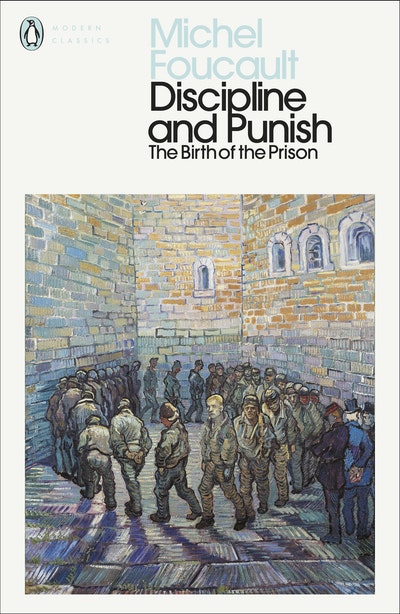
Conservative religious institutions function as disciplinary regimes. Modesty codes, spatial segregation, restrictions on movement, and bans on public music or dance are micro-techniques that condition the female body. A “docile” female body internalises the clerical gaze; she self-polices her posture, attire, and voice out of internalised shame or fear of social sanction. Her docility ensures the seamless reproduction of patriarchal authority.
Biopolitics and the Regulation of Pleasure
In The History of Sexuality (1976), Foucault extends this analysis to biopolitics—the institutional management of populations, biological processes, reproduction, and desire. Patriarchal religious structures are fundamentally biopolitical engines. They seek to regulate female sexuality to ensure that reproduction, marriage, and lineage remain strictly governed by religious and paternal consent.
The autonomous assertion of female pleasure, including the choice of partner, dress, timing of marriage, or cultural expression, is a direct assault on this biopolitical structure. When a woman claims her pleasure as an intrinsic right rather than a bartered commodity, she reclaims biopolitical sovereignty over her own biology.
Counter-Conduct vs. Pastoral Power
When the cleric brands public dance or festival participation as “sin,” he exercises what Foucault calls pastoral power, a form of authority that claims responsibility for the individual soul while demanding total obedience and confession.
However, Foucault famously asserted that “where there is power, there is resistance.” The public participation and group dance of young women in regional festivals constitute an explicit act of counter-conduct: a refusal to be governed in a particular way, by a particular authority, at a particular cost. By stepping into the public eye, these women dismantle the micro-surveillance of the clerical gaze, demonstrating that their bodies are active sites of self-determination rather than passive canvases for institutional discipline.
Deleuze, Guattari and Schizoanalysis: The Female Body as a Body without Organs
While Foucault maps the mechanisms of institutional control, Gilles Deleuze and Félix Guattari provide a framework for conceptualising pure liberation. Their concepts of the Body without Organs (BwO), deterritorialisation, and reterritorialisation illuminate the revolutionary potential of bodily autonomy
The Stratified Body vs. The Body without Organs
In Deleuzian thought, the “Organism” is not the physical body but a body that has been heavily stratified, organised, categorised, and bound by socio-political systems to perform specific, rigid functions. The patriarchal religious system stratifies the female body by imposing a strict functional organisation: the head is assigned the function of being covered, the eyes the function of lowering the gaze, the womb the function of reproduction, and the spirit the function of submission.
Opposed to the Organism is the Body without Organs (BwO) – a state of the body in which intensities, desires, and affects flow freely, unburdened by rigid organisational Grids. The BwO is a field of pure potentiality. When a young woman reclaims her body through autonomous expression, she transforms it into a Body without Organs. Her dance, laughter, and physical movement cease to serve patriarchal functions; they become raw flows of intensity, joy, and expression that resist institutional organisation.
Deterritorialization: Escaping the Clerical gaze and pastoral power.
The movement of young women into secular, cultural, and public spaces represents a process of deterritorialization. The cleric attempts to map female existence within a strictly defined territory bounded by moral decrees, domestic walls, and religious oversight.
When a woman steps onto the Onam swing, wears regional attire, or chooses her own path to pleasure, she deterritorialises her identity. She moves beyond the clerical map, breaking free from the territory of religious jurisdiction and entering unmapped terrain of bodily freedom. Her desire is no longer a resource to be managed by fathers, religious leaders, or patriarchal authority; it becomes “a river that flows without their blessing.”
Clerical Reterritorialization and its Inevitable Failure
Faced with a body that has deterritorialised itself, the religious establishment responds with frantic attempts to reterritorialise: to bring the body back under pastoral authority. Clerical threats of divine wrath, excommunication, and community shaming are violent efforts to drag the unruly body back into the organised territory of the priest or Mullah.
The Sovereign Body and the Future of Resistance
The ongoing struggle over female autonomy in Kerala, and in other contexts where religious dogmatism seeks to govern women’s lives, is not a trivial disagreement over traditional dress or seasonal festivities. It is a fundamental conflict over body sovereignty.
The patriarchal edifice, embodied by the anxious cleric, operates under the delusion that female sexuality, joy, and physical presence exist only on borrowed time, subject to institutional renewal and permission. When a young woman refuses to seek that permission, the entire theoretical machinery of control collapses:
Her refusal exposes the cleric’s Symbolic Phallus as an illusion, subjecting his authority to psychological castration.
Her subversive performance dismantles the rigid matrix of religious intelligibility, proving that identity cannot be locked in a theological cage.
Her public counter-conduct breaks the mandate of the docile body, reclaiming biopolitical control over her own life and desires.
Her transformation into a Body without Organs deterritorializes her existence, allowing her joy to escape the rigid grid of clerical policing.
The dancing body of a Muslim woman becomes a site of radical resistance, proving that pleasure, agency, and bodily motion cannot be permanently colonised by dogma. She transforms her body from a territory of clerical jurisdiction into a sovereign landscape of freedom.
Ultimately, the real fear harboured by the religious establishment is not the festival of Onam, the fabric of a saree, or the rhythm of a dance. Their fear is of female freedom itself – the realisation that when a woman recognises her pleasure as her own, no decree, no threat, and no pulpit can force her back into docility. By dancing on the boundaries of authority, celebrating their heritage, and claiming their own bodies, these women do not merely defy today’s patriarchs; they rewrite the possibilities of freedom for generations to come.

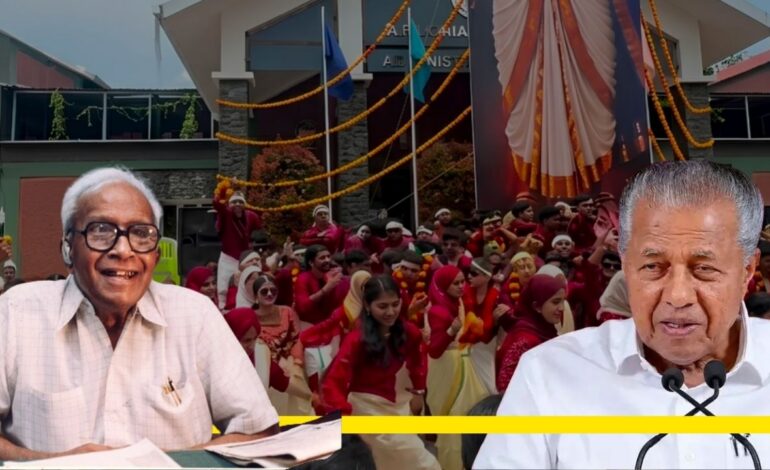








A powerful examination of how patriarchal and clerical power becomes threatened when women assert control over their own bodies, choices, and identities. The real anxiety is not in women’s autonomy, but in the loss of authority over them. This is a sharp and necessary critique of the structures that seek to discipline female freedom in the name of morality, tradition, and religion