

When Climate Enters the Classroom: Are Pune’s Schools Ready?

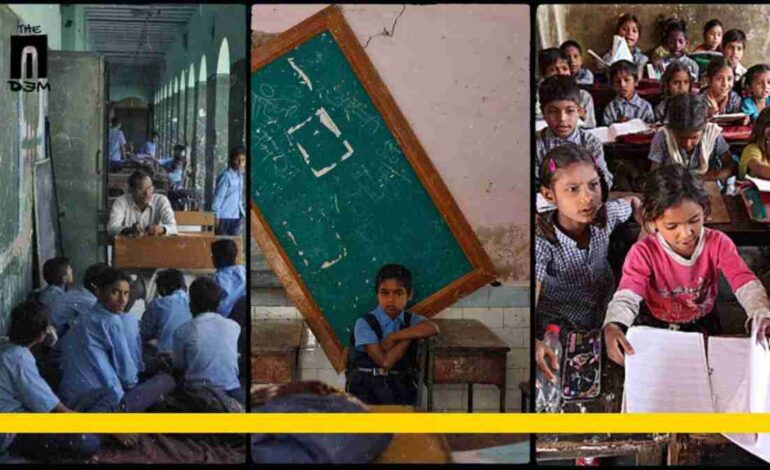
At two schools on opposite ends of the city, heat and rain are already deciding how children learn. Pune’s climate planning has not caught up with either.
A Fan That Is Not Enough
For students at Dhaneshwar School in Dhanori, heat is no longer just weather outside the classroom. It is an infrastructure problem inside it.
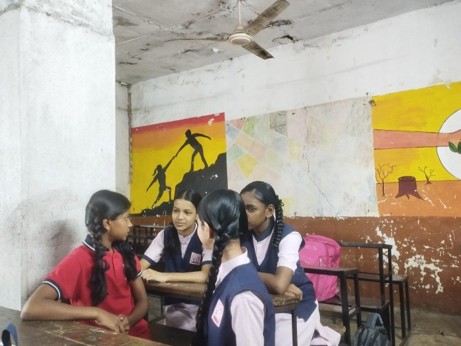
The school sits on roughly two gunthas of land, hemmed in on every side by residential buildings, with seven classrooms on each floor. In summer, about 700 students spend seven to eight hours a day in this compact space, with little ventilation, no open ground to speak of, and limited cooling. By late morning, the walls hold the heat as much as they block it. The building does not cool down until well after the last bell.
Class 8 student Sandhya Tidke feels it directly. “Our school feels congested inside and outside because it is heavily surrounded by residential apartments. One fan in our classroom does not give us cool air. The heat is constant. Even the water we filled in our bottles used to become hot during summer days,” she says.
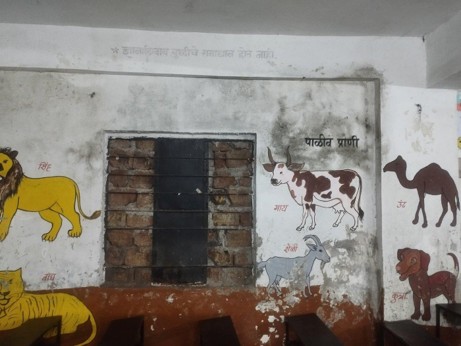
Principal Sampada Chavan says classrooms became so uncomfortable that the school moved students into an open hall with a tin roof. “Sitting in the classrooms used to become unbearable for both our students and teachers, so we shifted students to the open hall. But the hall can accommodate only around 200 students, while the remaining 500 have to continue in their classrooms,” she says.
The hall holds 200 children. The other 500 stay in the heat that pushed the first 200 out.
Moving students out of hot classrooms is adaptation. It is not a fix for the infrastructure that made them hot in the first place.
Chavan says many of Dhaneshwar’s students come from low-income households and may be used to living with fewer amenities. Sandhya’s account suggests otherwise. Familiarity with inadequate infrastructure is not the same as resilience to heat.
A City Built For Heat
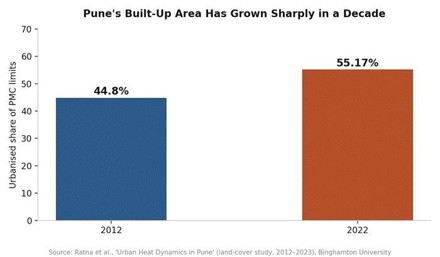
Dhaneshwar’s classrooms sit inside a citywide trend. A 2025 study of Pune’s urban heat, tracking six locations from 2012 to 2023, found the city’s built-up area grew from 44.8 percent to 55.17 percent of Pune Municipal Corporation limits over that decade. Maximum temperatures rose at every site studied, and heat-island intensity reached between 2°C and 8°C in the most built-up pockets. A separate assessment found Pune lost close to 620 hectares of tree cover between 2016-17 and 2019-20, while built-up area expanded by more than 839 hectares in the same years.
Fewer trees mean less shade over classrooms like Dhaneshwar’s. Dr. Gurudas Nulkar, who teaches sustainability at the Gokhale Institute of Politics and Economics, traces this to how the city has rebuilt itself. “A major factor in this is road widening. About four decades ago, on streets like S.B. Road, there were a lot of trees. Now, owing to road widening, none of that exists anymore,” he says.
For Dhaneshwar’s students, that transformation comes down to a single fan, a warm water bottle, and a hall that fits less than a third of the school. A 2026 national assessment by the child-rights group CRY found seven in ten children reporting missed school days because of extreme heat. Dhaneshwar is not an outlier. It is a data point.
Heat is one way climate stress enters a school. Rain is another.
Ten Kilometres Away, A Different Season
At Lunkad School in Dhankawadi, the problem arrives through the roof.
The school runs across two or three classroom blocks, separated by a stretch of bare soil. Its tin roofs have corroded at the seams, and where the rust has eaten through, light comes in patches even before the rain does. When the monsoon breaks, water drips into four of its eight classrooms.
Class 9 student Raj Sutar has a routine for it. “As soon as the monsoon arrives, we vacate the bench we sit on and put mugs over there,” he says. He says the leaks have worsened in recent years.
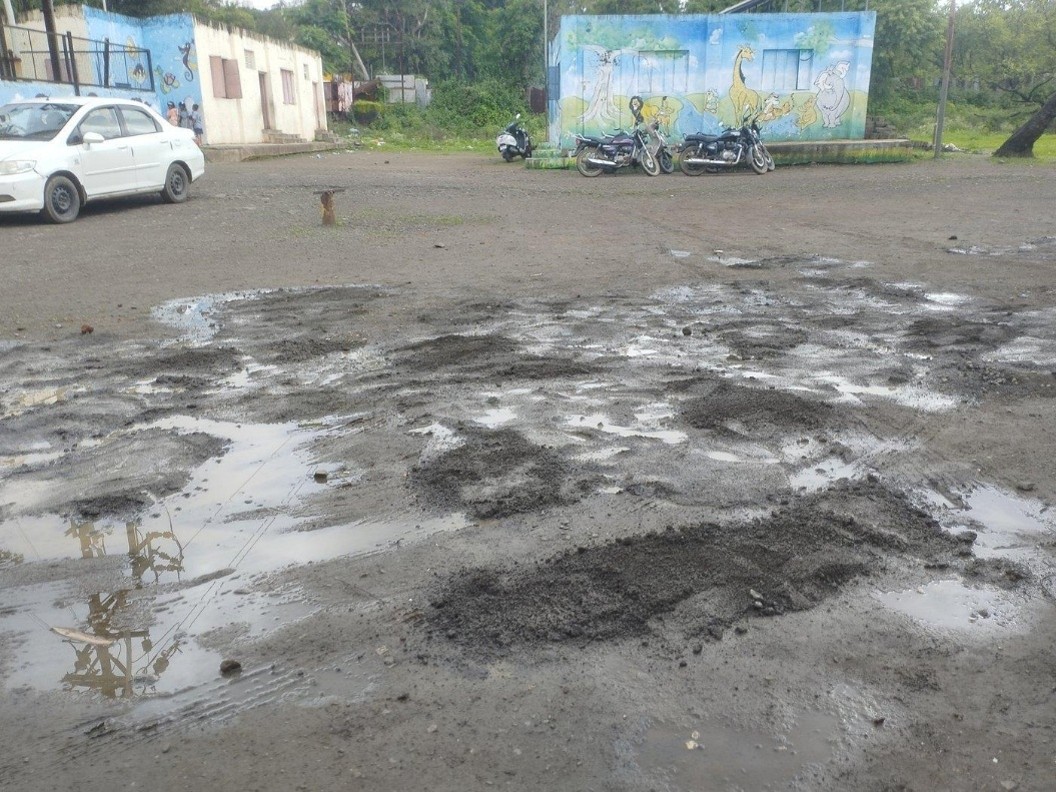
In 2023-24, a CSR-funded project refurbished the school’s toilets. The path leading to them did not change. It is still bare soil, and it turns to mud within minutes of rain – the same rain pooling inside four classrooms.
A toilet can be rebuilt. If children cannot reach it, the rebuilding only goes so far.
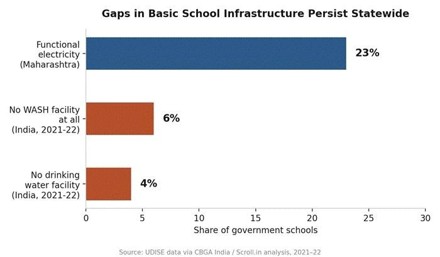
Nationally, government data for 2021-22 shows about 4 percent of schools had no drinking water facility at all, and 6 percent had no water, sanitation or handwashing facility of any kind. In Maharashtra, only about 23 percent of government schools had functional electricity – the power that keeps pumps and taps running. UNICEF’s review of climate resilience in Indian schools has separately flagged toilets that run dry for months at a stretch and water that turns unsafe once flooding sets in. Lunkad’s toilets exist on paper and mostly work – except when the monsoon makes them hard to reach.
A parent in the neighbourhood, who works as a labourer, sends her child to Lunkad because it is what she can afford. The school charges about ₹500 a month. “If we had a choice, we would have shifted our child to a better place,” she says.
Families with less money have fewer places to move a child when a school’s infrastructure fails them. At Dhaneshwar, that meant staying in a hot classroom because there was nowhere else to go. At Lunkad, it means a muddy walk to a working toilet, because a working toilet at a costlier school was never an option.
What Policy Covers, And What It Does Not
Pune’s civic and state authorities are not silent on climate change. But little of what they have built reaches a classroom.
Pune is drafting a city-wide Climate Action Plan with the National Institute of Urban Affairs and the Global Covenant of Mayors. Meeting records from March 2024 show sector-wise plans for buildings, transport, water and waste. Schools were not listed as one of those sectors. This reporting could not identify a published Pune Municipal Corporation standard that sets climate-resilience requirements — shade cover, water storage, flood-proofing — for school buildings.
The city’s Graded Response Action Plan for air pollution, one of the few civic tools that explicitly allows school closures, went unenforced through the second half of 2025 despite repeated air-quality breaches, according to reporting from that period. State intervention in schools specifically has come only during acute heatwaves: statewide closures in April 2023 and revised timings again in 2026. Pune Climate Warriors, the one PMC programme reaching directly into classrooms, teaches students about climate change. It does not fund repairs to the buildings they sit in. Neither Dhaneshwar’s fan nor Lunkad’s roof falls under any civic scheme this reporting could find.
Two Ways In
At Dhaneshwar, students move to another room when the heat becomes unbearable. At Lunkad, children move away from leaking roofs and negotiate a muddy path to reach the toilet.
These are ways of coping. A school should not have to improvise its way through every summer and monsoon.
Resilience begins when the infrastructure itself is prepared for the weather children are already experiencing. Two schools, ten kilometres apart, are still waiting for that to happen.
This article is authored by Madhura Shelke, mentee of the Climate Change Media Hub at the Asian College of Journalism, Chennai. The programme is supported by Interlink Academy, Germany.









Climate change is no longer a chapter in a textbook—it is already shaping how children learn. Madhura Bhaskar Shelke’s report powerfully shows that teaching students about climate change means little if classrooms remain unbearably hot, roofs leak during the monsoon, and basic infrastructure fails them. Climate resilience must move beyond policy papers and enter every school building. Our children deserve classrooms that are safe, healthy and prepared for the future.