


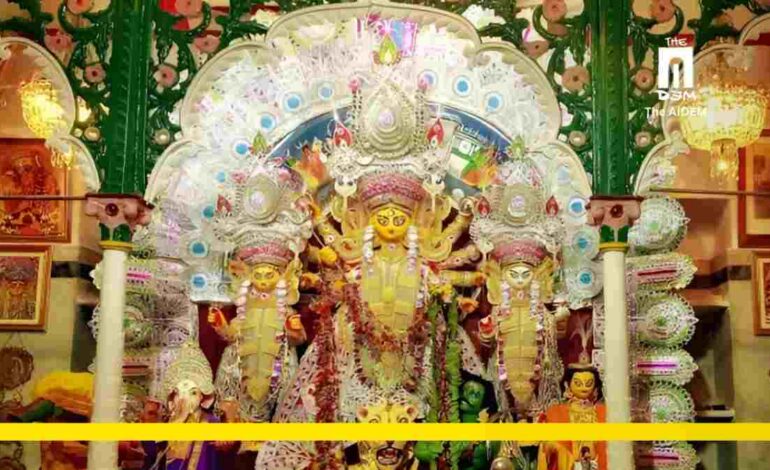
Kolkata’s Durga Puja is as much a celebration of artistic imagination and cultural identity as it is a religious festival. Yet, controversies surrounding the celebrations in September 2026 have brought into focus a larger conflict over who exercises authority over the festival’s imagery, traditions and public expression. At stake is not merely the representation of a goddess but the competing claims of political power, artistic freedom and the communities that sustain Bengal’s cultural heritage.
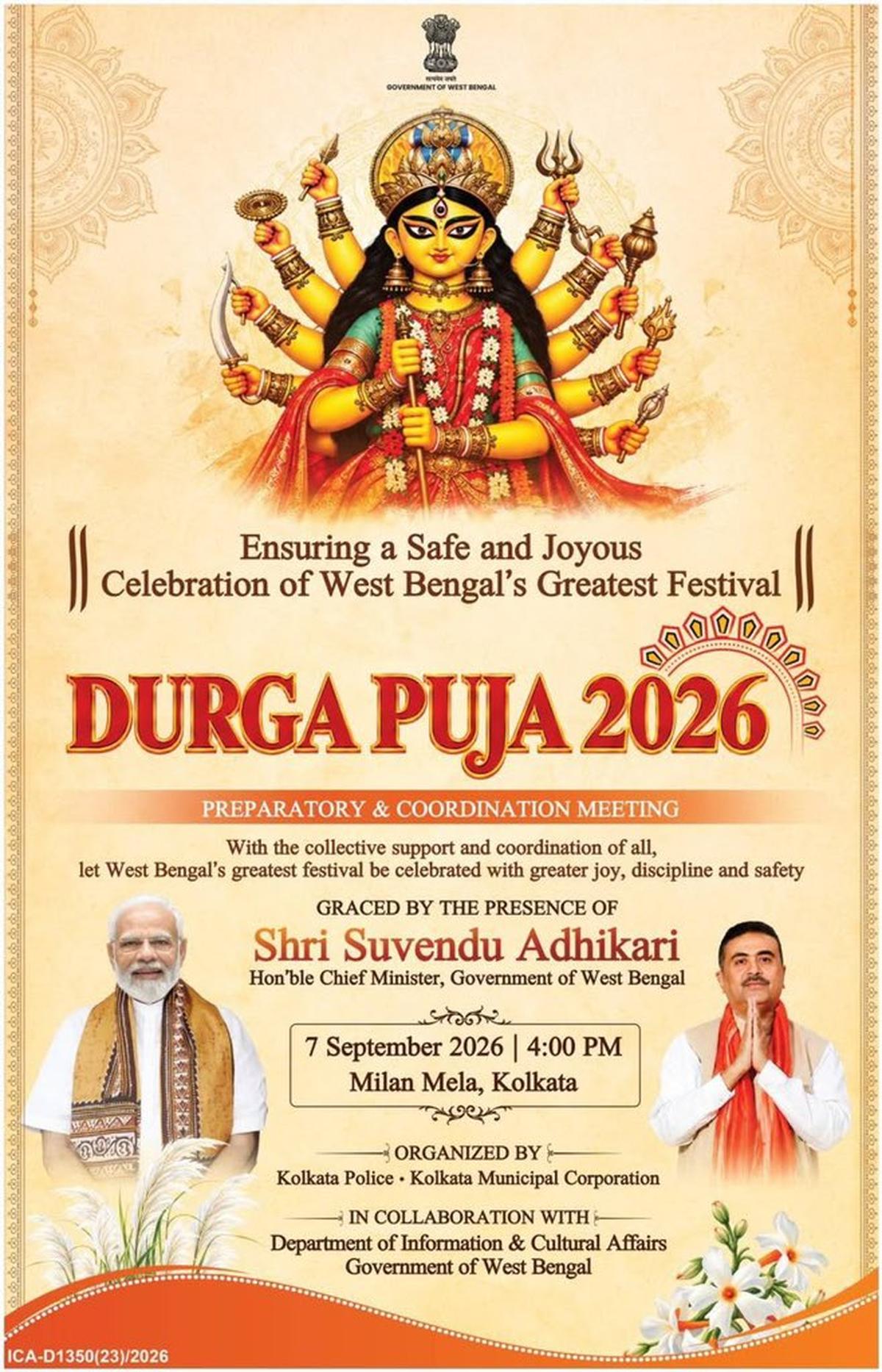
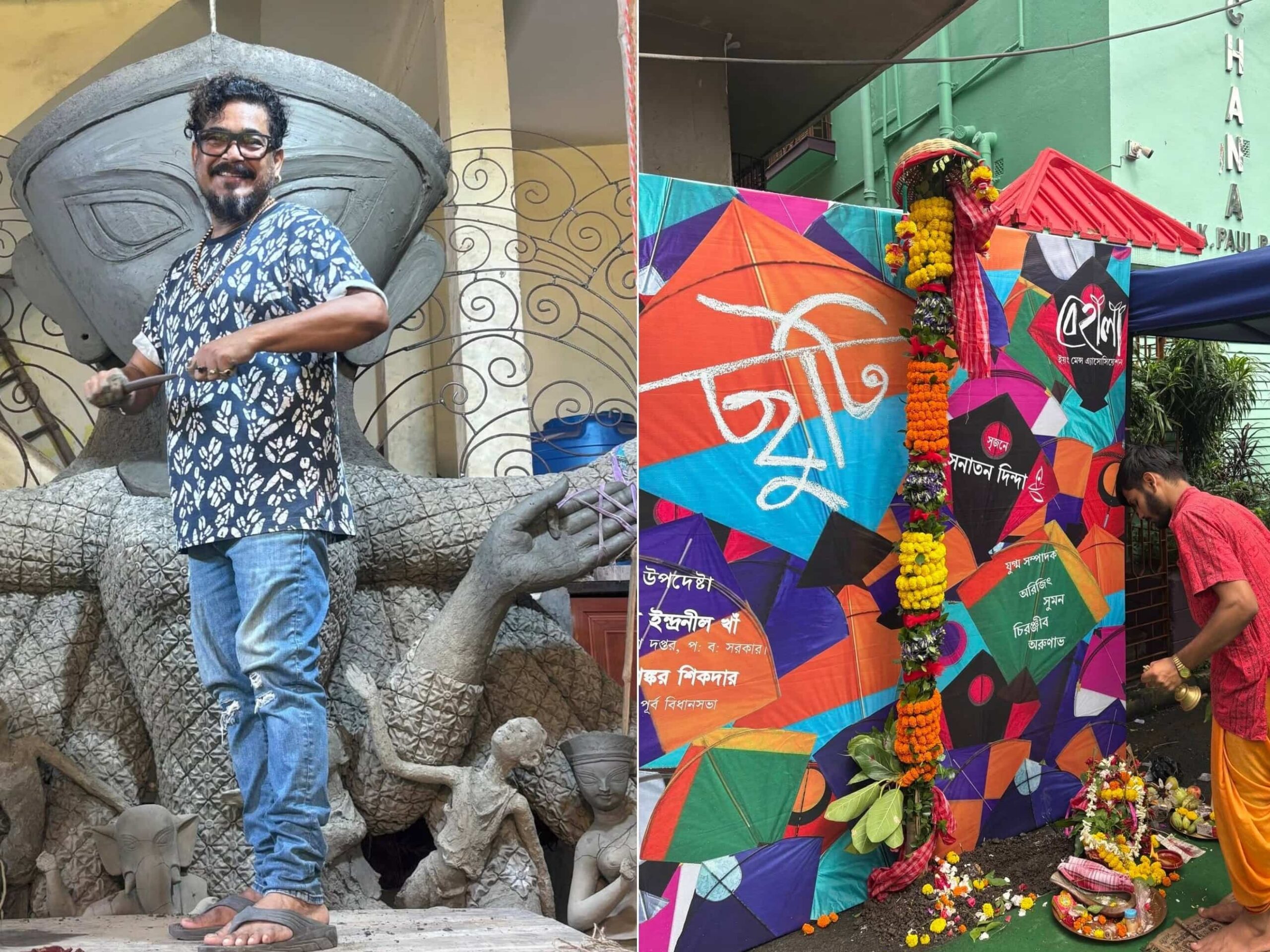
A West Bengal government advertisement depicting Goddess Durga with eleven arms instead of the conventionally recognised ten invited public criticism and an apology from Chief Minister Suvendu Adhikari on September 7. Later, the Behala Young Men’s Association faced criticism over a promotional poster featuring the caption Fakir Hussain alongside a tabla, which critics considered disrespectful to the late tabla maestro Zakir Hussain. The committee apologised on September 20, explaining that the poster was intended to reflect its theme, Chhuti, or holiday. Artist Sanatan Dinda, who was working on the idol and pandal, clarified that he had not designed the poster.
Although different in nature, both incidents exposed the complicated relationship between cultural representation, artistic responsibility and public sentiment.
Three Traditions, Different Cultural Expressions
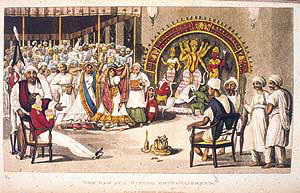
Kolkata’s Durga Puja celebrations broadly fall into three categories: bonedi bari pujas, traditional community (sarbojanin) pujas and contemporary themed pandals. Each reflects a different relationship between devotion, artistic expression and public participation.
The bonedi bari pujas are held within ancestral homes and ceremonial thakur dalans, or pillared halls. While some bonedi bari pujas draw their historical significance from associations with past grandeur, for most families, they remain cherished traditions. Their prestige often derives from historical continuity and the preservation of customs, although grand celebrations have also historically reflected social status and wealth.
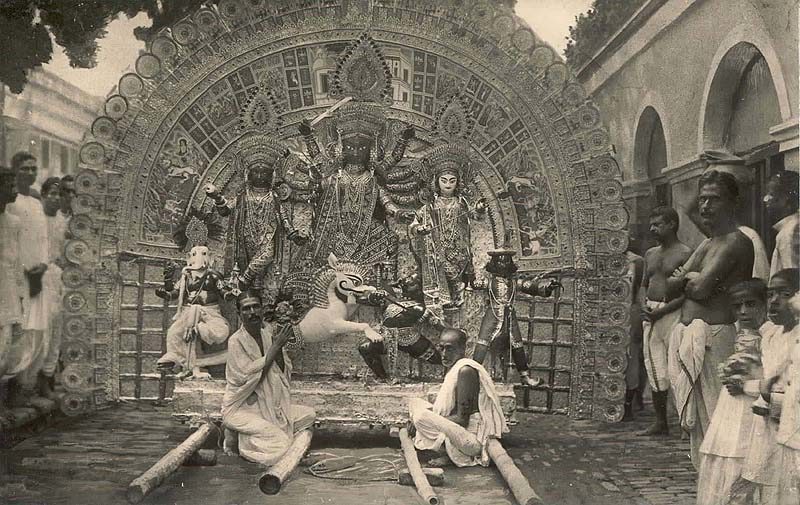
Traditional community pujas, organised by neighbourhood associations and sarbojanin committees, emphasise collective worship and local identity. They often retain familiar representations of Durga and established rituals. Nevertheless, these celebrations may also depend on corporate sponsorship, government grants and political relationships.
Themed pandals represent the festival’s more experimental dimension. Drawing inspiration from architecture, literature, folk art, environmental concerns and social injustice, they transform temporary structures into immersive artistic experiences. Their creators are guided by imagination and the desire to communicate particular ideas. Their growing popularity has generated a cycle in which innovative designs attract visitors, large audiences draw sponsors, and sponsorship makes increasingly ambitious installations possible.
None of these forms is inherently more authentic than another. Their coexistence reflects the diversity of the festival. The challenge arises when expectations of tradition, artistic innovation and public acceptability come into conflict.
Artistic Freedom, Political Authority and Public Sentiment
The controversy over the newly victorious fascist BJP government’s depiction of Durga illustrates the irrationality behind its decisions and raises larger questions about the exercise of political authority over cultural representation. An official government advertisement does more than reproduce a religious image; it also communicates a political and cultural message. An error in such a representation can therefore become a question of cultural knowledge, institutional responsibility and public accountability. Simply put, the actions of representatives of the central or state government carry far greater weight than those of ordinary citizens.
Durga occupies several positions in Bengali society. She is a religious figure, a symbol of feminine strength and an expression of regional identity. These meanings can coexist, but different audiences may interpret artistic representations differently. For instance, an unconventional image may appear innovative to an artist while seeming inappropriate to some viewers.
The Behala controversy, on the other hand, raises a completely different issue. Any themed exhibition is a collective undertaking involving artists, organisers and several other participants, each contributing to its public presentation. As a result, when religious hatred is openly propagated and patronised by the government, a festival traditionally associated with celebration and joy risks being transformed into an arena of hatred and political confrontation. The priorities have shifted from ensuring a safe and joyous Durga Puja to promoting a BJP-defined version of a supposedly pure puja.
Thus, artistic freedom does not mean freedom from criticism. However, public criticism should not automatically become a justification for restricting creative expression. The festival’s cultural strength lies in its ability to accommodate both inherited traditions and new interpretations.
The Pandal as a Platform for Social Criticism
One of the defining features of contemporary Durga Puja in Kolkata is the emergence of themed pandals as platforms for social commentary. These installations increasingly engage with questions of violence, gender inequality, environmental destruction and failures of public policy. Visitors who arrive for worship or entertainment often encounter artistic expressions that challenge prevailing social attitudes and political practises.
Such engagement with contemporary concerns is natural for art that seeks to connect with its audience. Yet, it is precisely this engagement that sometimes provokes controversy, particularly when artistic expression questions established beliefs or challenges political authority.
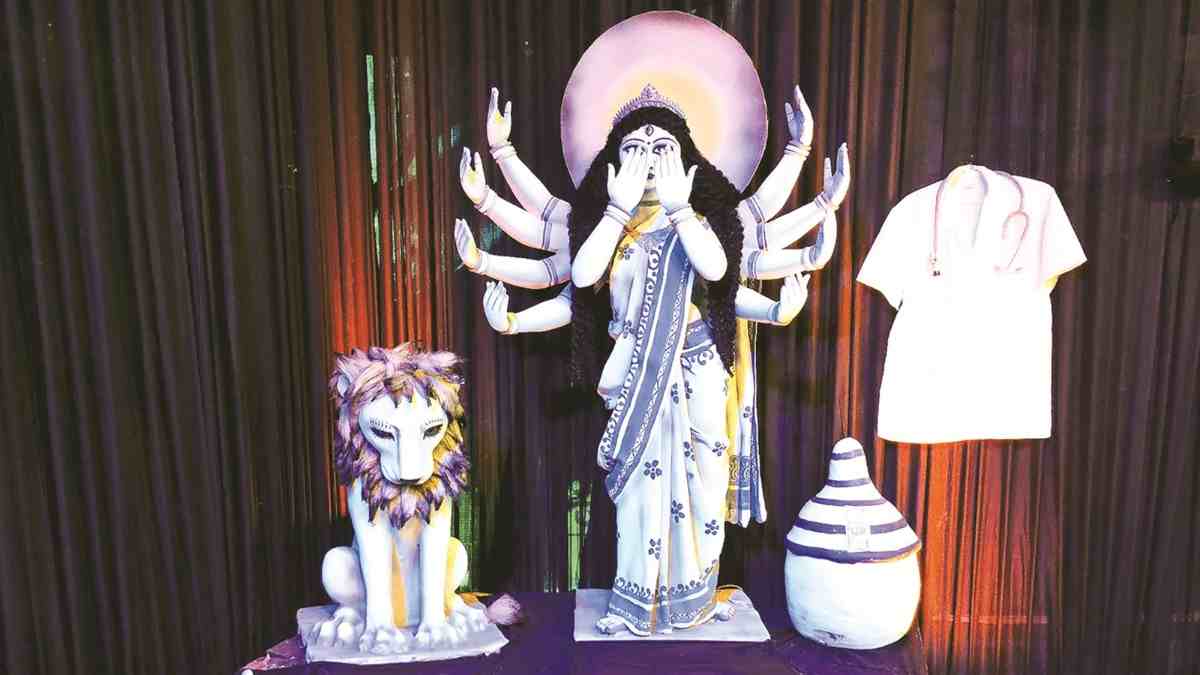
In 2024, the Shri Shri Saraswati Kalimata Mandir Parishad in Narkeldanga presented a theme titled Lojja, meaning shame, following the rape and murder of a trainee doctor at RG Kar Medical College and Hospital. The installation depicted Durga covering her face alongside a woman wearing a doctor’s coat and stethoscope. It questioned the contradiction between the worship of feminine power and the failure to ensure women’s safety. The installation also criticised the state government’s Lakshmir Bhandar welfare scheme.
Environmental concerns have similarly found expression in the festival. Chetla Agrani’s 2024 theme focused on river pollution, while other installations highlighted the condition of the Ganga and the Hooghly.
These examples demonstrate how public art can communicate complex social issues to a wide audience. However, an installation cannot determine how every visitor interprets or responds to it. The discussion it generates must therefore extend beyond the duration of the exhibition. Artists and event organisers should have the right to question prevailing social practises and public policies, even when their installations make sections of society uncomfortable.
Corporate Sponsorship and Public Space
The scale of Kolkata’s themed pandals depends on substantial financial resources. Materials, skilled labour, transport, lighting, security and technical installations all contribute to the cost. Corporate sponsorship has consequently become an important source of funding for prominent celebrations.
For major corporations, Durga Puja offers access to enormous audiences in an environment of celebration and public participation. Sponsorship allows businesses to associate their brands with cultural prestige while reaching potential consumers. But the relationship between corporate finance and artistic production raises a larger question: does sponsorship merely support cultural expression, or does it increasingly determine which forms of expression receive visibility and recognition?
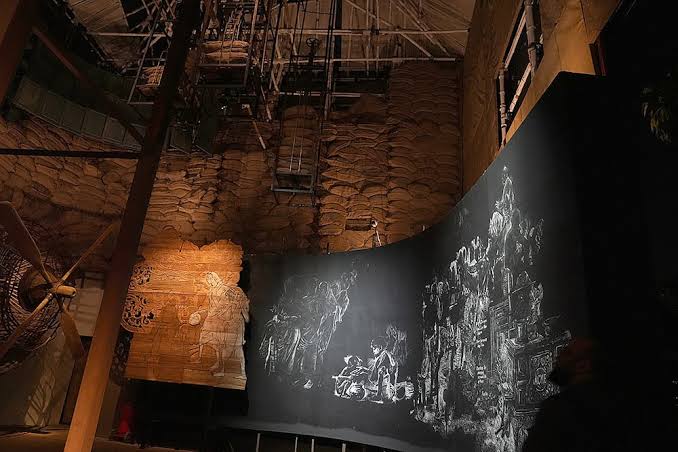
Corporate investment can support artistic experimentation and local employment. However, it can also create incentives to prioritise spectacular designs and visitor numbers over less commercially attractive cultural projects. A small installation preserving local history may have considerable cultural value without attracting the audience expected by a major sponsor.
This distinction is central to understanding the political economy of Durga Puja. Corporate sponsorship can provide the financial resources necessary for ambitious artistic projects, but the concentration of such resources among a relatively small number of prominent organising committees can also create inequalities within the festival’s cultural landscape. Celebrations with substantial financial backing enjoy greater opportunities to commission elaborate installations, attract publicity and draw large audiences. Smaller neighbourhood pujas and independent artistic initiatives may struggle to achieve comparable visibility, regardless of their cultural significance.
The influence of corporate finance is therefore not confined to the advertisements displayed around a pandal. It can shape the scale, presentation and public prominence of cultural expression itself. When sponsorship becomes closely associated with visitor numbers, media attention and commercial visibility, artistic decisions may increasingly be influenced by considerations of marketability. The danger is not that corporate support necessarily suppresses creativity, but that commercially successful forms of creativity may acquire a disproportionate advantage over artistic work that is less spectacular, more experimental or openly critical of prevailing social and political arrangements.
The issue extends beyond advertising. During Durga Puja, streets and neighbourhoods become temporary galleries, and commercial branding becomes part of the public visual environment. Financial power can influence which installations receive attention, which organisations gain prominence and which artistic projects can afford to participate in the festival on a significant scale.
This also raises questions about the use of public space. Streets, neighbourhoods and other shared urban spaces temporarily become sites of religious celebration, artistic display and commercial promotion. The ability to occupy and transform these spaces is not equally distributed. Organising committees with greater financial and political resources may enjoy advantages that smaller community initiatives cannot match. The festival’s expansion must therefore be considered not only in terms of artistic achievement and economic activity but also in relation to equitable access to public space.

A cultural economy that measures artistic success primarily through sponsorship, publicity and footfall risks overlooking the value of traditional crafts, the livelihoods of artisans and artistic expressions that challenge society rather than merely entertain it. The central issue is not whether corporate sponsorship should exist, but whether financial power should become the principal determinant of cultural recognition and public visibility.
UNESCO Recognition and Bengal’s Cultural Identity
On December 15, 2021, UNESCO included Kolkata’s Durga Puja on its Representative List of the Intangible Cultural Heritage of Humanity. This inclusion recognised an enduring cultural heritage sustained by communities, creative practitioners and collective participation.
UNESCO’s recognition brought Kolkata’s Durga Puja greater international visibility, strengthening its appeal as a cultural attraction and creating new opportunities for tourism and the local economy. Yet, the festival’s global recognition should not obscure the contributions of the communities, artisans, labourers and small businesses that have sustained it across generations.
Kolkata’s Durga Puja has also acquired a distinctive international identity through its innovative, thematic and participatory approach to religious celebration. However, international visibility and acclaim should not overshadow the festival’s ability to empower local communities and sustain their cultural practises.
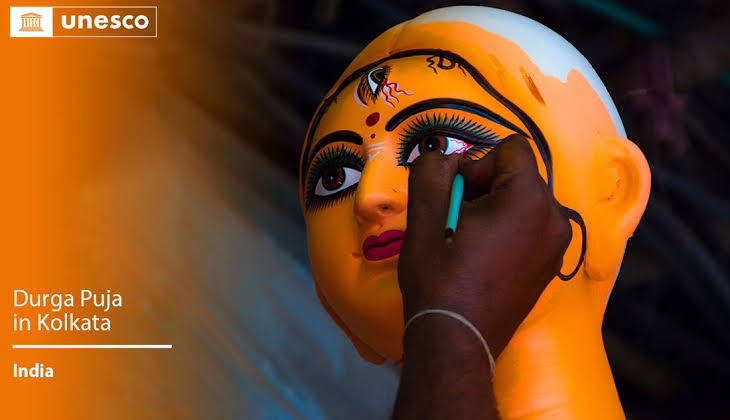
The festival’s cultural capital has been accumulated through the involvement of artisans, labourers, organisers and family businesses in sustaining the tradition. UNESCO’s inscription does not confer ownership of this cultural heritage on any government or political authority. Rather, it emphasises the importance of safeguarding traditions and supporting the livelihoods of those involved in their preservation and celebration.
Beyond the Spectacle
The political economy of Durga Puja reflects a continuing negotiation between cultural traditions, artistic ambitions, commercial interests and political authority. The controversies surrounding the festival demonstrate how difficult it has become to separate cultural expression from the exercise of power.
The challenge is to ensure that the festival’s growing commercial success does not undermine artistic independence, community participation or the responsible use of public space. Financial support and international recognition are important, but neither should determine the boundaries of acceptable cultural expression. Equally important is the need to accommodate both the festival’s spectacular growth and the everyday requirements of city residents.
Durga Puja’s greatest achievement is not simply that Kolkata becomes an enormous open-air gallery for a few days each year. It creates a space where inherited rituals and contemporary ideas encounter one another before a vast public. A traditional idol can preserve centuries of meaning, while a themed pandal can give contemporary injustice a powerful visual expression.
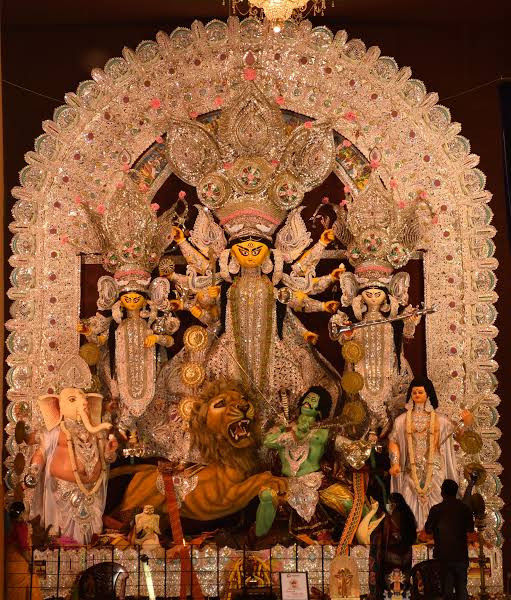
Who, then, owns the Goddess? No single political party, government, corporation or organising committee can claim exclusive ownership of the cultural world surrounding her. It belongs collectively to the communities that preserve the rituals, the artisans who give them form, the artists who reinterpret their meanings and the public whose participation keeps the festival alive.
The real challenge is to ensure that commercial success and political authority do not determine in advance what this shared cultural space is allowed to express. Kolkata’s Durga Puja will remain vibrant only as long as it preserves the freedom to celebrate, question and reinterpret its own traditions.






Who truly owns the Goddess Durga—the people, the artists, or those who control the money and public spaces? Kolkata’s Durga Puja is a living expression of culture, creativity and community, but its growing commercialisation raises important questions about who benefits and whose voices are pushed aside. Art and faith should not become mere instruments of profit, power or prestige. The Goddess belongs to the people, and the spirit of Durga Puja must remain rooted in cultural freedom, public participation and the dignity of ordinary citizens.
What a Brilliant , comprehensive socio-historical analysis of the Durga Puja . Prachi’s author bio says she is an intern at The AIDEM . Must be a Gen Z . In keeping with our times , she certainly belongs to observant, vibrant class among the generation . Keep going .