

The Making of Technological Power: From Menlo Park to the AI Age — Part II

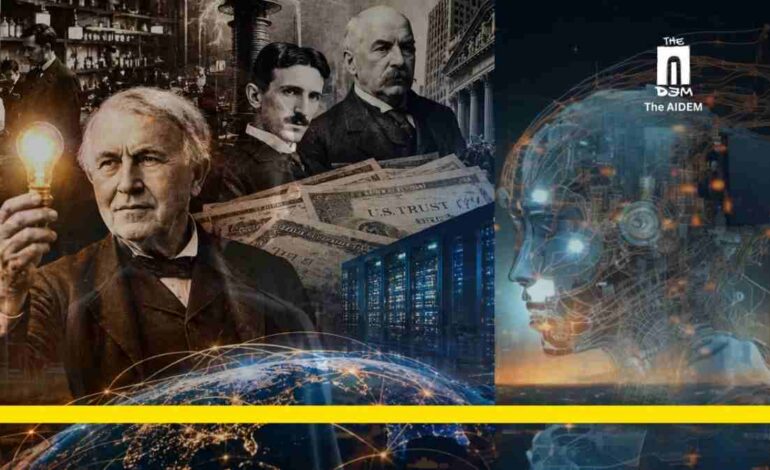
In the first part of this essay, Ajith Balakrishnan traced the transformation of invention from the domain of figures such as Edison and Tesla into an organised system of laboratories, corporations, infrastructure and institutionalised scientific knowledge. Part II follows the next, and politically more consequential, stage of that history: what happens when technological possibility encounters the immense organising power of capital.
The comparison between electrification and artificial intelligence now acquires a sharper edge. If the electrical age demonstrated how finance and industry could turn invention into infrastructure, AI arrives in a world where finance, corporate power and technological knowledge are already intertwined on an unprecedented scale.
And unlike electricity, AI reaches directly into activities associated with human cognition and intellectual labour. Balakrishnan thus moves from the history of invention to the politics of ownership and control, locating the AI revolution within an older struggle over who commands socially produced knowledge and who ultimately captures the power it generates.
When Invention Meets Capital
The electrical revolution of the late nineteenth century coincided with the rise of the large industrial corporation and financial institutions capable of mobilising capital on a scale that individual entrepreneurs, family firms and partnerships could rarely command.
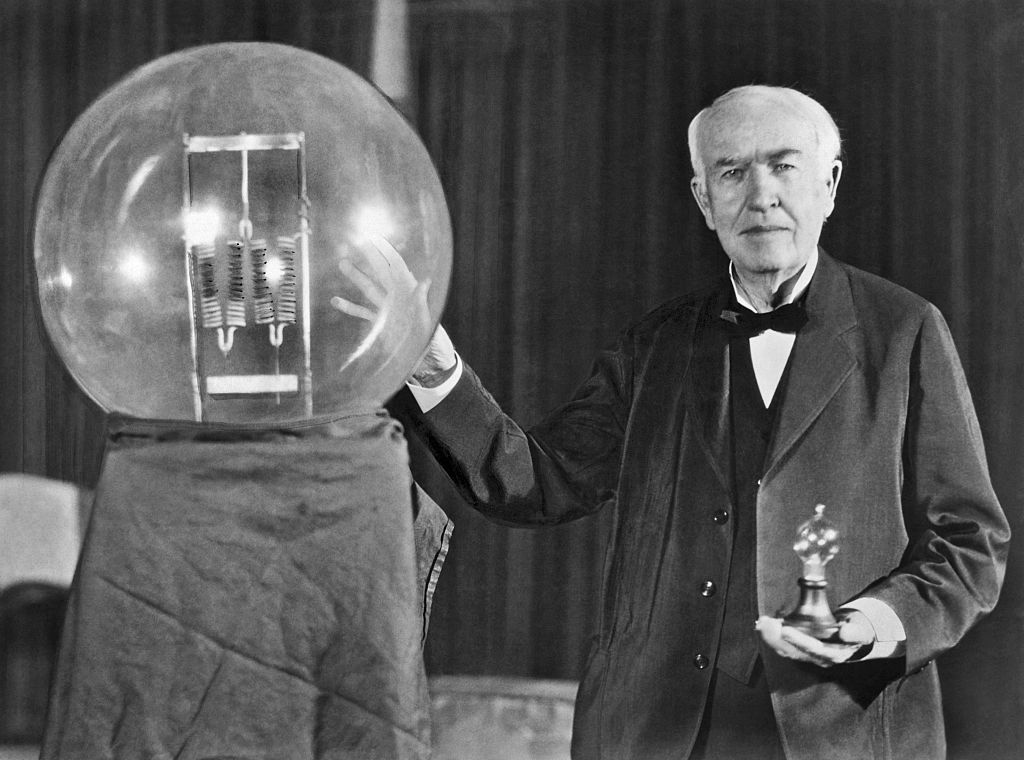
Railroads had already demonstrated the problem. Building networks across a continent required enormous investment long before revenues could be realised. Stocks and bonds assembled capital from dispersed investors; investment banks raised finances; and the corporation provided an institution capable of owning assets and raising capital. By the closing decades of the nineteenth century, this institutional machinery was spreading into steel, petroleum, electricity and other increasingly capital-intensive industries. It is against this background that the relationship between Edison and J. P. Morgan acquires a deeper significance. They represented two increasingly interdependent institutions of the emerging industrial order: organised technological knowledge and large-scale finance capital.
Electrical systems were enormously expensive to build. An invention might emerge from a laboratory, but an electrical network required corporations, banks and investors. Financiers like Morgan became architects of corporate capitalism. They raised capital, rescued indebted companies, merged competing businesses and built larger, more stable enterprises. Finance capitalism was no longer simply funding industry. It was reshaping industry itself.
Edison’s story captures this transformation. The individual inventor built Menlo Park, and organised invention helped create an industry. But that industry required ever larger corporations and more capital than any inventor could provide. Edison’s electrical businesses eventually became Edison General Electric, and after its 1892 merger with Thomson-Houston, General Electric. The man who symbolised the electrical revolution no longer controlled the corporation carrying it forward. Technological power had moved from the inventor to the institution.
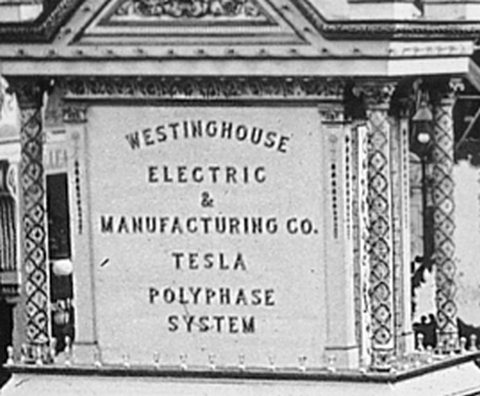
Tesla faced the same logic from another direction. His relationship with Westinghouse showed how dependent invention had become on industrial capital. When Westinghouse came under financial pressure, Tesla gave up his royalty arrangement. Knowledge could create technological possibilities, but it could not finance their industrial development.
This distinction is crucial. A technological possibility is not always an investment opportunity. The inventor asks whether something can be made to work. Capital asks other questions: Who will own it? Can it be produced at scale? How much investment is needed before revenues begin? How quickly can that investment be recovered? What infrastructure must be built first? Under capitalism, the journey from invention to a technological system is also a journey through capital.
Here the comparison with AI becomes especially interesting. Edison encountered a capitalism which was only beginning to develop the financial machinery needed to build large technological systems. AI arrives after more than a century of that development, while it itself requires vast physical infrastructure and colossal investment. Banks, securities markets, institutional investors, venture capital, private equity, bond markets and giant technology corporations can now mobilise resources on a scale Edison and Morgan could scarcely have imagined. AI is therefore developing within a capitalism in which finance is already deeply embedded in technological development.
This also changes where technological power resides. In the electrical age, its different functions could still be identified with individuals: Edison and Tesla with invention, Westinghouse with industrialisation, Morgan with finance. In AI, these functions are increasingly embedded within large institutions and networks. Demis Hassabis stands at the intersection of frontier research and corporate scale; Jensen Huang at the centre of the computing infrastructure on which much of AI depends; and Sam Altman at the mobilisation of capital, infrastructure and corporate alliances required to build frontier models. Yet none is simply an Edison, Tesla, Westinghouse or Morgan. The functions once associated with distinct individuals are now distributed across vast organisations. As technology becomes more complex and capital-intensive, technological power increasingly resides in institutions rather than individuals.

But AI is Not Electricity
While the historical parallel between electrification and machine intelligence is remarkable, pushing the analogy too far risks obscuring what makes contemporary AI distinct. Electricity is fundamentally a form of physical energy; its transformative power lay in making energy transmissible, divisible and controllable, thereby vastly expanding human capacity to organise industrial production. Machine intelligence operates on a different terrain. What is becoming an infrastructural capability is not mechanical power but functions long associated with human intellect: language, pattern recognition, code generation, synthesis, design and elements of abstract reasoning.
This has potentially profound economic consequences. When a software engineer works alongside a coding assistant, an analyst uses automated synthesis, or a researcher evaluates machine-generated hypotheses, some of the productive capability required for these tasks shifts from the trained individual into an infrastructure of models, compute, data and institutional systems.
Karl Marx identified an earlier iteration of this shift in the notebooks published as the Grundrisse. As industrial production mechanised, he observed that productive power increasingly drew upon accumulated scientific and social knowledge embodied in machinery—what he strikingly called “the power of knowledge, objectified”. The expansion of fixed capital, Marx argued, revealed the extent to which “general social knowledge has become a direct force of production”. He called it the “general intellect”. Decades later, Harry Braverman traced what this trend meant for labour under modern capitalism. As scientific knowledge was institutionalised within corporate enterprises and embedded directly into production, management systematically severed the conception of work from its execution, transferring knowledge and control away from shop-floor workers and driving what Braverman termed the degradation and deskilling of labour.
Viewed from this historical perspective, the progression from Edison to AI is ultimately a story of where productive capability resides. Tesla still exemplified the individual inventor as a central locus of technical knowledge. Menlo Park distributed the process of invention across a structured team. The corporate industrial laboratory institutionalised innovation within an enduring enterprise. Industrial machinery encoded science in physical mechanisms, and modern computing translated logic into software. AI extends this long historical trajectory into domains of intellectual labour once thought inseparable from human practice.
The central question then becomes one of control. Like electricity, AI may become a general-purpose technology embedded across the economy. As such systems become indispensable, control over their critical infrastructure becomes a source of economic power extending far beyond the industry itself. AI may intensify this concentration because it rests on an extraordinarily capital-intensive complex of computing infrastructure, foundation models, specialised talent and electrical power. If AI embeds capabilities drawn from collective human knowledge, while the infrastructure required to develop it can be commanded only by organisations capable of mobilising vast capital, control over technology and capital begin to reinforce each other. Those who command the essential infrastructure acquire strategic leverage across the wider economy.
But this outcome is not technologically predetermined. Electrification was shaped not only by private capital but by governments, regulators, municipal utilities and public struggles over how essential infrastructure should be organised. AI will likewise be shaped by institutional design, public policy and ownership structures. Technology creates possibilities and constraints; it does not determine who controls the resulting infrastructure or how its benefits are distributed. Those are ultimately political questions.
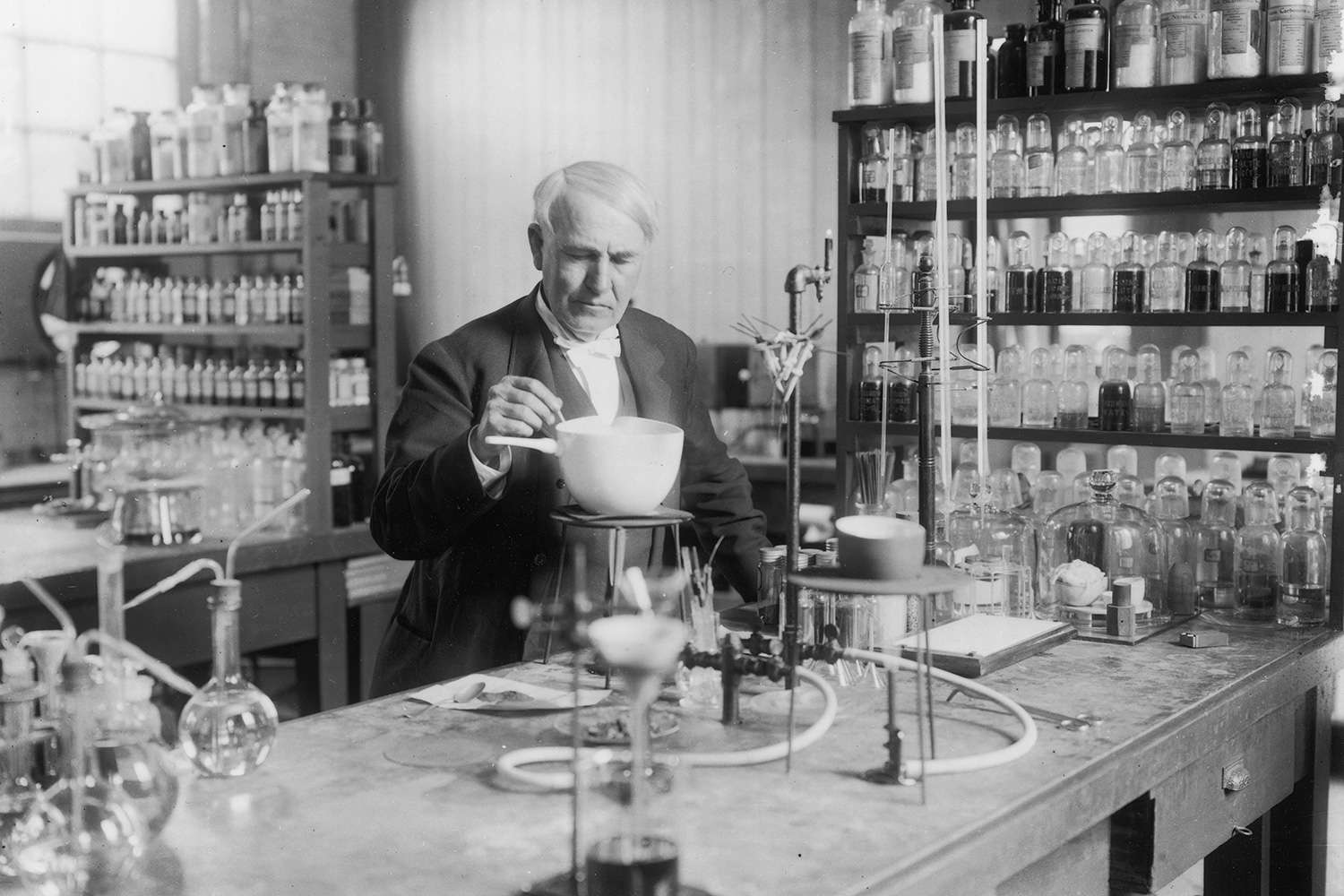
The historical journey from Menlo Park to machine intelligence does not suggest that AI will simply replay the past. Rather, it shows how capitalism can convert socially produced knowledge into proprietary infrastructure and systemic economic power. AI belongs to this history, but pushes it into new territory as industrialisation reaches into the realm of human cognition itself.
Sources and Further Readings
- Jonnes, Jill. Empires of Light: Edison, Tesla, Westinghouse, and the Race to Electrify the World. New York: Random House, 2003.
- Karen Hao, Empire of AI: Dreams and Nightmares in Sam Altman’s OpenAI (2025).
- Kate Crawford, Atlas of AI: Power, Politics, and the Planetary Costs of Artificial Intelligence (2021).
- Bresnahan, Timothy F., and Manuel Trajtenberg. “General Purpose Technologies: ‘Engines of Growth?’” Journal of Econometrics 65, no. 1 (1995).
- Hughes, Thomas P. Networks of Power: Electrification in Western Society, 1880–1930. Baltimore: Johns Hopkins University Press, 1983.
- David, Paul A. “The Dynamo and the Computer: An Historical Perspective on the Modern Productivity Paradox.” American Economic Review 80, no. 2 (1990): 355–361.
- Braverman, Harry. Labour and Monopoly Capital: The Degradation of Work in the Twentieth Century. New York: Monthly Review Press, 1974.
- Marx, Karl. Grundrisse: Foundations of the Critique of Political Economy. London: Penguin Books, 1973.
- Ng, Andrew. “Why AI Is the New Electricity.” Stanford Graduate School of Business, March 11, 2017.
To read the previous article from the series, click here.










This is a powerful continuation of the story of technological power—from Edison and Tesla to today’s AI giants. The real question is no longer simply what AI can do, but who owns the infrastructure, controls the knowledge, and captures the enormous power it creates. When collective human knowledge is transformed into proprietary technology controlled by institutions with immense capital, AI becomes much more than a tool—it becomes a question of economic power, labour and democracy. Ajith Balakrishnan’s analysis rightly reminds us that technology does not decide its own future; society and politics must decide who controls it and who benefits from it. A sharp and timely examination of the politics behind the AI revolution.