


Part III – From Barrister to Sardar: Patel, Gandhi and the Making of a National Leader
The first two parts of this five-part series examined the political journeys of Sardar Vallabhbhai Patel and Jawaharlal Nehru, their respective contributions to India’s freedom struggle, and the contrasting strengths they brought to the national movement. Their relationship, shaped by shared political commitments as well as differences in outlook and approach, was central to the Congress leadership during the final years of British rule.
In this third part, the focus shifts to the crucial events of 1946, when the question of who should lead the Congress acquired far-reaching implications for independent India’s political future.
Anu Jain examines Mahatma Gandhi’s preference for Nehru despite Patel’s overwhelming organisational support, the circumstances surrounding that decision, and how the two leaders came to assume complementary roles in the government of a newly independent nation.
By the spring of 1946, the question of who would lead the Indian National Congress had acquired an importance that went far beyond the party’s internal affairs. British rule was approaching its end, the Cabinet Mission was negotiating India’s constitutional future, and the Congress was preparing to enter the final phase of the transfer of power. The next Congress president would not merely lead the organisation. Given the circumstances then unfolding, he was also likely to become the central political figure in the government that would take over from the British.
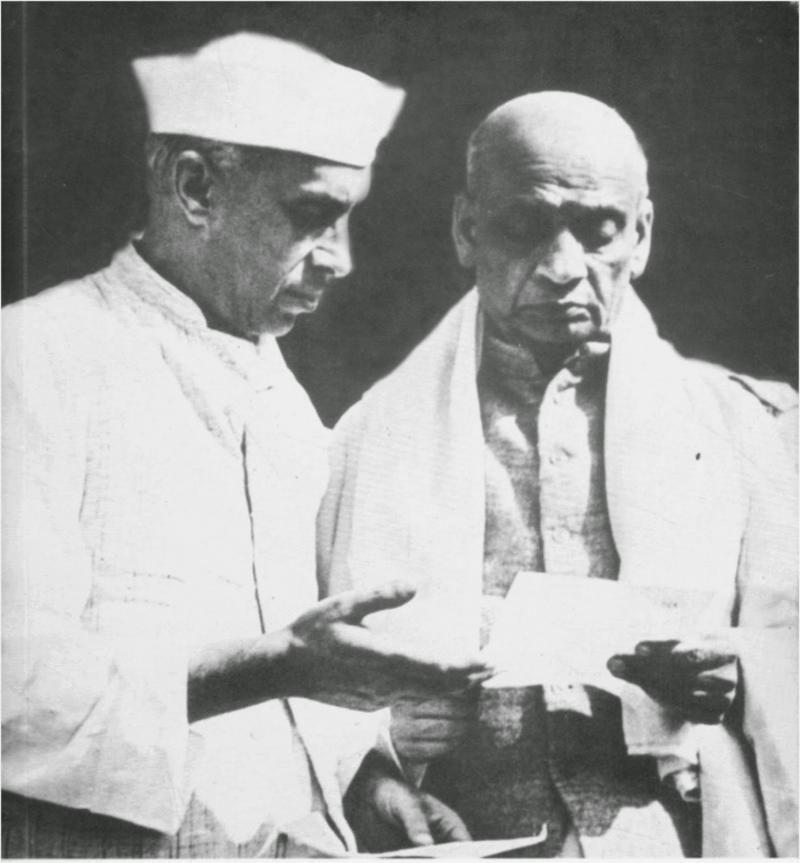
Two names came to dominate the discussion: Vallabhbhai Patel and Jawaharlal Nehru. The provincial Congress organisations overwhelmingly supported Patel, while Gandhi privately preferred Nehru. What followed has often been described as a contest in which Patel won the nominations but Gandhi ensured that Nehru became India’s first Prime Minister. That familiar account, however, compresses several different decisions into one. The issue was the Congress presidency, not a direct election for the office of Prime Minister. The political consequences of the choice became clear only because India was on the threshold of independence.
A Question That Was Never Really an Election
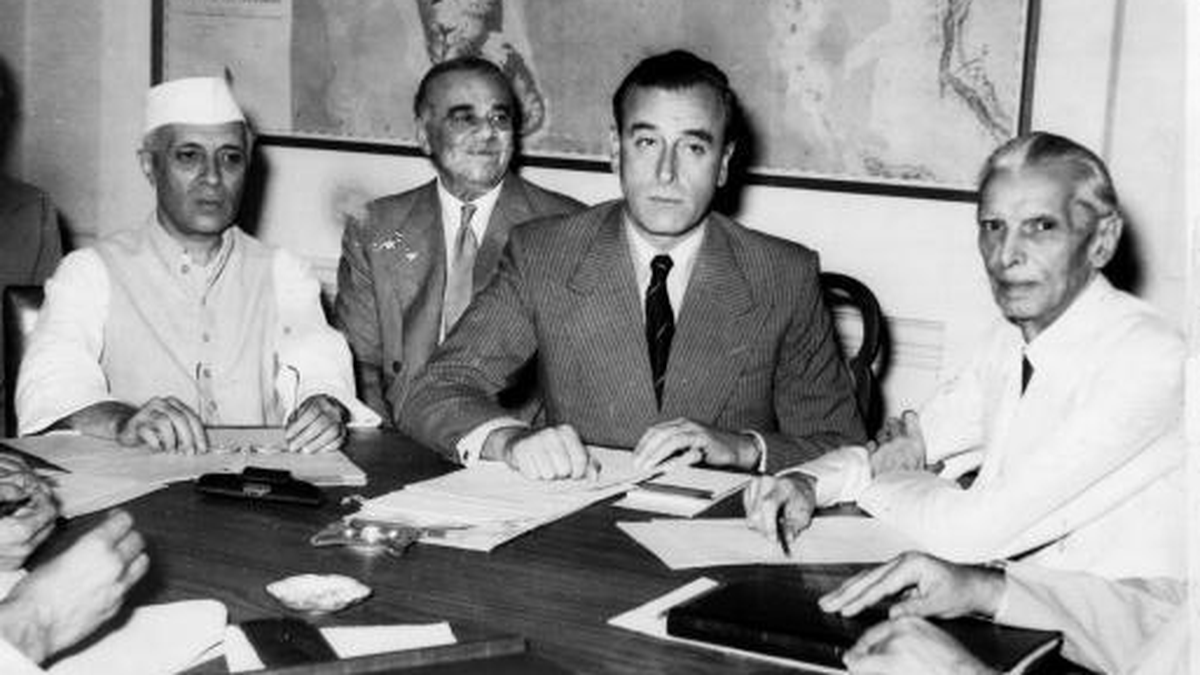
The Cabinet Mission had arrived in India in March 1946 to negotiate the country’s constitutional future. Its members, Lord Pethick-Lawrence, Sir Stafford Cripps and A. V. Alexander, attempted to preserve a united India through a three-tier constitutional arrangement in their proposals of 16 May. However, differences between the two political organisations persisted, particularly over the grouping of provinces and the composition of the proposed interim government. By the end of June, the Mission had left India without securing a lasting agreement between the two parties.
Meanwhile, the Congress needed a new president. Maulana Abul Kalam Azad had continued in the position since 1940, partly because the normal cycle of annual elections had been disrupted by the war, the Quit India Movement and the imprisonment of the party’s senior leaders. By 1946, the question of succession could no longer be postponed. The deadline for nominations was 29 April.
The contest was for the presidency of the Indian National Congress, an office that mattered enormously because its holder was expected to occupy a central position in the Interim Government. The later association of the Congress presidency with the leadership of independent India reflected the exceptional circumstances of 1946; it was not a straightforward election in which Congress members voted directly for the country’s first Prime Minister.
Twelve of the fifteen Provincial Congress Committees nominated Patel. Nehru received no nominations from these committees. This was not surprising. Patel had spent years building and rebuilding the Congress organisation, managing provincial units and maintaining the party’s internal machinery. By 1946, his authority within the organisation was considerable. Nehru, meanwhile, possessed a different kind of political standing, built through his public appeal, mass mobilisation and international profile.
The nomination process did not, however, end with the provincial committees. Acharya J. B. Kripalani played an important role in securing support for Nehru’s candidature at the central level. Patel ultimately withdrew, and Nehru emerged as the choice for the Congress presidency. The Working Committee and senior leadership were central to the process, and the outcome was not the result of a direct nationwide ballot between the two men.
A revealing anecdote, dating from 1948, captures something of the difference in their public appeal. The American journalist Vincent Sheean was present at a large Bombay meeting addressed by both men. Seeing the size of the crowd, Patel is said to have remarked to Sheean: “They come for Jawahar, not for me.” The words should therefore be treated as a reported remark rather than a verbatim historical record. Yet the anecdote is revealing because it attributes to Patel an awareness of Nehru’s extraordinary appeal to the wider public.
Gandhi’s Own Words, and Their Deliberate Incompleteness
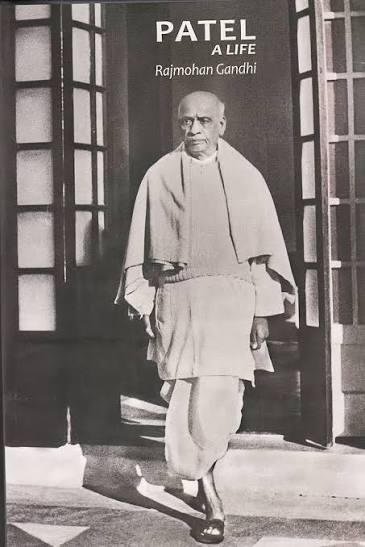
The strongest evidence of Gandhi’s preference comes not from a later recollection or newspaper reconstruction, but from his own letter. On 20 April 1946, Gandhi wrote to Maulana Azad, who was still Congress president. In a sentence that has since become central to the debate, he stated: “In today’s circumstances, I would, if asked, prefer Jawaharlal. I have many reasons for this. Why go into them?” The wording is reproduced in Rajmohan Gandhi’s Patel: A Life and discussed in Ramachandra Guha’s account of the succession.
The letter is important for two reasons. First, it establishes that Gandhi had a clear preference for Nehru while the succession was being decided. Second, it reveals how little he chose to explain. He acknowledged having many reasons but did not enumerate them. Gandhi left those reasons unexplained in the letter. Historians have therefore tried to understand his preference through his other writings, statements and the political circumstances of the time.
Ramachandra Guha offers a detailed account of the episode, placing Gandhi’s preference within the political circumstances of 1946. He suggests that Gandhi understood that independence was approaching and that the next Congress president would probably lead the Interim Government. The choice was therefore far more consequential than an ordinary party election. Gandhi had also regarded Nehru as his political heir for many years. This preference was not new in 1946, nor was it entirely unknown to Patel.
Guha further suggests that Gandhi saw Nehru as a leader with an appeal across regional and communal boundaries. Nehru enjoyed considerable support among Muslims, was respected beyond North India, and had a strong international outlook. His role in the Congress campaigns of 1937 and 1946 had strengthened his public standing. His relative youth, compared with Patel and other senior leaders, was another consideration. In Guha’s interpretation, Nehru represented an all-India political figure at a time when India was preparing for independence.
A particularly vivid account comes from journalist Durga Das, who later recalled asking Gandhi about the preference among many Working Committee members for Patel. Gandhi reportedly acknowledged that Patel would have been “a better negotiator and organiser as Congress President”, but felt that Nehru should head the Government. When Das asked how this could be reconciled with Gandhi’s assessment of Patel, Gandhi reportedly laughed and said: “Jawahar is the only Englishman in my camp.”
In that same recollection, Gandhi is said to have explained that Nehru would not accept a subordinate position, was better known abroad and could help India play a role in international affairs, while Patel would look after the country’s internal affairs. He reportedly compared the two men to “two oxen yoked to the governmental cart”, each needing the other to pull it forward. Das’s account is retrospective rather than a contemporary transcript and should be regarded as a recollection rather than independently verified verbatim evidence.
The Man Who Had Seen the World
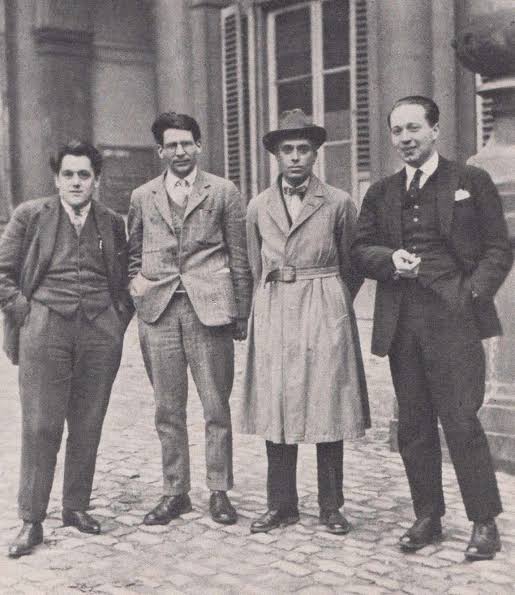
Nehru’s international outlook had developed over nearly two decades. In February 1927, he travelled to Brussels as the Indian National Congress’s representative at the International Congress against Imperialism. Bringing together labour leaders, socialists and representatives of colonised peoples, the gathering placed India’s freedom struggle within a wider international movement. Nehru joined its Presidium and participated in its deliberations, encountering political movements that viewed colonialism as part of a larger system of domination.
His understanding of world politics deepened during the 1930s, as fascism spread across Europe and the continent moved towards war. One revealing episode was his refusal to meet Benito Mussolini in Rome in 1936. Nehru later recalled that although he was curious about the Italian dictator’s growing influence, he strongly disapproved of fascism and feared that a meeting would be used for propaganda. He had also been troubled by what he regarded as a misleading interview published after Gandhi’s 1931 visit to Rome. When an Italian official insisted that the meeting had already been arranged, Nehru protested that he had declined the invitation. He did not attend. “There was no interview,” he later wrote.
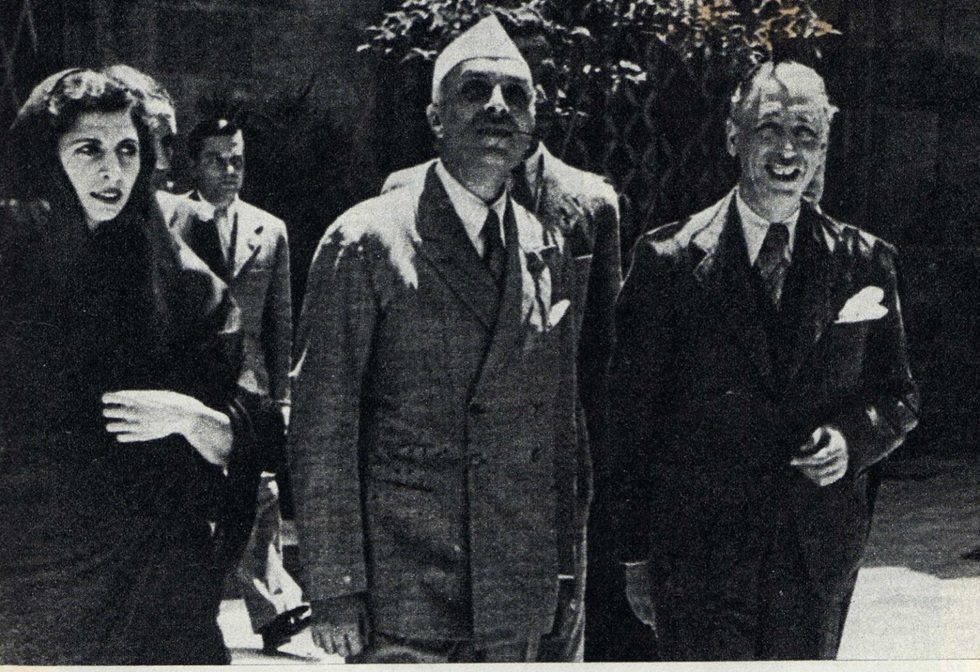
Nehru’s visit to Republican Spain during the Civil War exposed him to another dimension of the conflict between fascism and democracy. In 1939, he travelled to China during the Sino-Japanese War, meeting Chinese leaders, visiting institutions and witnessing the consequences of Japanese aggression. These journeys broadened his understanding of the political struggles unfolding beyond Europe and of the connections between colonialism, war and the future of Asia.
By the time independence approached, Nehru had accumulated an international experience few Indian leaders could match. He had done more than travel abroad; he had engaged with anti-imperialist movements and witnessed some of the defining political conflicts of his time. This background helps explain his international stature and may also have formed part of the considerations behind Gandhi’s preference for him in 1946.
The Man Who Had Walked the Country
If Europe and China broadened Nehru’s political horizon, his travels within India brought him into direct contact with the country’s mass politics. In The Discovery of India, he describes his election tours during the winter of 1936–37, when he travelled day and night, often without rest, by car, aeroplane and train, and sometimes by elephant, canoe and bicycle. On one occasion, he recalled, his programme continued for twenty-three hours.
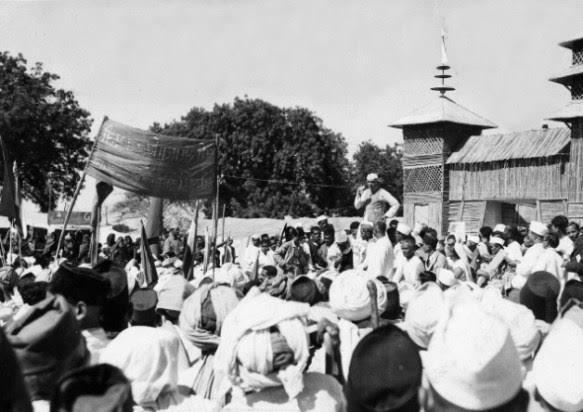
Nehru estimated that around ten million people attended his meetings during these months, with millions more encountering him along the way. Some gatherings, he wrote, drew as many as a hundred thousand people, while crowds of twenty thousand were common.
These were Nehru’s own retrospective estimates, not independently verified figures. Yet they convey the scale of his campaign and the reach of his public appeal. These journeys took him beyond urban political centres into towns and rural districts across the country. By 1946, he was not merely an influential Congress leader; he had become a familiar figure to large sections of the Indian public, particularly younger people.
His mass appeal, combined with his international experience, gave him a political reach that extended well beyond the provincial Congress organisations that had nominated Patel.
Patel’s Case, Undiminished
Patel represented a different but equally formidable kind of political authority, built through organisation and the practical work of the national movement. His leadership in Gujarat, his role in the Kheda and Bardoli movements, and his work within the Congress had earned him the trust of provincial leaders. His reputation for discipline, negotiation and organisational ability was reflected in the support of twelve of the fifteen Provincial Congress Committees in 1946.
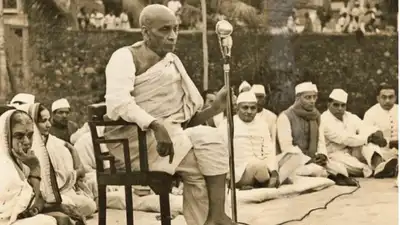
His later record as Deputy Prime Minister and Home Minister, particularly his work with V. P. Menon on the integration of the princely states, further demonstrated his administrative abilities. This later achievement should not be retrospectively interpreted as the reason for Gandhi’s preference in April 1946, but it illustrates the strengths Patel brought to the new government.
Nehru and Patel therefore represented distinct but complementary strengths: Nehru brought mass appeal and an international outlook, while Patel brought organisational authority and administrative experience. The challenge was to make both work together at a crucial moment in India’s history.
From the Congress Presidency to the Interim Government
Gandhi’s preference for Nehru did not remove Patel from the political arrangements that followed. On 12 August 1946, Viceroy Lord Wavell invited Nehru to form an interim government, which was sworn in on 2 September. Nehru became Vice-President of the Viceroy’s Executive Council, taking charge of External Affairs and Commonwealth Relations, while Patel assumed responsibility for Home Affairs, including Information and Broadcasting.
In his address to the press that day, Nehru emphasised that the government would function collectively, with its members discussing important matters and taking joint decisions. He also declared that its objective was complete independence (Nehru, 1946). The Muslim League initially stayed out of the government but joined in October, requiring a reshuffle. Its entry, however, did not resolve the underlying disagreements.
The failure of the Cabinet Mission’s attempt to secure a united constitutional settlement, the League’s boycott of the Constituent Assembly and the violence following Direct Action Day in August 1946 deepened the political crisis. The Interim Government was therefore required to negotiate the transfer of power while the future unity of India remained uncertain.
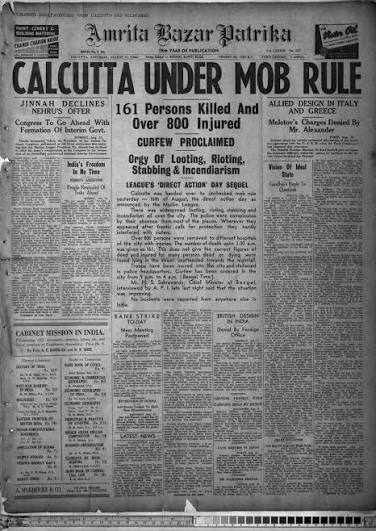
The political differences that had shaped the Congress succession now had to be reconciled within a government in which Nehru and Patel held major responsibilities, while Gandhi continued to exert influence without holding formal office.
The Road to Partition and Independence
By early 1947, the Cabinet Mission’s attempt to preserve a united India had failed. Communal violence was intensifying, and the British government was preparing to leave. On 20 February, Prime Minister Clement Attlee announced that power would be transferred no later than June 1948. Lord Mountbatten arrived as Viceroy in March to oversee the process.
Gandhi continued to oppose Partition, while Nehru and Patel, who had also resisted division, gradually accepted it as a painful response to the political deadlock and worsening violence. On 3 June 1947, Mountbatten announced the Partition Plan, accepted by both Congress and the Muslim League. The Indian Independence Act 1947 received royal assent on 18 July, providing for the creation of India and Pakistan as independent Dominions from 15 August 1947.
The approaching transfer of power also brought distinct responsibilities. Patel, who headed the States Department, faced the task of integrating the princely states into the Indian Union after the lapse of British paramountcy. Nehru would lead a sovereign India into international affairs while confronting the challenges of Partition, displacement, communal violence and nation-building. Gandhi, however, would experience independence in an altogether different way.
Independence: A Moment of Celebration and Mourning
On 15 August 1947, Gandhi was in Calcutta, not Delhi, where communal violence threatened the fragile peace between Hindus and Muslims. He observed Independence Day through fasting, prayer and spinning, choosing to remain with people whose lives had been torn apart by Partition. His presence reflected his abiding concern for communal harmony and the human consequences of freedom.
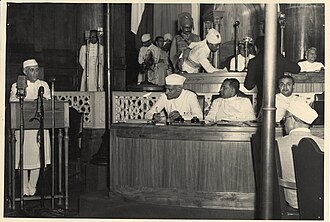
In Delhi, Nehru addressed the Constituent Assembly shortly before midnight on 14–15 August. His speech, remembered as “Tryst with Destiny”, celebrated India’s freedom while reminding the nation of its responsibilities. “At the stroke of the midnight hour, when the world sleeps, India will awake to life and freedom…,” he declared, before turning to the unfinished tasks of ending poverty, ignorance, disease and inequality.
Patel, meanwhile, faced the task of strengthening the new state and integrating the princely states. The resolution of the 1946 question of whether Patel or Nehru should lead the Congress had not required the exclusion of one to accommodate the other: Nehru became India’s first Prime Minister, while Patel served as Deputy Prime Minister and Home Minister. Gandhi, Nehru and Patel had reached independence in different places and with different responsibilities. The struggle against colonial rule had brought them together despite their differences; building the new nation would test their partnership in ways that freedom itself could not.
To read previous article from the series, click here.
Make sure to check back tomorrow for the fourth part of article in this series.







The 1946 leadership question was far more complex than a simple contest between Patel and Nehru. While Patel had overwhelming support from the Provincial Congress Committees, Nehru brought a wider national and international political appeal. Gandhi’s preference shaped the final outcome, but history must be understood through facts, context and the contributions of all three leaders. India’s freedom struggle was a collective achievement, and reducing its legacy to a rivalry between two towering personalities does injustice to that history.