No AI Shortcut to Thinking: The Meaning of Mamdani’s New York Initiative in the Classroom: PART ONE
Anena S
September 6, 2026
6 min read
PART ONE: New York Mayor Zohran Mamdani’s restrictions on generative AI in schools are widely perceived as an attempt to reclaim intellectual struggle, human interaction and independent thought as essential parts of education. Anena’s 2-part series explores the various dimensions of the one-year moratorium on student-facing generative AI for children from 2-K through Grade 8. This is part one of the series, which examines New York’s decision, the rationale behind it, and the repercussions it might have for balancing the preparation of children for an AI-driven future with the protection of the human intellect through which they learn to think independently.
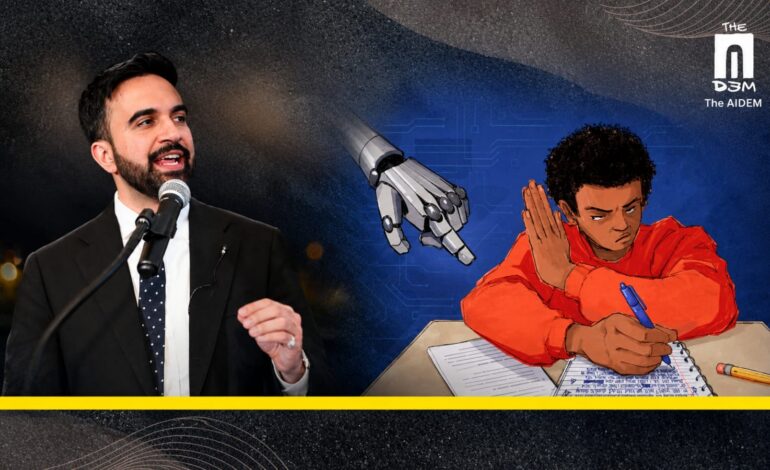
“Children need teachers and human connection to learn and grow. They need to develop skills alongside their peers, build relationships with educators and wrestle with tough problems on their own.”- Zohran Mamdani.
(Photo credit: X)
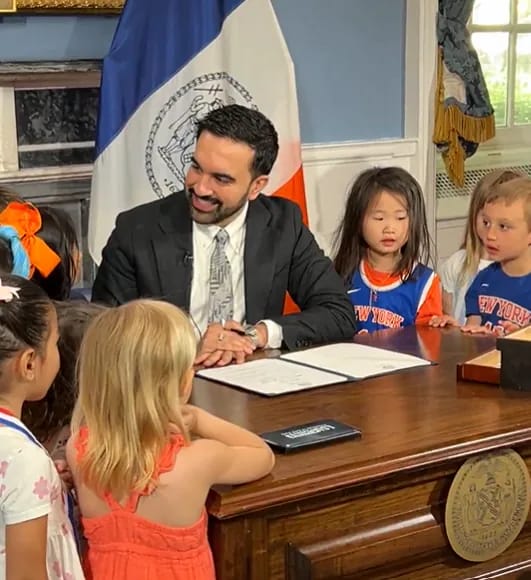
New York City is putting the brakes on the classroom’s rapid march towards artificial intelligence. Beginning with the 2026–27 school year, the city will impose a one-year moratorium on student-facing generative AI from 2-K — the city’s early-childhood programme for two-year-olds — through Grade 8. The measure will affect nearly 600,000 public-school students.
But New York’s digital retreat raises a question considerably larger than the policy itself: Is AI enriching the way children learn, or quietly replacing the human interaction, intellectual struggle and independent thinking that education is supposed to nurture?
That question matters because generative AI represents something fundamentally different from earlier waves of classroom technology. Calculators made computation easier; computers opened vast new avenues for accessing information. Generative AI can increasingly perform part of the intellectual task itself — summarising information, composing prose, solving problems and producing apparently reasoned answers within seconds.
And that brings education to an uncomfortable frontier: What happens to learning when the struggle to find an answer can be outsourced to a machine?
IQ Over AI: Putting Human Intellect Back at the Centre
At the heart of the Mamdani administration’s policy lies a simple question: Should children learn with AI before they have learned how to think without it? Mayor Mamdani and Schools Chancellor Kamar Samuels have framed the moratorium around the importance of preserving human interaction, independent thought and the teacher-student relationship.
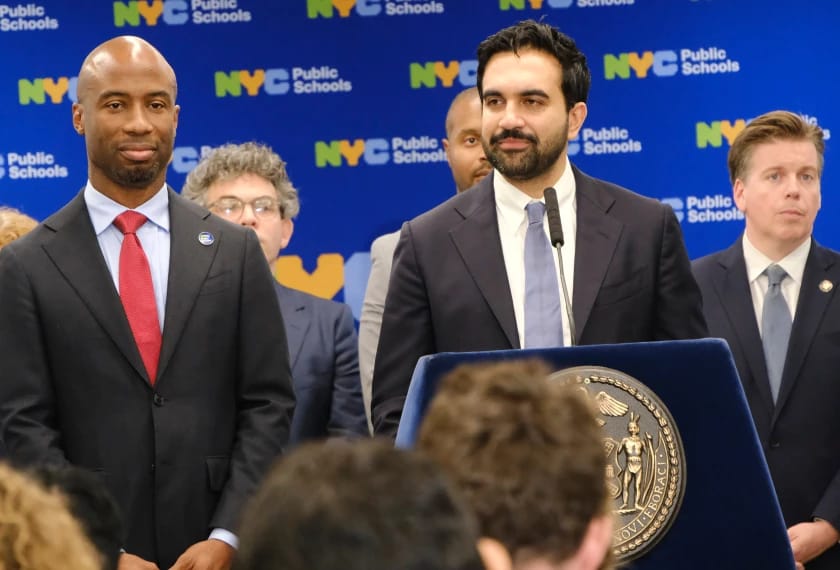
Zohran Mamdani( Right side) and Kamar Samuels(Left side). The photo is from the one-year moratorium announcement at the Brooklyn STEAM Centre. (Photo Credit: New York Post)
Mamdani is in the process of taming the Stochastic parrot (a metaphor for large language models digitally wired together to mimic text based on probability rather than understanding the linguistic and connotative nuances of a language). Writing is understood as far more than a vehicle for communicating information; it is a cognitive and creative process through which individuals learn to think, interpret, question, and construct their intellectual identities. The act of writing requires students to wrestle with ideas, make choices about language, organise competing arguments and arrive at conclusions in their own words. It is precisely this intellectual friction that scholars and humanists fear may be diminished by the growing dependence on generative AI. ( NBC NEWS)
Critics describe this phenomenon as “Linguistic Alienation“—a growing distance between the student and the language through which their thoughts are expressed. When drafting, summarising, sentence construction or even the organisation of an argument is delegated to AI, students may bypass the slower, often frustrating process through which an individual develops a distinctive critical voice. The concern is therefore not simply that AI might produce inaccurate or generic writing, but that excessive reliance on it could gradually weaken the connection between thinking and writing, thereby stunting them. If the machine continually supplies the words, structures the argument and resolves the difficulty of expression, students may have fewer opportunities to discover how they themselves think. (ASCCC)
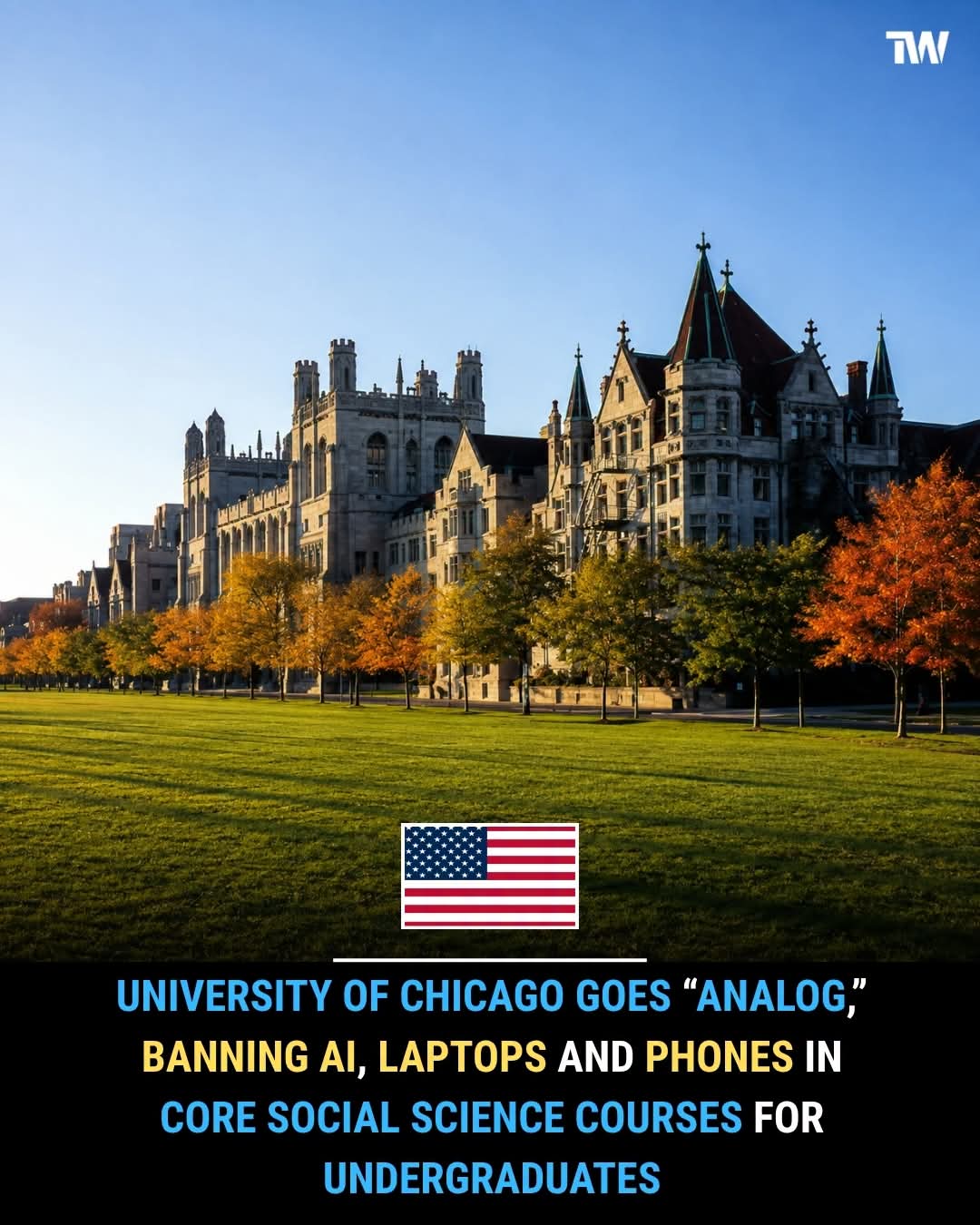
This anxiety has begun to influence institutional responses to AI in higher education. The University of Chicago, for instance, has adopted strict “analog” requirements in core social science courses, including device-free and AI-free classroom environments. Such measures reflect a growing willingness among educational institutions to reclaim spaces where students are expected to read closely, write independently and engage directly with ideas without technological mediation.
( Source: Facebook page of Techworm)
The approach challenges an assumption that has shaped educational policy for years — that greater technological integration necessarily represents educational progress. Instead, New York is proposing a different principle: technology should demonstrate its educational value before being given an expanded role in the classroom. Innovation, in other words, should not be confused with improvement.
The distinction deserves serious consideration. Generative AI can produce an answer in seconds. Education, however, is not merely about obtaining answers. It is about learning how to ask questions, make mistakes, test assumptions, evaluate evidence, recognise contradictions and construct an argument independently.
The frustrating interval between encountering a difficult problem and eventually understanding it is not necessarily wasted time. Very often, that struggle is the learning.
If technology eliminates too much of that struggle, the danger is not simply that students might cheat. The deeper concern is cognitive dependence: children may become increasingly skilled at obtaining answers without developing the intellectual habits required to arrive at them.
Not Quite an AI Ban
Yet “ban” is not quite the right word for what New York is attempting. The city is not seeking to remove artificial intelligence from education altogether. Instead, it is drawing a line based largely on age and educational maturity.
High school students will receive AI literacy instruction twice a year, covering the technology’s capabilities and limitations, as well as questions of bias, risk, ethics, and implications for future careers.
At the same time, five controlled AI pilot programmes — Quill, Edia, Brisk Teaching, Playlab and Intel AI-Ready Schools — will be permitted in selected high school classrooms under the supervision of educators. The pilots could eventually involve up to 50,000 students.
The distinction is important.
For younger children, the emphasis is on developing foundational intellectual and social capacities before generative AI becomes part of everyday learning. For older students, the objective shifts towards teaching them how to understand and critically engage with a technology they will almost certainly encounter in higher education and the workplace.
This makes the policy less an attempt to turn back technological change than an experiment in determining when children should encounter AI and under what conditions.
Part 2 on the different approaches countries take to handle AI follows.
About Author
Anena S
Anena S is a English literature graduate and writer with an MA in English Literature From The University Of Delhi. She is interested in researching and understanding how Literature, Cinema, Media, Culture, and Gender, influence and shape social narratives. She is currently an intern at the AIDEM.
A powerful and timely reflection on education in the age of AI. Mamdani’s initiative reminds us that technology can assist learning, but it can never replace curiosity, critical thinking, and the human capacity to question. Education must produce independent minds—not students dependent on shortcuts. A thought-provoking piece with a message that deserves to be heard far beyond New York.
Ramesh Krishnan
19 days ago
Comes at most apposite moment. Well delineated. The social impact is beyond comprehension. Apprehensions are correctly brought out. Compliments.
Support Us
The AIDEM is committed to people-oriented journalism, marked by transparency, integrity, pluralistic ethos, and, above all, a commitment to uphold the people’s right to know. Editorial independence is closely linked to financial independence. That is why we come to readers for help.













A powerful and timely reflection on education in the age of AI. Mamdani’s initiative reminds us that technology can assist learning, but it can never replace curiosity, critical thinking, and the human capacity to question. Education must produce independent minds—not students dependent on shortcuts. A thought-provoking piece with a message that deserves to be heard far beyond New York.
Comes at most apposite moment. Well delineated. The social impact is beyond comprehension. Apprehensions are correctly brought out. Compliments.