

The Rhizomatic Alternative; Beyond the Oedipal Trap

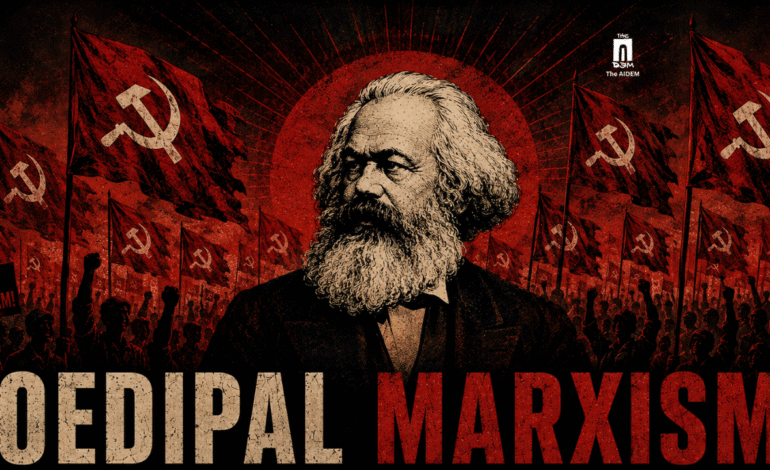
Part 7: The Oedipal Marxism
Having traced the vanguard’s century-long capture by the State it swore to destroy, Mubash closes by asking what comes after: would it be a rhizomatic Marxism that treats caste, gender, and land not as secondary contradictions but as equally primary fronts, and resolutely refuses to become the Father, whatever the ideological colour he wears – a red flag or a saffron robe.
The Rhizomatic Alternative: Slaying the Bureaucratic Oedipus
To break the suffocating trap of the technocratic Party-Father, the radical imagination must entirely abandon the traditional arborescent (tree-like) vanguard model and turn to the Deleuzian concept of the Rhizome. As Deleuze argued, the traditional Communist Party, despite its revolutionary rhetoric, structurally mirrors the capitalist state it claims to fight. It is a capture apparatus because it is built like a tree. The tragedy of the arboreal Party is that it acts as a psychoanalyst for the masses: it takes their wild, systemic rage, forces it onto a bureaucratic couch, and renders them political neurotics.
In orthodox Marxist-Leninist theory, the concept of the “Main Contradiction” (or principal contradiction) is the supreme analytical rule. It dictates that in any complex society, there is one fundamental conflict, typically the economic clash between the bourgeoisie (capital owners) and the proletariat (wage workers), that drives all of history. According to this orthodox view, every other form of oppression (such as caste discrimination, gender violence, racial subjugation, or religious exclusion) is classified as a “secondary contradiction.” The party line argues that these secondary issues are merely byproducts of the main economic base. Therefore, the instruction to the masses is always the same: “Focus all your energy on smashing the main economic contradiction first. Once we achieve class revolution and the state controls the economy, all secondary oppressions will naturally dissolve.”
A rhizomatic Marxism completely eliminates this vertical hierarchy. A rhizome grows horizontally and recognises that power does not flow from a single tap. Capitalism does not sit isolated in an economic cave; it plugs directly into pre-existing structures of power, like Brahminical patriarchy and state bureaucracy. Therefore, we cannot separate the economic machine from the social machine. In a rhizomatic model, there is no single principal contradiction (Economic base). Instead, there is a web of simultaneous struggles: Caste is not a “secondary superstructure”; it is the literal material architecture through which labour is organised, and Subalterns are alienated from land and resources in India. Gender exploitation is not a minor footnote; it is the domestic enclosure required to reproduce the next generation of compliant workers.
Unlike a tree, which relies on a single, dominant trunk and grows rigidly upwards, a rhizome, such as ginger, grass, or underground roots, spreads horizontally. It has no central brain, no permanent hierarchy, no Polit Bureau, no principal contradiction and can connect any point to any other at any moment. As the philosophical critique of vertical structures shows, the tree inevitably symbolises the division between the ruler and the ruled, the vanguard and the masses, trapping the political imagination within a rigid logic of command and obedience.

Deleuze looked at the collapse of arborescent revolutionary movements and realised that focusing on a single “main contradiction” makes a movement incredibly easy to defeat. The state simply needs to compromise, bribe, or crush that one central front. A rhizomatic Marxism succeeds because it treats every point of oppression as a primary, explosive front line. It does not ask the Dalit landless labourer, the Adivasi protecting their forest, or the feminist striking for autonomy to wait in line. It allows these distinct movements to connect horizontally across the terrain on their own terms. Treating all struggles as equally primary creates an unpredictable, decentralised network of resistance that the state cannot map, capture, or control. The revolution ceases to be a single, distant event managed by a party bureaucracy and becomes an active, multi-directional sabotage of the status quo.
The fundamental failure of mainstream Indian Marxism has always been an epistemic error: a deep-seated, theoretical blindness that treats the complex, lived realities of caste, gender, and indigenous identity as mere “superstructures” or secondary contradictions. This Eurocentric lens insists on compressing centuries of unique, localised oppression into an abstract, flat category of “class,” forcing multi-dimensional subaltern life onto a rigid, single-axis assembly line. The vanguard arrives as an ideological coloniser, demanding that the subaltern surrender their specific histories of survival and caste humiliation to the sterile, universal blueprint of the economic contradiction.
A truly contextualised Indian Marxism must cure itself of this epistemic error by adopting a rhizomatic structure that respects and roots itself within the Inner Domain of social life. It must refuse to demand that the Dalit assertion, the Adivasi fight for water, forest, land, or feminist revolts bow down or act as subservient clients to a “main” class struggle dictated from above. Instead of acting as an institutional warden that forces these raw, vital movements into a sterile bureaucratic container, a rhizomatic Marxism functions as an open terrain of resistance, a living map of horizontal alliances where the unique, spiritual, and material sharpness of the Inner Domain is preserved, not erased.
The ultimate destruction of the Bureaucratic Oedipus occurs when the subaltern ceases seeking the Party-Father’s approval or the security of the 3-cent cage. By recognising that the fight against Brahminical Patriarchy and Capital is not a separate battle but the same material machinery, the masses can connect horizontally across the terrain. By abandoning the Freudian couch of institutionalised politics and embracing the rhizome’s horizontal, multidirectional flow, the subaltern ceases to be a passive consumer of developmental and social welfare schemes. The political neurotic can thus finally be liberated. This cure is achieved not by submitting to further organisational discipline, but by smashing the family cage entirely, re-opening the wild, creative field of organic social change.
Beyond the Oedipal Trap
By misreading Marx, revolutionary and open-ended, and choosing instead a rigid, mechanical, state-centric dogma, the Indian Left ultimately became the tragedy of its own theory.
When they captured regional power (as in West Bengal and Kerala), they did not dismantle the state’s repressive machinery. Instead, they became its most efficient, technocratic operators. They used the bloodless language of “development,” “industrialisation,” and “law and order” to run the very apparatus of sovereign capture that they had historically sworn to destroy.
By mimicking the bureaucratic, centralised models of the 20th century, they transformed Marxism from a liberating line of flight into a heavy, static instrument of state administration.

The 2026 Kerala defeat is not an anomaly to be explained away by electoral arithmetic or the conspiracies of opponents. It is the logical endpoint of a century of epistemological error. The Left lost not because it failed to manage the economy or distribute welfare efficiently, but because it fundamentally misunderstood the nature of Indian society. It treated caste as a secondary contradiction, the inner domain as a pre-modern residue, and the subaltern as a client rather than a comrade. It substituted its own bureaucratic survival for the liberation of the oppressed and, in doing so, became indistinguishable from the Father it had sworn to kill.
The path forward requires a radical epistemological break. A rhizomatic Indian Marxism must abandon the arborescent model of the vanguard party and embrace a horizontal, connective politics that treats all struggles as primary. It must recognise that caste is not a superstructural phenomenon but the material architecture of Indian society. It must enter the inner domain, not to dismiss it as false consciousness, but to engage with the desires, affects, and attachments that shape mass life. It must learn to hear the ontological wound of the Dalit, the Adivasi, and the landless labourer, and to understand that their struggle is not merely economic but existential.
The cure for the neurotic comrade is not more discipline but the smashing of the family cage altogether. It is the recognition that liberation cannot come from the Father-State, whether that Father wears a red flag or a saffron robe. It is the embrace of a politics that emerges from below, that connects horizontally across differences, and that refuses to reduce the complexity of subaltern life to a single contradiction.
The question is not whether Indian Marxism can be saved, but whether it can be transformed, whether it can kill the Oedipal Father within itself and become something new: a rhizomatic Marxism that is not a state philosophy but a living map of resistance, a war-machine that refuses to become the state, a revolution that does not devour its children. The 2026 defeat is the death of one kind of Marxism. The question is whether a new one can be born from its ashes.
Read the Opening article here

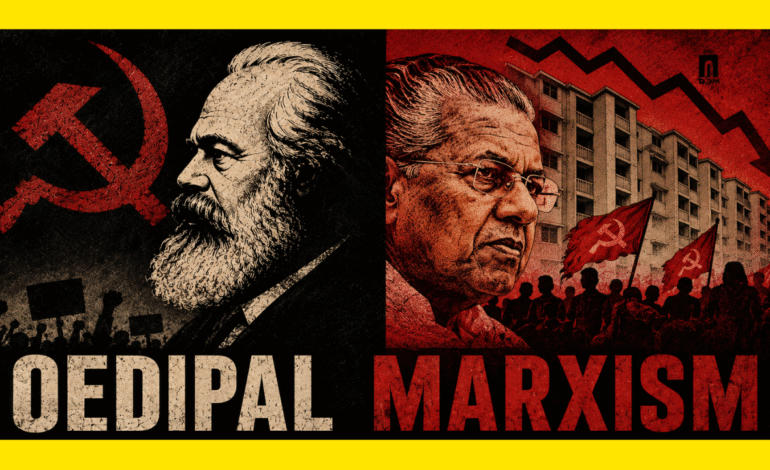






Solomon Mubash’s “The Rhizomatic Alternative” is a powerful challenge to the rigid, hierarchical imagination of Indian Marxism. The argument that caste, gender, land and class cannot be reduced to a single “main contradiction” is crucial. Liberation cannot come through another Party-Father or State-Father; it must emerge horizontally, from the lived struggles of people themselves. A deeply provocative and necessary intervention in the debate on the future of the Indian Left.